. 2019 Mar 14;24(6):1022.
doi: 10.3390/molecules24061022.

Skin Protective Activity of Silymarin and its Flavonolignans

Affiliations

Skin Protective Activity of Silymarin and its Flavonolignans

Jitka Vostálová et al. Molecules. .

Abstract

Silybum marianum (L.) is a medicinal plant traditionally used in treatment of liver disorders. In last decades, silymarin (SM), a standardized extract from S. marianum seeds has been studied for its dermatological application, namely for UVB-protective properties. However, information on SM and its polyphenols effect on activity of enzymes participating in the (photo)aging process is limited. Therefore, evaluation of SM and its flavonolignans potential to inhibit collagenase, elastase, and hyaluronidase in tube tests was the goal of this study. The antioxidant and UV screening properties of SM and its flavonolignans silybin, isosilybin, silydianin, silychristin and 2,3-dehydrosilybin (DHSB) were also evaluated by a DPPH assay and spectrophotometrical measurement. DHSB showed the highest ability to scavenge DPPH radical and also revealed the highest UVA protection factor (PF-UVA) that corresponds with its absorption spectrum. SM and studied flavonolignans were found to exhibit anti-collagenase and anti-elastase activity. The most potent flavonolignan was DHSB. None of studied flavonolignans or SM showed anti-hyaluronidase activity. Our results suggest that SM and its flavonolignans may be useful agents for skin protection against the harmful effects of full-spectrum solar radiation including slowing down skin (photo)aging.

Keywords: Silybum marianum; collagenase; elastase; sun protection factor.


Conflict of interest statement

The authors declare no conflict of interest.

Figures
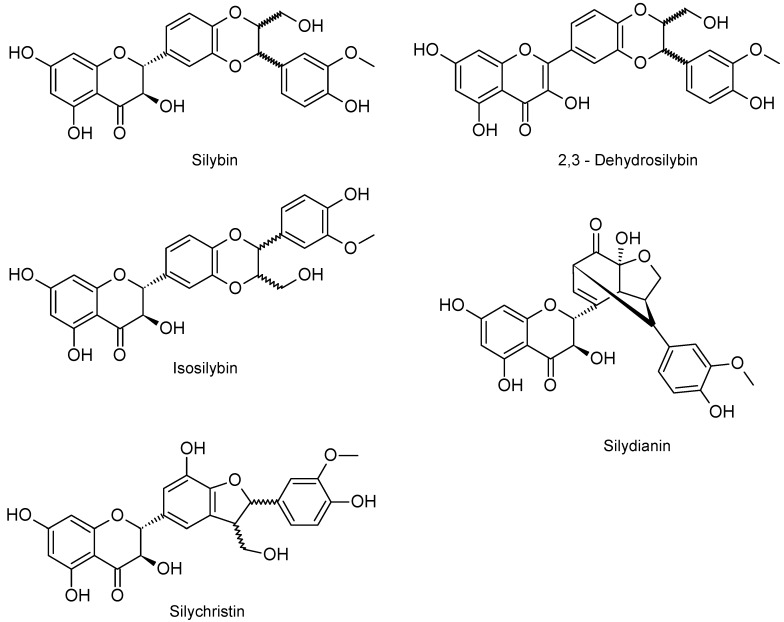
Figure 1
Figure 1
Structure of silymarin´s flavonolignans.
Figure 2
Figure 2
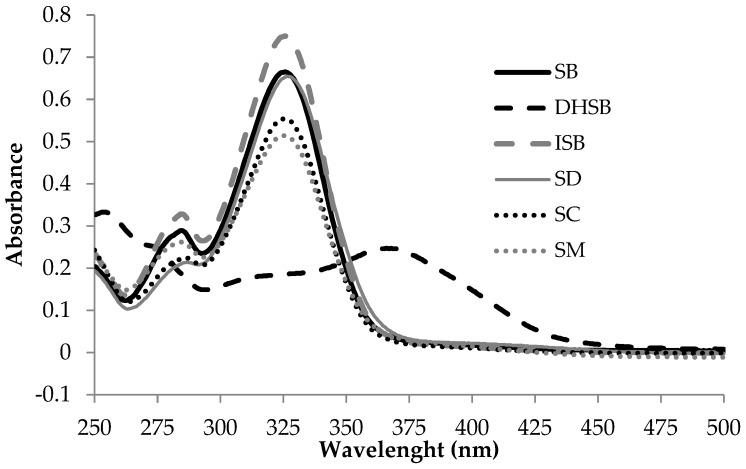
Absorption spectra of silymarin and flavonolignans (12.05 mg/L in 0.5% DMSO in PBS pH 7.5).
Figure 3
Figure 3
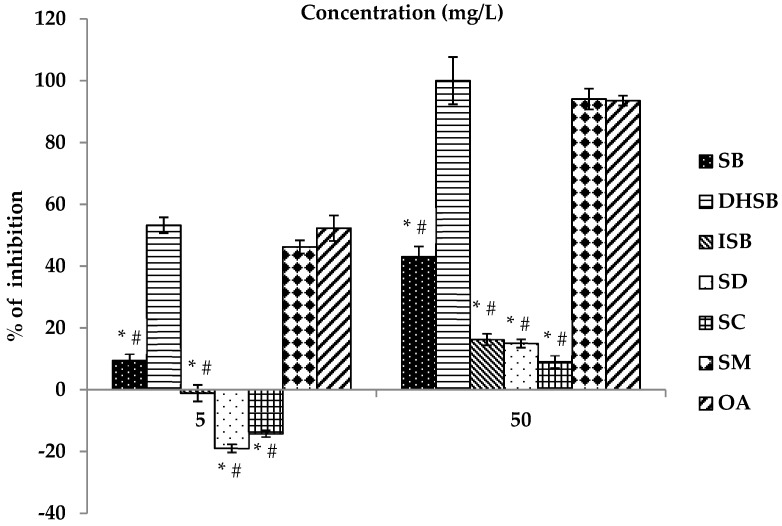
Anti-elastase activity of silymarin and flavonolignans. Silybin (SB), dehydrosilybin (DHSB), isosilybin (ISB), silydianin (SD), silychristin (SC), silymarin (SM), oleanolic acid (OA). OA is a standard inhibitor of elastase. Data are expressed as mean ± SEM from four independent experiments carried out in triplicate. # Significantly different from OA as the standard inhibitor at p = 0.05; * significantly different from SM at p = 0.05.
Figure 4
Figure 4
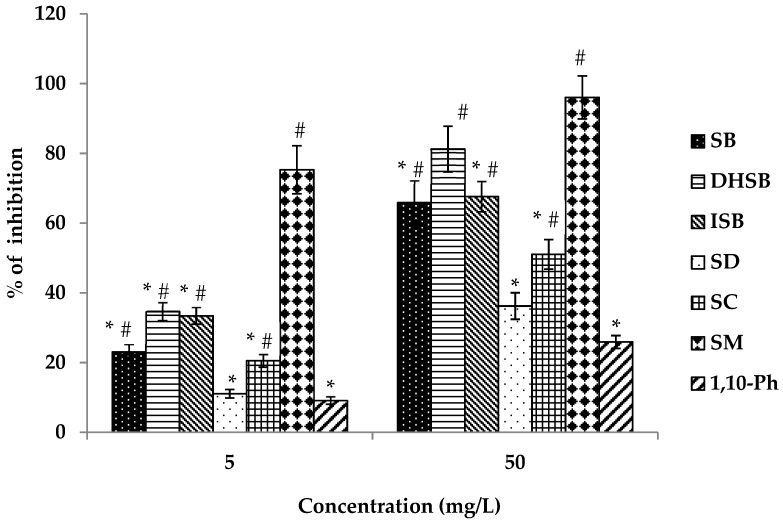
Anti-collagenase activity of silymarin and flavonolignans. Silybin (SB), dehydrosilybin (DHSB), isosilybin (ISB), silydianin (SD), silychristin (SC), silymarin (SM), 1,10-phenantroline (1,10-Ph). 1,10-Ph is a specific inhibitor of collagenase. Data are expressed as mean ± SEM from four independent experiments carried out in triplicate. # Significantly different from 1,10-Ph as the standard inhibitor at p = 0.05; * significantly different from silymarin at p = 0.05.

References

    1. Rinnerthaler M., Bischof J., Streubel M.K., Trost A., Richter K. Oxidative stress in aging human skin. Biomolecules. 2015;5:545–589. doi: 10.3390/biom5020545. - DOI - PMC - PubMed
    1. Rijken F., Bruijnzeel P.L. The pathogenesis of photoaging: The role of neutrophils and neutrophil-derived enzymes. J. Investig. Dermatol. Symp. Proc. 2009;14:67–72. doi: 10.1038/jidsymp.2009.15. - DOI - PubMed
    1. Buhren B.A., Schrumpf H., Hoff N.P., Bölke E., Hilton S., Gerber P.A. Hyaluronidase: From clinical applications to molecular and cellular mechanisms. Eur. J. Med. Res. 2016;21:5. doi: 10.1186/s40001-016-0201-5. - DOI - PMC - PubMed
    1. Tundis R., Loizzo M.R., Bonesi M., Menichini F. Potential role of natural compounds against skin aging. Curr Med Chem. 2015;22:1515–1538. doi: 10.2174/0929867322666150227151809. - DOI - PubMed
    1. Chambers C.S., Holečková V., Petrásková L., Biedermann D., Valentová K., Buchta M., Křen V. The silymarin composition...and why does it matter? Food Res. Int. 2017;100:339–353. doi: 10.1016/j.foodres.2017.07.017. - DOI - PubMed

LinkOut - more resources