


Progress in Understanding the Physiological and Molecular Responses of Populus to Salt Stress
- PMID: 30875897
- PMCID: PMC6471404
- DOI: 10.3390/ijms20061312
Progress in Understanding the Physiological and Molecular Responses of Populus to Salt Stress
Abstract
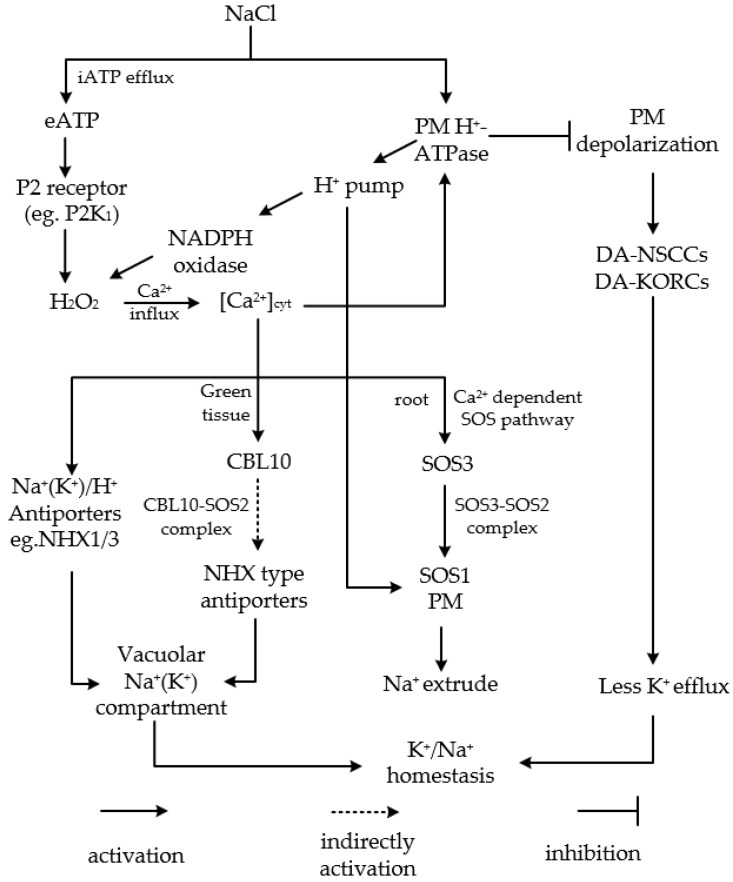
Salt stress (SS) has become an important factor limiting afforestation programs. Because of their salt tolerance and fully sequenced genomes, poplars (Populus spp.) are used as model species to study SS mechanisms in trees. Here, we review recent insights into the physiological and molecular responses of Populus to SS, including ion homeostasis and signaling pathways, such as the salt overly sensitive (SOS) and reactive oxygen species (ROS) pathways. We summarize the genes that can be targeted for the genetic improvement of salt tolerance and propose future research areas.
Keywords: ROS; SOS; molecular mechanisms; poplars (Populus); salt tolerance.
Conflict of interest statement
The authors declare that they have no conflict of interest.
Figures
References
-
- Wu Z.Y., Raven P.H., editors. Flora of China. Volume 4. Beijing: Science Press; Beijing, China: Missouri Botanical Garden Press; St. Louis, MO, USA: 1999. pp. 139–162.
-
- Sixto H. Response to sodium chloride in different species and clones of genus Populus L. Forestry. 2005;78:93–104. doi: 10.1093/forestry/cpi009. - DOI
-
- Bradshaw H.D., Ceulemans R., Davis J., Stettler R. Emerging Model Systems in Plant Biology: Poplar (Populus) as A Model Forest Tree. J. Plant Growth Regul. 2000;19:306–313. doi: 10.1007/s003440000030. - DOI
Publication types
MeSH terms
Substances
Grants and funding
LinkOut - more resources
Full Text Sources
Miscellaneous
