


Identifying eating habits in Finnish children: a cross-sectional study
- PMID: 30876472
- PMCID: PMC6420733
- DOI: 10.1186/s12889-019-6603-x
Identifying eating habits in Finnish children: a cross-sectional study
Abstract
Background: We aimed to identify different eating habits among Finnish children and to evaluate their association with meal patterns, breakfast consumption, and socio-demographic characteristics in a large, nationwide cohort of children.
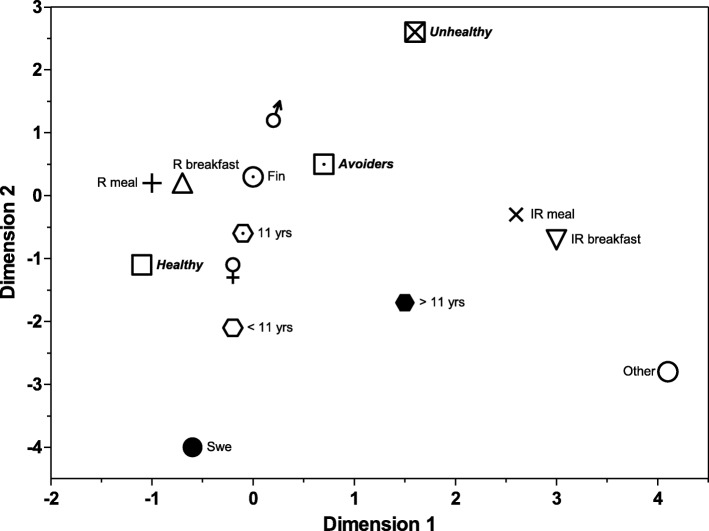
Methods: We evaluated 10,569 children aged 9-14 years into the Finnish Health in Teens cohort in a cross-sectional design. The hierarchical K-means method was used to identify groups of children with different eating habits, based on five factors obtained through factor analysis of 10 food items. Multiple correspondence analysis was used to show associations between groups with different eating habits and meal patterns, breakfast patterns, gender, age, and language spoken at home.
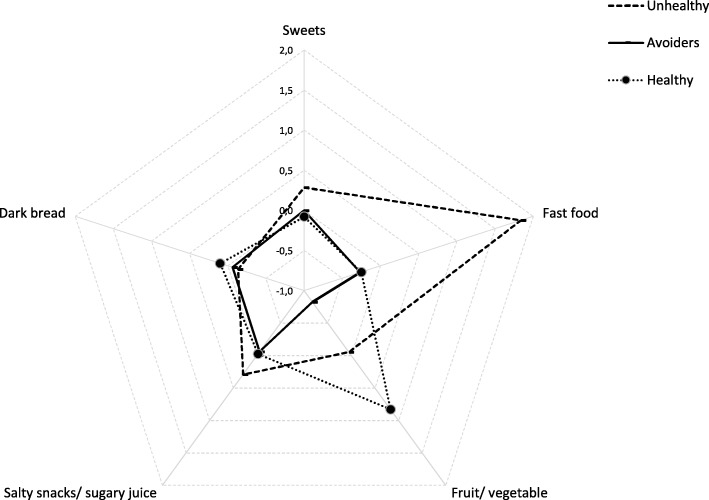
Results: Analyses identified three groups: unhealthy eaters (12.3%), fruit and vegetable avoiders (43.3%), and healthy eaters (44.1%). Most children had regular meal and breakfast patterns. The proportion of boys was higher among unhealthy eaters. Unhealthy eaters also showed irregular meal and breakfast patterns, and had parents with low education level. There was a higher proportion of girls among healthy eaters. Healthy eaters also showed regular meal and breakfast patterns, and had parents with high education level.
Conclusions: Although the number of unhealthy eaters was small, special attention should be still paid to these, mostly male children, as they have poor eating habits and they lack regular eating routine. Skipping breakfast was more common among older children and girls, although girls had healthier eating habits overall. Our results can contribute to public health efforts to improve eating behaviours, especially among children with poor eating habits and those skipping healthy food items.
Keywords: Breakfast; Children; Eating habits; Epidemiology; Finland; Healthy eating; Meal pattern.
Conflict of interest statement
Ethics approval and consent to participate
The Fin-HIT study protocol was approved by the Coordinating Ethics Committee of the Helsinki and Uusimaa Hospital District (decision number 169/13/03/00/10). Informed written consent was obtained from all children and from one legally responsible adult per each child (i.e. parent or legal guardian) according to the Helsinki Declaration.
Consent for publication
Not applicable.
Competing interests
The authors declare that they have no competing interests.
Publisher’s Note
Springer Nature remains neutral with regard to jurisdictional claims in published maps and institutional affiliations.
Figures
References
-
- Winkvist A, Hultén B, Kim J-L, Johansson I, Torén K, Brisman J, et al. Dietary intake, leisure time activities and obesity among adolescents in Western Sweden: a cross-sectional study. Nutr J [Internet]. Nutr J; 2015;15:41. Available from: http://nutritionj.biomedcentral.com/articles/10.1186/s12937-016-0160-2. - DOI - PMC - PubMed
-
- Ng M, Fleming T, Robinson M, Thomson B, Graetz N, Margono C, et al. Global, regional, and national prevalence of overweight and obesity in children and adults during 1980-2013: a systematic analysis for the global burden of disease study 2013. Lancet. 2014;384:766–781. doi: 10.1016/S0140-6736(14)60460-8. - DOI - PMC - PubMed
-
- Arkkola T, Uusitalo U, Kronberg-Kippilä C, Männistö S, Virtanen M, Kenward MG, Veijola R, Knip M, Ovaskainen ML VS. Seven distinct dietary patterns identified among pregnant Finnish women--associations with nutrient intake and sociodemographic factors. Public Heal Nutr [Internet]. Cambridge University Press; 2008 [cited 2017 May 18];11:176–82. Available from: http://researchonline.lshtm.ac.uk/7958/. - PubMed
MeSH terms
Grants and funding
LinkOut - more resources
Full Text Sources
