The Protective Effects of Increasing Serum Uric Acid Level on Development of Metabolic Syndrome
- PMID: 30877704
- PMCID: PMC6712225
- DOI: 10.4093/dmj.2018.0079
The Protective Effects of Increasing Serum Uric Acid Level on Development of Metabolic Syndrome
Abstract
Background: It has not been determined whether changes in serum uric acid (SUA) level are associated with incident metabolic syndrome (MetS). The aim of the current study was to investigate the relationship between changes in SUA level and development of MetS in a large number of subjects.
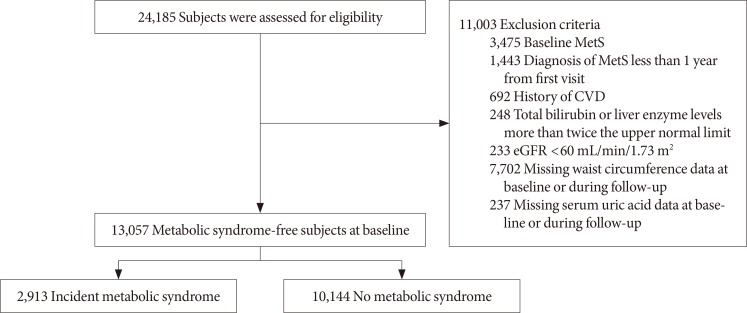
Methods: In total, 13,057 subjects participating in a medical health check-up program without a diagnosis of MetS at baseline were enrolled. Cox proportional hazards models were used to test the independent association of percent changes in SUA level with development of MetS.
Results: After adjustment for age, systolic blood pressure, body mass index, fat-free mass (%), estimated glomerular filtration rate, smoking status, fasting glucose, triglyceride, low density lipoprotein cholesterol, high density lipoprotein cholesterol, and baseline SUA levels, the hazard ratios (HRs) (95% confidence intervals [CIs]) for incident MetS in the second, third, and fourth quartiles compared to the first quartile of percent change in SUA level were 1.055 (0.936 to 1.190), 0.927 (0.818 to 1.050), and 0.807 (0.707 to 0.922) in male (P for trend <0.001) and 1.000 (0.843 to 1.186), 0.744 (0.615 to 0.900), and 0.684 (0.557 to 0.840) in female (P for trend <0.001), respectively. As a continuous variable in the fully-adjusted model, each one-standard deviation increase in percent change in SUA level was associated with an HR (95% CI) for incident MetS of 0.944 (0.906 to 0.982) in male (P=0.005) and 0.851 (0.801 to 0.905) in female (P<0.001).
Conclusion: The current study demonstrated that increasing SUA level independently protected against the development of MetS, suggesting a possible role of SUA as an antioxidant in the pathogenesis of incident MetS.
Keywords: Longitudinal studies; Metabolic syndrome; Uric acid.
Copyright © 2019 Korean Diabetes Association.
Conflict of interest statement
No potential conflict of interest relevant to this article was reported.
Figures
References
-
- Grundy SM, Cleeman JI, Daniels SR, Donato KA, Eckel RH, Franklin BA, Gordon DJ, Krauss RM, Savage PJ, Smith SC, Jr, Spertus JA, Costa F American Heart Association; National Heart, Lung, and Blood Institute. Diagnosis and management of the metabolic syndrome: an American Heart Association/National Heart, Lung, and Blood Institute Scientific Statement. Circulation. 2005;112:2735–2752. - PubMed
-
- Eckel RH, Grundy SM, Zimmet PZ. The metabolic syndrome. Lancet. 2005;365:1415–1428. - PubMed
-
- Ford ES. Risks for all-cause mortality, cardiovascular disease, and diabetes associated with the metabolic syndrome: a summary of the evidence. Diabetes Care. 2005;28:1769–1778. - PubMed
-
- Becker BF. Towards the physiological function of uric acid. Free Radic Biol Med. 1993;14:615–631. - PubMed
-
- Choi HK, Ford ES. Prevalence of the metabolic syndrome in individuals with hyperuricemia. Am J Med. 2007;120:442–447. - PubMed
Publication types
MeSH terms
Substances
LinkOut - more resources
Full Text Sources
Medical
Research Materials