


Hallucinations and Delusions Signal Alzheimer's Associated Cognitive Dysfunction More Strongly Compared to Other Neuropsychiatric Symptoms
- PMID: 30877750
- PMCID: PMC7751129
- DOI: 10.1093/geronb/gbz032
Hallucinations and Delusions Signal Alzheimer's Associated Cognitive Dysfunction More Strongly Compared to Other Neuropsychiatric Symptoms
Abstract
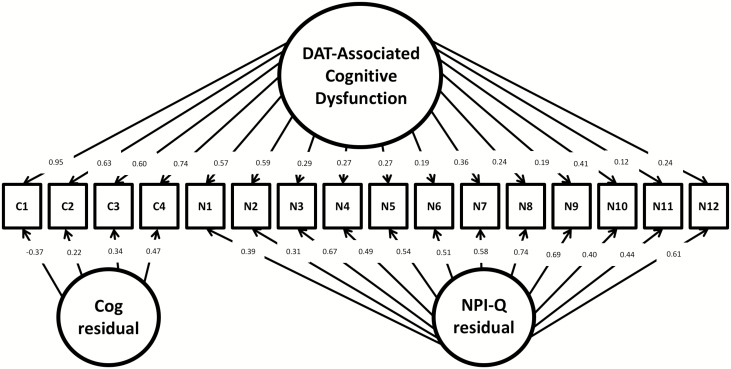
Objectives: Neuropsychiatric symptoms (NPS) are common among individuals with dementia of the Alzheimer's type (DAT). We sought to characterize which NPS more purely relate to cognitive dysfunction in DAT, relative to other NPS.
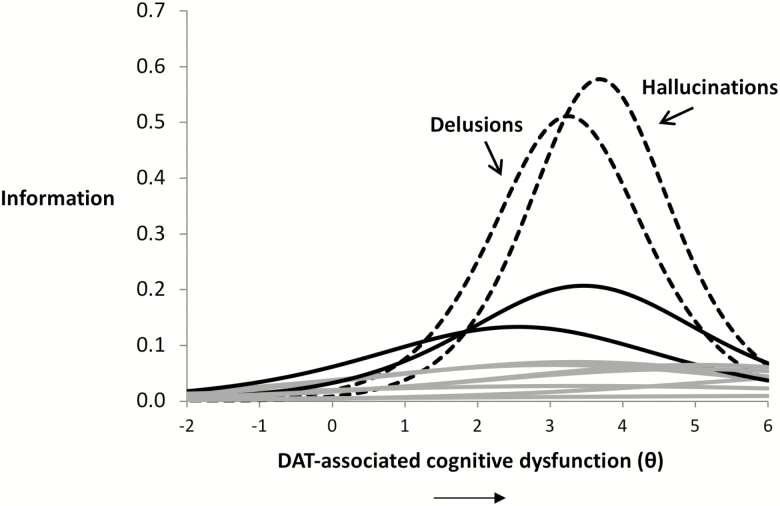
Method: Demographic, neurocognitive, neuroimaging, and NPS data were mined from the Alzheimer's Disease Neuroimaging Initiative database (n = 906). Using factor analysis, we analyzed the degree to which individual NPS were associated with DAT-associated cognitive dysfunction. We also employed item response theory to graphically depict the ability of individual NPS to index DAT-associated cognitive dysfunction across a continuum ranging from cognitively normal to mild DAT.
Results: Psychotic symptoms (hallucinations and delusions) were more strongly related to the continuum of DAT-associated cognitive dysfunction than other NPS, with the strength of the relationship peaking at high levels of disease severity. Psychotic symptoms also negatively correlated with brain volume and did not relate to the presence of vision problems. Aberrant motor behavior and apathy had relatively smaller associations with DAT-associated cognitive dysfunction, while other NPS showed minimal associations.
Discussion: Psychotic symptoms most strongly indexed DAT-associated cognitive dysfunction, whereas other NPS, such as depression and anxiety, were not as precisely related to the DAT-associated cognitive dysfunction.
Keywords: Alzheimer’s disease; Dementia; Mild cognitive impairment; Quantitative methods.
© The Author(s) 2019. Published by Oxford University Press on behalf of The Gerontological Society of America. All rights reserved. For permissions, please e-mail: journals.permissions@oup.com.
Figures
References
-
- Baker F. B. (2001). The basics of item response theory Retrieved from http://ericae.net/irt/baker/software.htm
-
- Balsis S., Geraci L., Benge J., Lowe D. A., Choudhury T. K., Tirso R., … Doody R. S.; Alzheimer’s Disease Neuroimaging Initiative (2018). Statistical model of dynamic markers of the Alzheimer’s pathological cascade. The Journals of Gerontology, Series B: Psychological Sciences and Social Sciences, 73, 964–973. doi:10.1093/geronb/gbx156 - PMC - PubMed
-
- Bassiony M. M., Steinberg M. S., Warren A., Rosenblatt A., Baker A. S., & Lyketsos C. G (2000). Delusions and hallucinations in Alzheimer’s disease: Prevalence and clinical correlates. International Journal of Geriatric Psychiatry, 15, 99–107. doi:10.1002/(SICI)1099-1166(200002)15:2<99::AID-GPS82>3.0.CO;2-5 - PubMed
-
- Bentler P. M. (1990). Comparative fit indexes in structural models. Psychological Bulletin, 107, 238–246. doi:10.1037//0033-2909.107.2.238 - PubMed
Publication types
MeSH terms
Grants and funding
LinkOut - more resources
Full Text Sources
Medical
