


Frustration with feeling: Latent classes of non-suicidal self-injury and emotion regulation difficulties
- PMID: 30878858
- PMCID: PMC6543814
- DOI: 10.1016/j.psychres.2019.03.014
Frustration with feeling: Latent classes of non-suicidal self-injury and emotion regulation difficulties
Abstract
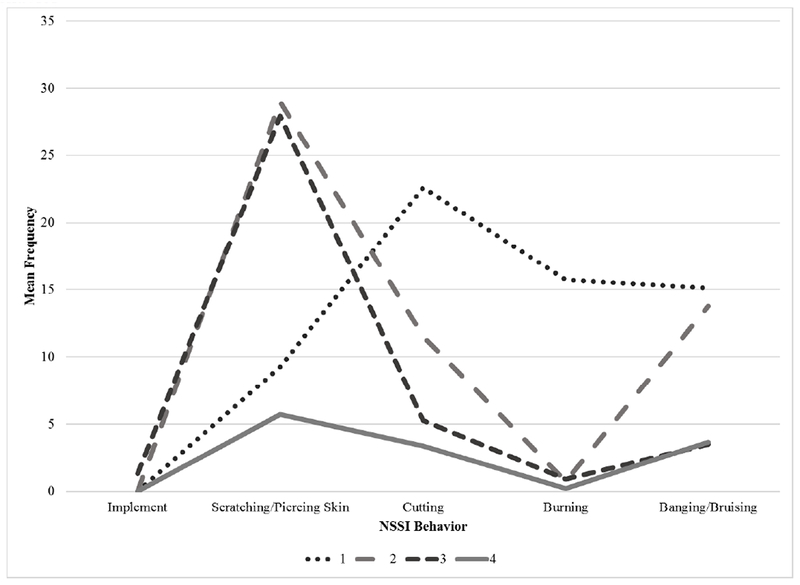
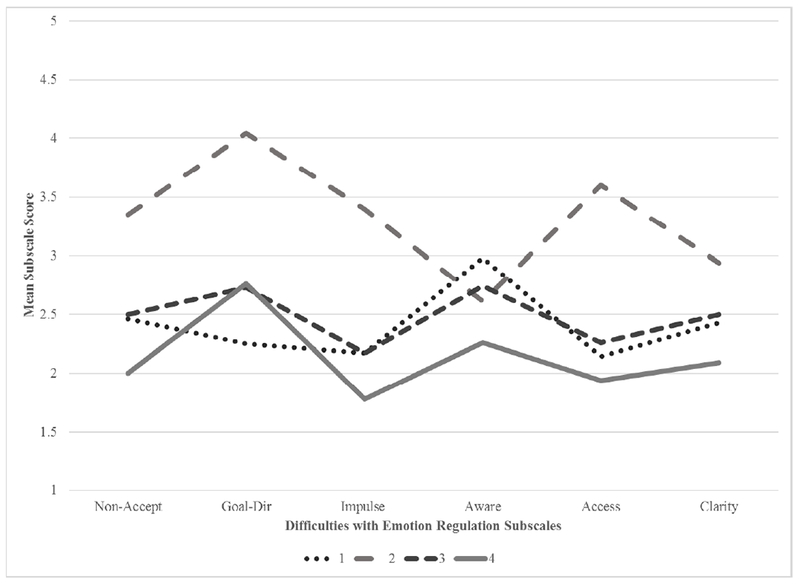
Although emotion regulation has been identified as a key function of non-suicidal self-injury (NSSI), it is unclear how specific indices of emotion regulation are associated with particular NSSI methods as markers of risk. This study used latent class analysis (LCA) to identify subgroups of individuals who engage in NSSI and their patterns of emotional regulation difficulties. Undergraduate students in the southeastern United States (N = 326) completed an online survey. LCA was used to identify subgroups of individuals engaging in NSSI and their associated emotion regulation difficulties. These subgroups were then compared across a variety of behavioral health outcomes (e.g. impulsive behavior, disordered eating, problematic alcohol use, suicide attempt history) to characterize specific risk profiles. The LCA revealed four subgroups who engage in NSSI and have specific emotion regulation difficulties. These subgroups were differentially associated with behavioral health outcomes, including suicide risk, disordered eating, and impulsive behavior. Results of this research could aid in clinical identification of at-risk individuals.
Keywords: Emotions; Models statistical; Self-injurious behavior; Suicide; Suicide attempted; Universities.
Copyright © 2019. Published by Elsevier B.V.
Conflict of interest statement
Figures
References
-
- Aldao A, Nolen-Hoeksema S, Schweizer S, 2010. Emotion-regulation strategies across psychopathology: A meta-analytic review. Clin Psychol Rev. 30(2), 217–237. - PubMed
-
- Allen JP, Litten RZ, Fertig JB, Babor T, 1997. A review of research on the Alcohol Use Disorders Identification Test (AUDIT). Alcohol Clin Exp Res. 21, 613–619. - PubMed
-
- Anestis MD, Bagge CL, Tull MT, Joiner TE, 2011. Clarifying the role of emotion dysregulation in the interpersonal-psychological theory of suicidal behavior in an undergraduate sample. J Psychiatr Res. 45(5), 603–611. - PubMed
-
- Bender TW, Gordon KH, Joiner TE, 2007. Impulsivity and suicidality: A test of the mediating role of painful experiences. Unpublished manuscript. - PubMed
Publication types
MeSH terms
Grants and funding
LinkOut - more resources
Full Text Sources
Medical
Research Materials
