


Physics of growing biological tissues: the complex cross-talk between cell activity, growth and resistance
- PMID: 30879412
- PMCID: PMC6452036
- DOI: 10.1098/rsta.2018.0070
Physics of growing biological tissues: the complex cross-talk between cell activity, growth and resistance
Abstract
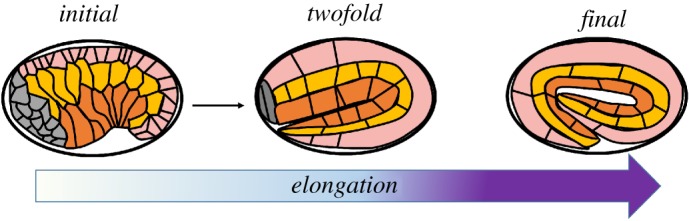
For many organisms, shapes emerge from growth, which generates stresses, which in turn can feedback on growth. In this review, theoretical methods to analyse various aspects of morphogenesis are discussed with the aim to determine the most adapted method for tissue mechanics. We discuss the need to work at scales intermediate between cells and tissues and emphasize the use of finite elasticity for this. We detail the application of these ideas to four systems: active cells embedded in tissues, brain cortical convolutions, the cortex of Caenorhabditis elegans during elongation and finally the proliferation of epithelia on extracellular matrix. Numerical models well adapted to inhomogeneities are also presented. This article is part of the theme issue 'Rivlin's legacy in continuum mechanics and applied mathematics'.
Keywords: active and multi-scale rheology; finite elasticity; morphogenesis; tissue growth; tissue mechanics.
Conflict of interest statement
We declare that we have no competing interests.
Figures
References
-
- Ogden RW. 1997. Non-linear elastic deformations. Mineola, NY: Courier Corporation.
-
- Holzapfel GA. 2000. Nonlinear solid mechanics: a continuum approach for engineering. Chichester, UK: Wiley.
-
- Goriely A. 2017. The mathematics and mechanics of biological growth. Berlin, Germany: Springer.
Publication types
MeSH terms
LinkOut - more resources
Full Text Sources
