. 2019 Apr 4;104(4):701-708.
doi: 10.1016/j.ajhg.2019.02.002. Epub 2019 Mar 14.

Deleterious Variation in BRSK2 Associates with a Neurodevelopmental Disorder

Affiliations

Deleterious Variation in BRSK2 Associates with a Neurodevelopmental Disorder

Susan M Hiatt et al. Am J Hum Genet. .

Abstract

Developmental delay and intellectual disability (DD and ID) are heterogeneous phenotypes that arise in many rare monogenic disorders. Because of this rarity, developing cohorts with enough individuals to robustly identify disease-associated genes is challenging. Social-media platforms that facilitate data sharing among sequencing labs can help to address this challenge. Through one such tool, GeneMatcher, we identified nine DD- and/or ID-affected probands with a rare, heterozygous variant in the gene encoding the serine/threonine-protein kinase BRSK2. All probands have a speech delay, and most present with intellectual disability, motor delay, behavioral issues, and autism. Six of the nine variants are predicted to result in loss of function, and computational modeling predicts that the remaining three missense variants are damaging to BRSK2 structure and function. All nine variants are absent from large variant databases, and BRSK2 is, in general, relatively intolerant to protein-altering variation among humans. In all six probands for whom parents were available, the mutations were found to have arisen de novo. Five of these de novo variants were from cohorts with at least 400 sequenced probands; collectively, the cohorts span 3,429 probands, and the observed rate of de novo variation in these cohorts is significantly higher than the estimated background-mutation rate (p = 2.46 × 10⁻⁶). We also find that exome sequencing provides lower coverage and appears less sensitive to rare variation in BRSK2 than does genome sequencing; this fact most likely reduces BRSK2's visibility in many clinical and research sequencing efforts. Altogether, our results implicate damaging variation in BRSK2 as a source of neurodevelopmental disease.

Keywords: BRSK2; Mendelian disease; clinical sequencing; de novo; developmental delay; exome; genome; intellectual disability.


Figures

Figure 1
Figure 1
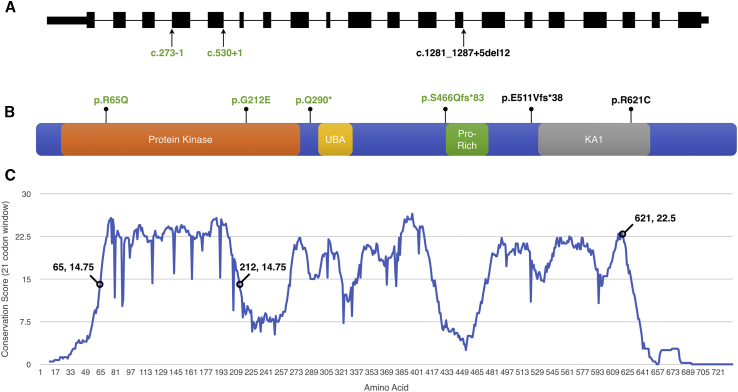
Exon and Domain Structure, Conservation, and Locations of Observed Variation in BRSK2 (A and B) Variation observed in BRSK2 is shown for (A) the canonical, 20-exon transcript, GenBank: NM_001256627.1 and (B) the 736 aa protein, GenBank: NP_001243556.1. Protein domains include protein kinase, ubiquitin-associated (UBA), proline-rich (Pro-Rich), and kinase-associated 1 (KA1) domains. Splice variants are shown below the schematic representation of the canonical transcript, and protein-altering variants are shown above the schematic representation of BRSK2. De novo variants are shown in green text, and those of unknown inheritance are shown in black. (C) Analysis of conservation throughout BRSK2 was performed with amino acid selection scores as previously published and used a 21-codon sliding window. The most-selected motifs of a protein are identified as peaks. The three residues found to be affected by variation here are labeled, along with their respective conservation scores.
Figure 2
Figure 2
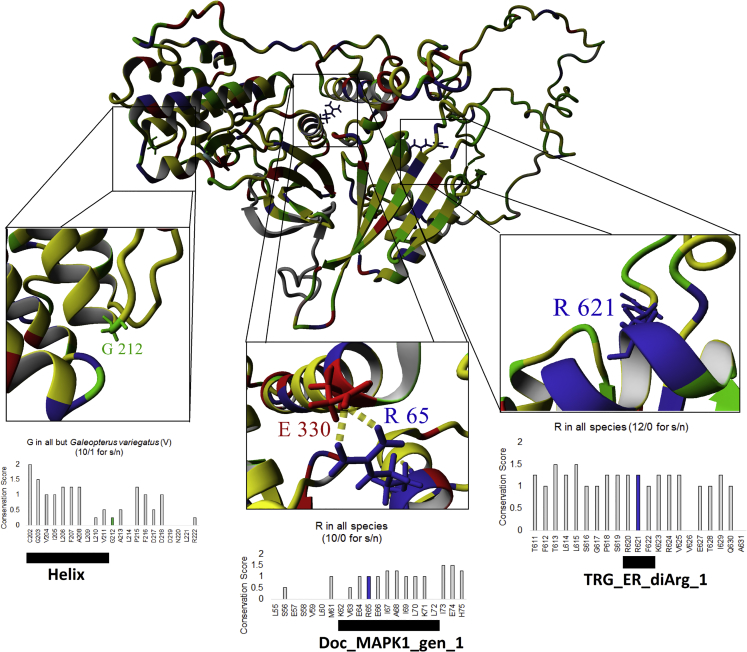
Computational Modeling of BRSK2 Missense Variants A full model of BRSK2 was created with I-TASSER modeling using PDB: 4YOM, 4YNZ, and 4IW0. This model of BRSK2 was combined via ConSurf mapping with sequences for BRSK2 from 99 species. Amino acid coloring is as follows: gray = not conserved, yellow = conserved hydrophobic, green = conserved hydrophilic, red = conserved polar acidic, blue = conserved polar basic, and magenta = conserved human variants of interest. Zoomed-in views of the three locations are shown, along with codon usage throughout evolution. The conservation score is defined as an additive metric of amino acid conservation and codon selection as previously defined. For example, a conservation score of 2 indicates 100% conservation with >2 standard deviations above the mean for codon selection. s/n indicates synonymous mutations versus non-synonymous mutations observed at the same position in other species; differences are indicated. All three sites are under high selection and have multiple synonymous (s) amino acids in 99 open reading frames (ORFs) of BRSK2 and only a single nonsynonymous (n) change observed at G212. Linear motifs mapped with the Eukaryotic Linear Motif (ELM) tool are shown below each site.
Figure 3
Figure 3
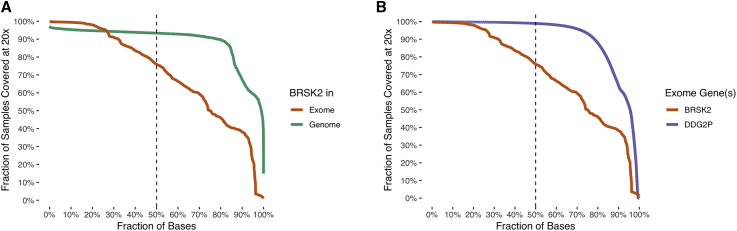
Comparisons of BRSK2 Sequencing Depth across gnomAD Datasets Fractions of gnomAD samples that attain a per-base sequencing depth of ≥20× are plotted as a function of the percentage of bases examined, ordered by a decreasing fraction of exonic-base coverage. Only autosomal positions are included. The dashed line shows the fraction of samples covered at the median-depth base. (A) Using only BRSK2 exonic bases (exons plus 10 bp on either side), coverage is compared in gnomAD exomes (orange; 125,748 individuals) and gnomAD genomes (green; 15,708 individuals). (B) Using only gnomAD exomes (125,748 individuals), exonic bases (exons plus 10 bp on either side) in BRSK2 (orange) are compared to exonic bases in 1,012 confirmed developmental-delay genes identified by the Developmental Disorders Genotype-Phenotype Database (DDG2P; purple).

References

    1. Reiss A.L. Childhood developmental disorders: An academic and clinical convergence point for psychiatry, neurology, psychology and pediatrics. J. Child Psychol. Psychiatry. 2009;50:87–98. - PMC - PubMed
    1. Thapar A., Rutter M. Neurodevelopmental disorders. In: Thapar A., Pine D.S., Leckman J.F., Scott S., Snowling M.J., Taylor E.A., editors. Rutter’s Child and Adolescent Psychiatry. John Wiley & Sons, Ltd; 2015. pp. 31–40.
    1. Plummer J.T., Gordon A.J., Levitt P. The genetic intersection of neurodevelopmental disorders and shared medical comorbidities - relations that translate from bench to bedside. Front. Psychiatry. 2016;7:142. - PMC - PubMed
    1. Philippakis A.A., Azzariti D.R., Beltran S., Brookes A.J., Brownstein C.A., Brudno M., Brunner H.G., Buske O.J., Carey K., Doll C. The Matchmaker Exchange: A platform for rare disease gene discovery. Hum. Mutat. 2015;36:915–921. - PMC - PubMed
    1. Sobreira N., Schiettecatte F., Valle D., Hamosh A. GeneMatcher: A matching tool for connecting investigators with an interest in the same gene. Hum. Mutat. 2015;36:928–930. - PMC - PubMed

Publication types

MeSH terms

Substances