Bilateral Internal Carotid and Left Vertebral Artery Dissection after Blunt Trauma: A Case Report and Literature Review
- PMID: 30880295
- PMCID: PMC6465530
- DOI: 10.2176/nmc.cr.2018-0239
Bilateral Internal Carotid and Left Vertebral Artery Dissection after Blunt Trauma: A Case Report and Literature Review
Abstract
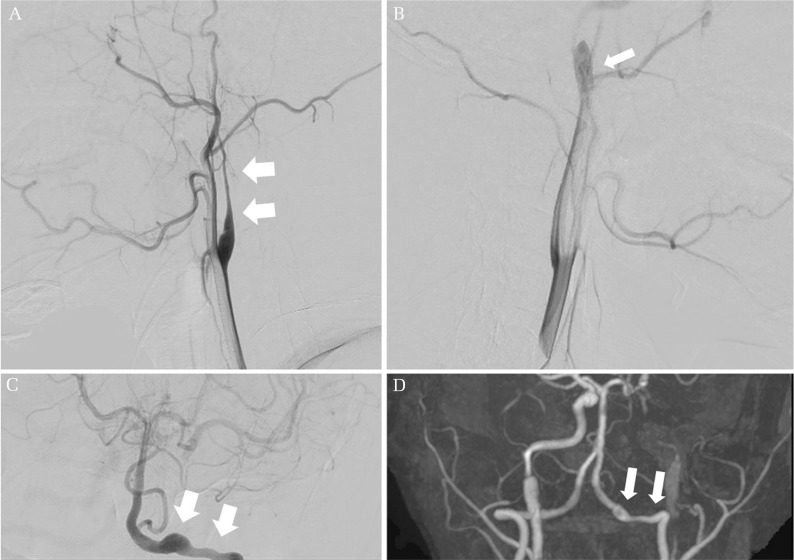
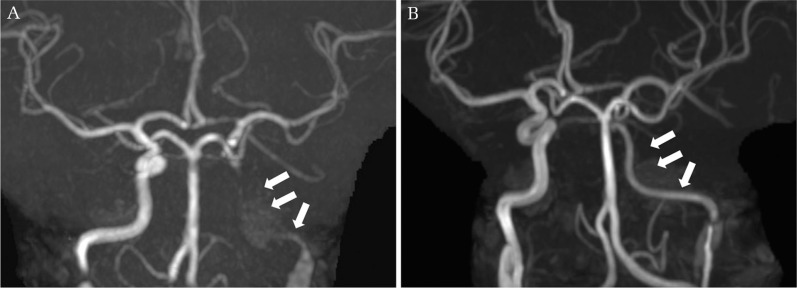
Multi-vessel cervical arterial injury after blunt trauma is rare, and its pathophysiology is unclear. Although blunt cerebrovascular injury is a common cause of cerebral ischemia, its management is still controversial. We describe a 23-year-old man in previously good health who developed three-vessel cervical arterial dissections due to blunt trauma. He was admitted to our emergency and critical care center after a motor vehicle crash. Computed tomography showed a thin, acute subdural hematoma in the right hemisphere and fractures of the odontoid process (Anderson type III), pelvis, and extremities. He was treated conservatively, and about 1 month later, he developed bleariness. Computed tomography angiography showed bilateral internal carotid and left vertebral artery dissection. Aspirin therapy was started immediately, and then clopidogrel was added to the regimen. Two weeks later, magnetic resonance angiography (MRA) showed improved blood flow of the vessels. Only aspirin therapy was continued. About 3 months after discharge, MRA demonstrated further improvement of the blood flow of both internal carotid arteries, but the dissection flap on the right side remained. Therefore, we extended the duration of antiplatelet therapy. On the basis of our experience with this case, we think that antithrombotic therapy is crucial for the management of multi-vessel cervical arterial injury, and agents should be used properly according to the injury grade and phase; however, further study is needed to confirm this recommendation.
Keywords: CT angiography; antithrombotic therapy; blunt cerebrovascular injury; dual antiplatelet therapy; motor vehicle crash.
Conflict of interest statement
All authors declare no conflict of interest.
Figures
References
-
- Eastman AL, Chason DP, Perez CL, McAnulty AL, Minei JP: Computed tomographic angiography for the diagnosis of blunt cervical vascular injury: is it ready for primetime? J Trauma 60: 925–929, 2006 - PubMed
-
- Goodwin RB, Beery PR, Dorbish RJ, et al. : Computed tomographic angiography versus conventional angiography for the diagnosis of blunt cerebrovascular injury in trauma patients. J Trauma 67: 1046–1050, 2009 - PubMed
-
- Cogbill TH, Moore EE, Meissner M, et al. : The spectrum of blunt injury to the carotid artery: a multicenter perspective. J Trauma 37: 473–479, 1994 - PubMed