


COPD patients' characteristics, usual care, and adherence to guidelines: the Greek UNLOCK study
- PMID: 30880944
- PMCID: PMC6402614
- DOI: 10.2147/COPD.S185362
COPD patients' characteristics, usual care, and adherence to guidelines: the Greek UNLOCK study
Abstract
Purpose: GOLD guidelines classify COPD patients into A-D groups based on health status as assessed by COPD Assessment Test (CAT) or mMRC tools and exacerbations and recommend single or dual long-acting bronchodilators as maintenance therapy, with additional inhaled corticosteroids (ICS) if the disease remains uncontrolled. We aimed to classify primary care COPD patients into A-D groups, assess usual treatment and adherence to guidelines, potential mismatches between CAT-and mMRC-based classification and described symptoms within groups.
Patients and methods: A total of 257 primary care COPD patients were enrolled between 2015 and 2016 in Greece. Physicians used structured interviews to collect cross-sectional data including demographics, symptoms, CAT, mMRC scores, and medications. Patients were classified into A-D groups based on CAT and mMRC, and prevalence of symptoms and medication was estimated within A-D groups. Interviews with physicians were also performed to explore additional issues about treatment and adherence to guidelines.
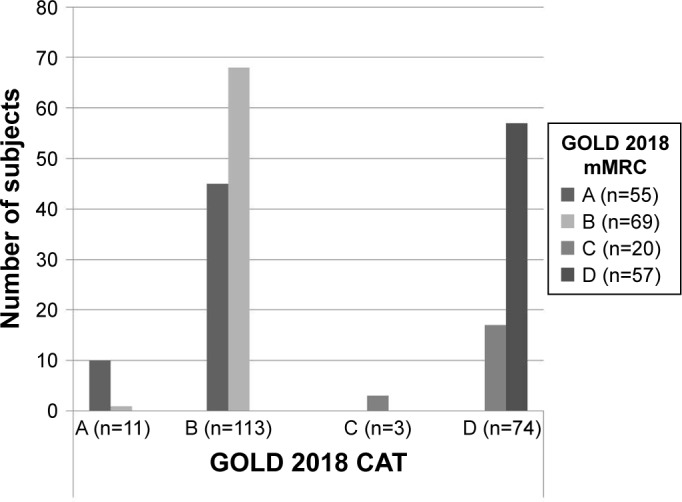
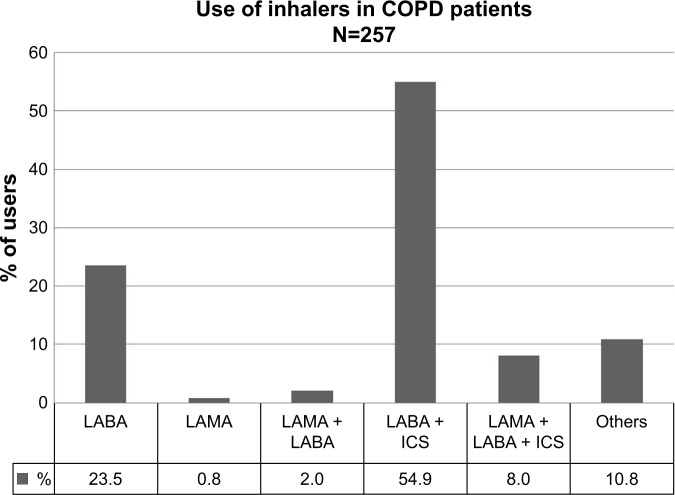
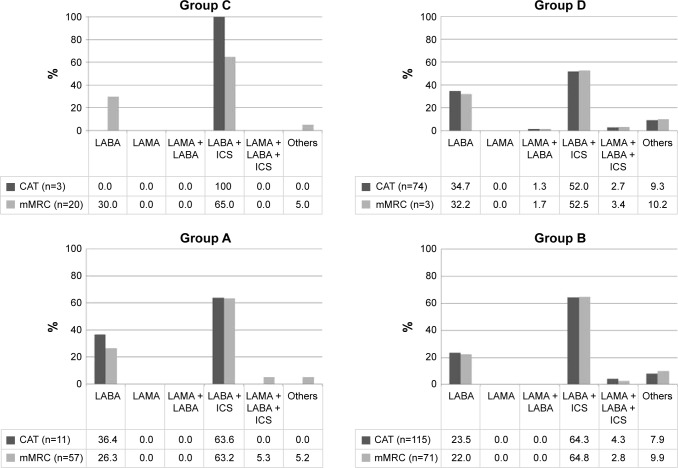
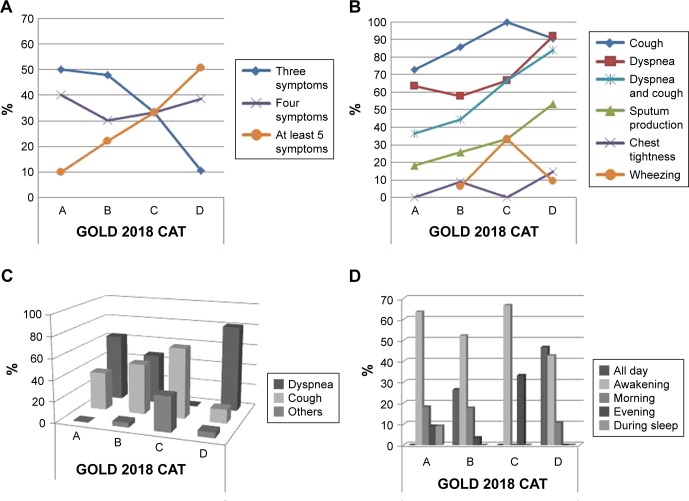
Results: Mean (SD) age was 65 (12.3) years with 79% males. The majority of patients reported uncontrolled symptoms (91% and 61% with ≥10 CAT or ≥2 mMRC scores, respectively). Thirty-seven percentage had $2 exacerbations in the past year. Group B was the largest followed by Groups D, A, and C. Patients were classified as more severe by CAT than by mMRC. In all groups, the majority were treated with combined long-acting beta agonist/ICS (> 50%). When patients were asked to report their main symptoms, dyspnea and cough were the most important symptoms mentioned, and there was a great variation between the A-D groups. However, Groups A-C reported mainly morning symptoms, whereas Group D suffered symptoms all day. Physicians reported a significant number of barriers to implementing guidelines, eg, frequent lack of guideline updates, access to diagnostic procedures, and prescription-reimbursement issues.
Conclusion: Our study confirms poor adherence to guidelines regarding treatment with an overuse of ICS and important barriers to implementation. A mismatch in classification occurs depending on the tool used, which can mislead clinicians in their choice of treatment.
Keywords: CAT; COPD; GOLD guidelines; adherence; classification; mMRC; symptoms; usual care.
Conflict of interest statement
Disclosure The authors report no conflicts of interest in this work.
Figures
References
-
- GOLD Global strategy for the diagnosis, management and prevention of COPD, global initiative for chronic obstructive lung Disease (Gold 2018 report) 2018. [Accessed October 10, 2018]. Available from: https://goldcopd.org/wp-content/uploads/2017/11/GOLD-2018-v6.0-FINAL-rev....
-
- Levy ML, Quanjer PH, Booker R, et al. Diagnostic spirometry in primary care: Proposed standards for general practice compliant with American Thoracic Society and European Respiratory Society recommendations: a General Practice Airways Group (GPIAG)1 document, in association with the Association for Respiratory Technology & Physiology (ARTP)2 and Education for Health3 1 www.gpiag.org 2 www.artp.org 3 www.educationforhealth.org.uk. Prim Care Respir J. 2009;18(3):130–147. - PMC - PubMed
-
- Hajiro T, Nishimura K, Tsukino M, et al. Analysis of clinical methods used to evaluate dyspnea in patients with chronic obstructive pulmonary disease. Am J Respir Crit Care Med. 1998;158(4):1185–1189. - PubMed
MeSH terms
Substances
LinkOut - more resources
Full Text Sources
Medical
Miscellaneous
