


Treatment intensity and survival in patients with relapsed or refractory diffuse large B-cell lymphoma in Denmark: a real-life population-based study
- PMID: 30881137
- PMCID: PMC6407517
- DOI: 10.2147/CLEP.S178003
Treatment intensity and survival in patients with relapsed or refractory diffuse large B-cell lymphoma in Denmark: a real-life population-based study
Abstract
Purpose: High-dose chemotherapy with autologous stem cell transplantation (ASCT) is considered to be the only curative treatment option for patients with refractory or relapsed diffuse large B-cell lymphoma (DLBCL). Due to toxicity, not all patients are eligible for this treatment leading to different treatment intensities. Here, we aim to analyze the impact of treatment intensity on survival in patients previously treated with rituximab and chemotherapy, and, furthermore, to analyze the association between socioeconomic position and treatment intensity, defined as palliation, non-salvage, and salvage regimens.
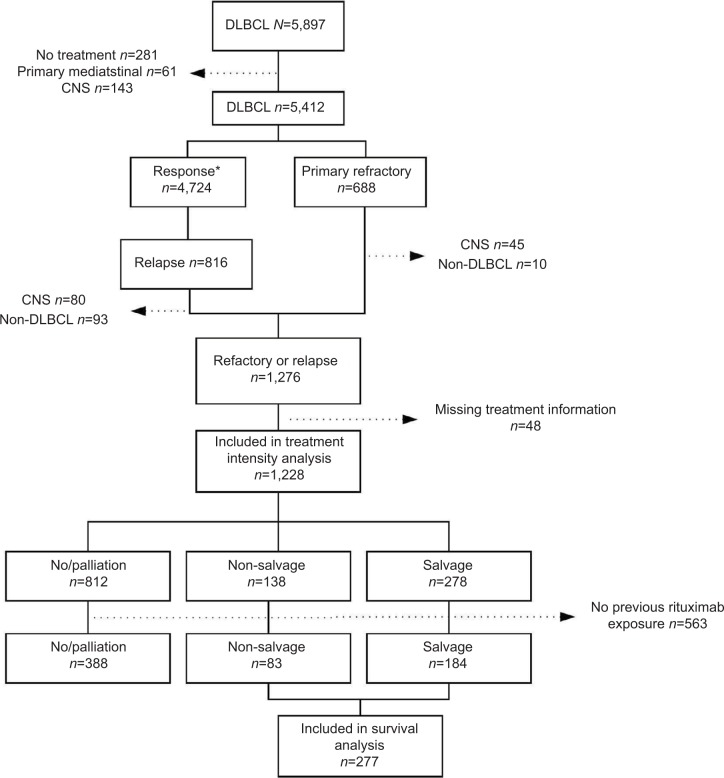
Materials and methods: We identified patients with refractory or relapsed DLBCL diagnosed in 2000-2015 in the Danish National Lymphoma Registry (n=1,228). We analyzed the impact of treatment intensity on survival in patients previously treated with rituximab (n=277) using a Cox proportional hazards model. Multinomial regression analyses were performed to identify associations between socioeconomic factors and treatment intensity for the entire cohort.
Results: In the rituximab era, the 5-year overall survival (OS) was 31% for patients receiving salvage regimens (n=194), and 17% for patients receiving non-salvage regimens (n=83). In the adjusted analysis, HR was 1.88, 95% CI: 0.9-3.9 for patients receiving salvage regimens. Patients living alone were significantly less likely to receive salvage regimens, as were patients with two or more comorbidities.
Conclusion: We observed a better OS in patients treated with salvage regimens compared with non-salvage regimens; however, the adjusted analysis contradicts this. Furthermore, our results indicate that there is a chance of remission for patients not eligible for ASCT.
Keywords: chemotherapy; education; epidemiology; income; non-Hodgkin lymphoma; socioeconomic status; stem cell transplantation.
Conflict of interest statement
Disclosure The authors report no conflicts of interest in this work.
Figures

References
-
- Coiffier B, Thieblemont C, Van Den Neste E, et al. Long-term outcome of patients in the LNH-98.5 trial, the first randomized study comparing rituximab-CHOP to standard CHOP chemotherapy in DLBCL patients: a study by the Groupe d’Etudes des Lymphomes de l’Adulte. Blood. 2010;116(12):2040–2045. - PMC - PubMed
-
- Pfreundschuh M, Trümper L, Österborg A, et al. CHOP-like chemotherapy plus rituximab versus CHOP-like chemotherapy alone in young patients with good-prognosis diffuse large-B-cell lymphoma: a randomised controlled trial by the MabThera International Trial (MInT) Group. Lancet Oncol. 2006;7(5):379–391. - PubMed
-
- Sehn LH, Donaldson J, Chhanabhai M, et al. Introduction of combined CHOP plus rituximab therapy dramatically improved outcome of diffuse large B-cell lymphoma in British Columbia. J Clin Oncol. 2005;23(22):5027–5033. - PubMed
-
- Philip T, Guglielmi C, Hagenbeek A, et al. Autologous bone marrow transplantation as compared with salvage chemotherapy in relapses of chemotherapy-sensitive non-Hodgkin’s lymphoma. N Engl J Med. 1995;333(23):1540–1545. - PubMed
-
- Friedberg JW. Relapsed/refractory diffuse large B-cell lymphoma. Hematology Am Soc Hematol Educ Program. 2011;2011(1):498–505. - PubMed
LinkOut - more resources
Full Text Sources
Medical
