


A longitudinal diary study of the effects of causality orientations on exercise-related affect
- PMID: 30881230
- PMCID: PMC6415914
- DOI: 10.1080/15298868.2010.534238
A longitudinal diary study of the effects of causality orientations on exercise-related affect
Abstract
According to self-determination theory, a tendency to view causes of a behavior as autonomous, controlled, or impersonal can influence motivation, self-regulation, and experience. We propose that causality orientations for exercise may shape self-determined regulations for exercise by leading to more positive exercise-related affect, leading to greater internalization of exercise behavior and more self-determined regulations to exercise (e.g., regulation on the basis of inherent interest and personally-held values).
Methods: Participants (N = 104) kept an online diary for four weeks documenting exercise behavior and affect experienced during exercise. Exercise causality orientations were measured at baseline and exercise regulations were measured at follow-up. Analyses were performed using multilevel modeling and path analysis.
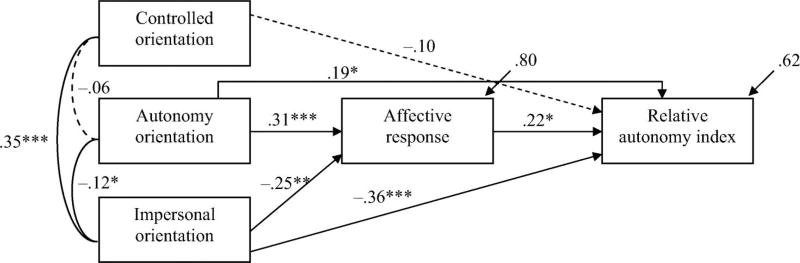
Results: Exercise-related affect was more positive for those with higher levels of the autonomy orientation and lower levels of the impersonal orientation. Exercise-related affect partially mediated the relationship between autonomy and impersonal orientations and self-determined regulations for exercise.
Conclusions: Affective responses to self-selected exercise were more positive for those who tend to perceive exercise opportunities as more autonomous, which in turn led to more self-determined regulations.
Keywords: Affective response; Intrinsic motivation; Physical activity; Self-determination theory.
Figures
References
-
- Baumeister RF, Vohs KD, DeWall CN, Zhang L. How emotion shapes behavior: Feedback, anticipation, and reflection, rather than direct causation. Personality and Social Psychology Review. 2007;11(2):167–203. - PubMed
-
- Bock BC, Marcus BH, Pinto BM, Forsyth LH. Maintenance of physical activity following an individualized motivationally tailored intervention. Annals of Behavioral Medicine. 2001;23:79–87. - PubMed
-
- Deci EL. The psychology of self-determination. Lexington, MA: D. C. Heath; 1980.
-
- Deci EL, Ryan RM. The General Causality Orientations Scale: Self-determination in personality. Journal of Research in Personality. 1985;19:109–134.
-
- Deci EL, Ryan RM. Facilitating optimal motivation and psychological well-being across life’s domains. Canadian Psychology. 2008;49(1):14–23.
Grants and funding
LinkOut - more resources
Full Text Sources