Review
. 2019 Mar 1:10:79.
doi: 10.3389/fgene.2019.00079. eCollection 2019.

Dietary Compounds as Epigenetic Modulating Agents in Cancer

Affiliations
Review

Dietary Compounds as Epigenetic Modulating Agents in Cancer

Ángeles Carlos-Reyes et al. Front Genet. .

Abstract

Epigenetic mechanisms control gene expression during normal development and their aberrant regulation may lead to human diseases including cancer. Natural phytochemicals can largely modulate mammalian epigenome through regulation of mechanisms and proteins responsible for chromatin remodeling. Phytochemicals are mainly contained in fruits, seeds, and vegetables as well as in foods supplements. These compounds act as powerful cellular antioxidants and anti-carcinogens agents. Several dietary compounds such as catechins, curcumin, genistein, quercetin and resveratrol, among others, exhibit potent anti-tumor activities through the reversion of epigenetic alterations associated to oncogenes activation and inactivation of tumor suppressor genes. In this review, we summarized the actual knowledge about the role of dietary phytochemicals in the restoration of aberrant epigenetic alterations found in cancer cells with a particular focus on DNA methylation and histone modifications. Furthermore, we discussed the mechanisms by which these natural compounds modulate gene expression at epigenetic level and described their molecular targets in diverse types of cancer. Modulation of epigenetic activities by phytochemicals will allow the discovery of novel biomarkers for cancer prevention, and highlights its potential as an alternative therapeutic approach in cancer.

Keywords: DNA methylation; cancer therapy; epigenetic machinery; histones modifications; phytochemicals.


Figures
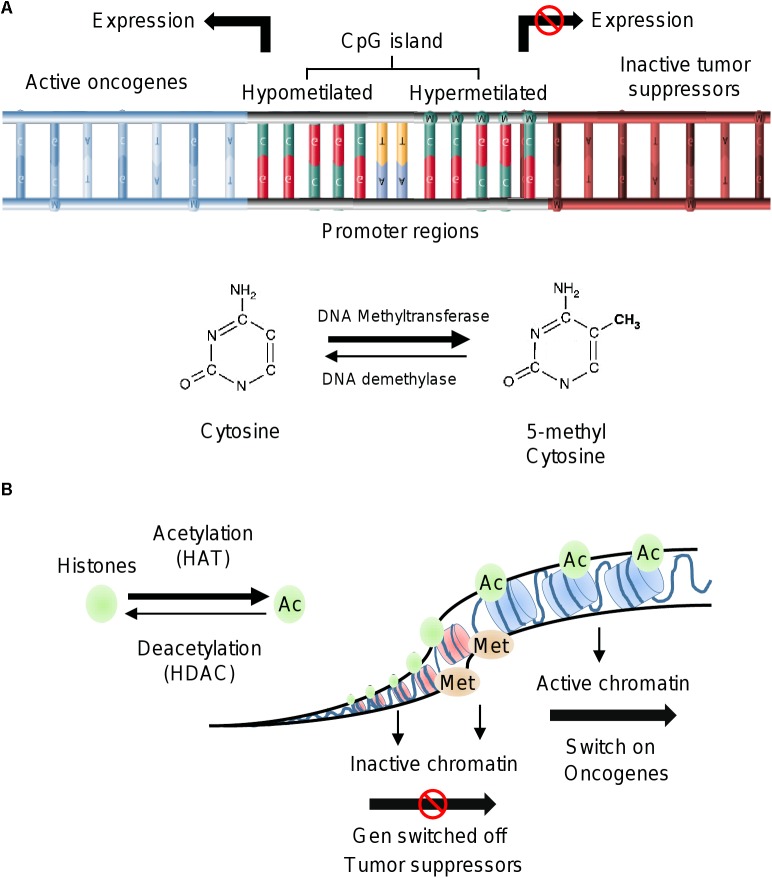
FIGURE 1
FIGURE 1
Epigenetic alterations in cancer. (A) Methylation of DNA by DNA methyltransferases occurs on CpG islands of promoter gene regions. Hypermethylation of DNA induces repression of gene expression, whereas the hypomethylation status is associated to activation of gene transcription. (B) Histone modifications include acetylation by HAT and deacetylation by HDAC. Acetylated status of histones is observed in euchromatin and related to oncogenes activation. Histone methylation can be associated with either transcriptional repression or activation. Trimethylation of histone H3 at lysine 4 (H3K4me3) is an active mark for transcription.
FIGURE 2
FIGURE 2
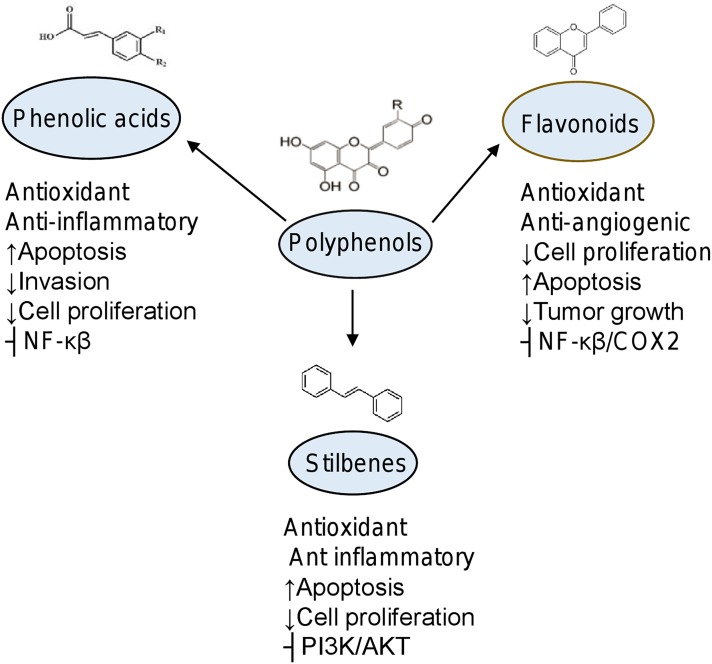
Biological effects of phytochemicals in cancer. Chemical structures of subgroups of polyphenols and organosulfur compounds. Effects in diverse cellular processes are indicated. ⊢, inhibition; ↑, increased; ↓, decreased.
FIGURE 3
FIGURE 3
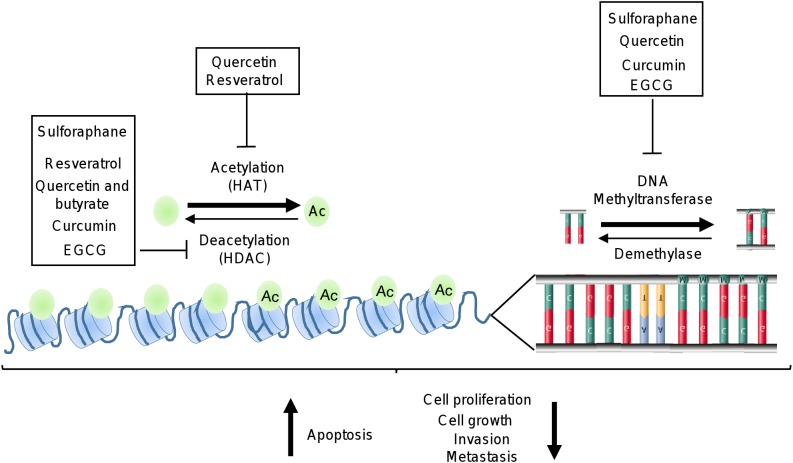
Epigenetic machinery as targets of polyphenols. Illustration depicts how polyphenols may inhibit HDAC, HAT, and DNA methyltransferases activities which are deregulated in cancer cells.

References

    1. Abbas A., Hall J. A., Patterson W. L., III, Ho E., Hsu A., Al-Mulla F., et al. (2016). Sulforaphane modulates telomerase activity via epigenetic regulation in prostate cancer cell lines. Biochem. Cell Biol. 94 71–81. 10.1139/bcb-2015-0038 - DOI - PubMed
    1. Abdallah R., Xiong Y., Lancaster J. M., Judson P. L. (2015). Complementary and alternative medicine use in women with gynecologic malignancy presenting for care at a comprehensive cancer center. Int. J. Gynecol. Cancer 25 1724–1730. 10.1097/IGC.0000000000000549 - DOI - PubMed
    1. Adams M., Jewell A. P. (2007). The use of complementary and alternative medicine by cancer patients. In International Seminars in Surgical Oncology. BioMed. Central 4:10. 10.1186/1477-7800-4-10 - DOI - PMC - PubMed
    1. Adjakly M., Bosviel R., Rabiau N., Boiteux J. P., Bignon Y. J., Guy L., et al. (2011). DNA methylation and soy phytoestrogens: quantitative study in DU-145 and PC-3 human prostate cancer cell lines. Epigenomics 3 795–803. 10.2217/epi.11.103 - DOI - PubMed
    1. Adjakly M., Ngollo M., Lebert A., Dagdemir A., Penault-Llorca F., Boiteux J. P., et al. (2014). Comparative effects of soy phytoestrogens and 17β-estradiol on DNA methylation of a panel of 24 genes in prostate cancer cell lines. Nutr. Cancer 66 474–482. 10.1080/01635581.2014.884236 - DOI - PubMed

LinkOut - more resources