


Creating Consensus: Revisiting the Emergency Medicine Resident Scholarly Activity Requirement
- PMID: 30881559
- PMCID: PMC6404691
- DOI: 10.5811/westjem.2018.10.39293
Creating Consensus: Revisiting the Emergency Medicine Resident Scholarly Activity Requirement
Abstract
Introduction: In the context of the upcoming single accreditation system for graduate medical education resulting from an agreement between the Accreditation Council for Graduate Medical Education (ACGME), American Osteopathic Association and American Association of Colleges of Osteopathic Medicine, we saw the opportunity for charting a new course for emergency medicine (EM) scholarly activity (SA). Our goal was to engage relevant stakeholders to produce a consensus document.
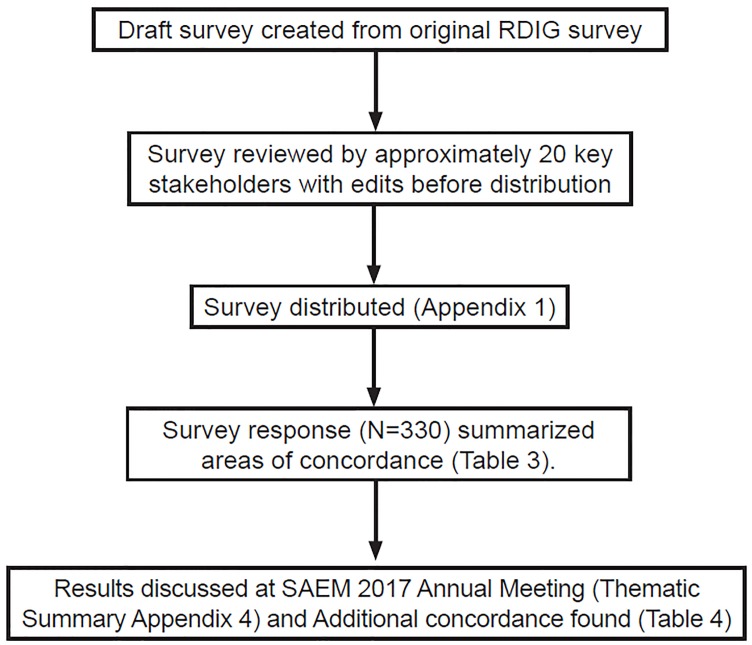
Methods: Consensus building focused on the goals, definition, and endpoints of SA. Representatives from stakeholder organizations were asked to help develop a survey regarding the SA requirement. The survey was then distributed to those with vested interests. We used the preliminary data to find areas of concordance and discordance and presented them at a consensus-building session. Outcomes were then re-ranked.
Results: By consensus, the primary role(s) of SA should be the following: 1) instruct residents in the process of scientific inquiry; 2) expose them to the mechanics of research; 3) teach them lifelong skills, including search strategies and critical appraisal; and 4) teach them how to formulate a question, search for the answer, and evaluate its strength. To meet these goals, the activity should have the general elements of hypothesis generation, data collection and analytical thinking, and interpretation of results. We also determined consensus on the endpoints, and acceptable documentation of the outcome.
Conclusion: This consensus document may serve as a best-practices guideline for EM residency programs by delineating the goals, definitions, and endpoints for EM residents' SA. However, each residency program must evaluate its available scholarly activity resources and individually implement requirements by balancing the ACGME Review Committee for Emergency Medicine requirements with their own circumstances.
Conflict of interest statement
Conflicts of Interest: By the WestJEM article submission agreement, all authors are required to disclose all affiliations, funding sources and financial or management relationships that could be perceived as potential sources of bias. No author has professional or financial relationships with any companies that are relevant to this study. There are no conflicts of interest or sources of funding to declare.
Figures
Comment in
-
Response to "Creating Consensus: Revisiting the Emergency Medicine Scholarly Activity Requirement".West J Emerg Med. 2019 Mar;20(2):376-379. doi: 10.5811/westjem.2019.1.42332. Epub 2019 Feb 14. West J Emerg Med. 2019. PMID: 30881560 Free PMC article. No abstract available.
References
-
- Summers R, Fish S, Blanda M, et al. Assessment of the “scholarly project” requirement for emergency medicine residents: report of the SAEM Research Director’s Workshop. Acad Emerg Med. 1999;6(11):1160–5. - PubMed
-
- American Osteopathic Association. Basic Standards for Residency Training in Emergency Medicine. [Accessed July 7, 2017]. Available at: http://www.osteopathic.org/inside-aoa/accreditation/postdoctoral-trainin....
-
- Emergency Medicine Resident Association. 24/7/365: The evolution of emergency medicine. 2013. [Accessed July 7, 2017]. Available at: https://www.emra.org/publications/legacy-documentary/
-
- Geyer BC, Kaji AH, Katz ED, et al. A National Evaluation of the Scholarly Activity Requirement in Residency Programs: A Survey of Emergency Medicine Program Directors. Acad Emerg Med. 2015;22(11):1337–44. - PubMed