


Changes in US Outpatient Antibiotic Prescriptions From 2011-2016
- PMID: 30882145
- PMCID: PMC8078491
- DOI: 10.1093/cid/ciz225
Changes in US Outpatient Antibiotic Prescriptions From 2011-2016
Abstract
Background: While antibiotics are life-saving drugs, their use is not without risk, including adverse events and antibiotic resistance. The majority of US antibiotic prescriptions are prescribed in outpatient settings, making outpatient antibiotic prescribing an important antibiotic stewardship target. The primary objective of this study was to describe trends in US outpatient oral antibiotic prescriptions from 2011-2016.
Methods: We estimated annual oral antibiotic prescription rates using national prescription dispensing count data from IQVIA Xponent, divided by census estimates for 2011-2016. We calculated the ratio of broad- to narrow-spectrum prescriptions by dividing broad-spectrum prescription rates by narrow-spectrum prescription rates. We used Poisson models to estimate prevalence rate ratios, comparing 2011 and 2016 antibiotic prescription rates, and linear models to evaluate temporal trends throughout the study period.
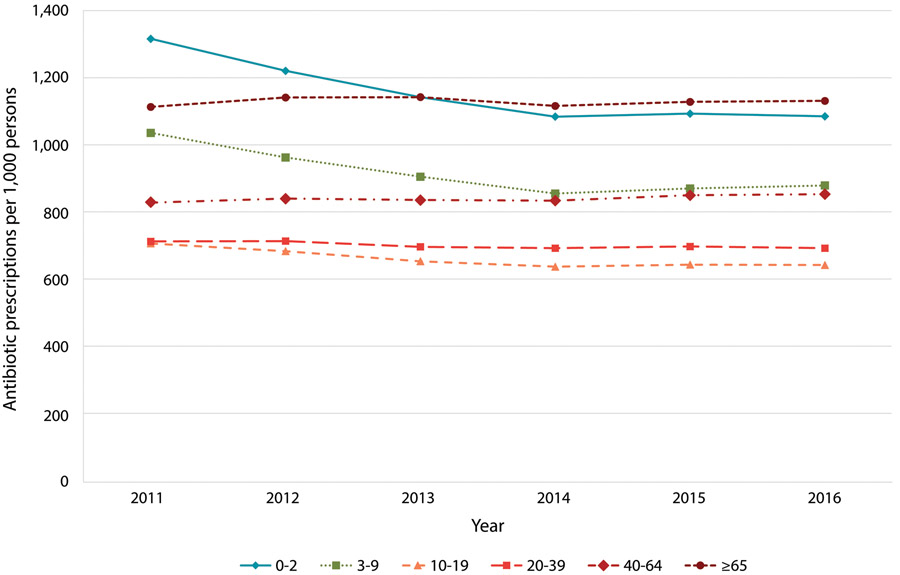
Results: Oral antibiotic prescription rates decreased 5%, from 877 prescriptions per 1000 persons in 2011 to 836 per 1000 persons in 2016. During this period, rates of prescriptions dispensed to children decreased 13%, while adult rates increased 2%. The ratio of broad- to narrow-spectrum antibiotics decreased from 1.62 in 2011 to 1.49 in 2016, driven by decreases in macrolides and fluoroquinolones. The proportion of prescriptions written by nurse practitioners and physician assistants increased during the study period; in 2016, these providers prescribed over one-quarter of all antibiotic prescriptions.
Conclusions: Outpatient antibiotic prescription rates, especially of broad-spectrum agents, have decreased in recent years. Clinicians who prescribe to adults, including nurse practitioners and physician assistants, are important targets for antibiotic stewardship.
Keywords: antibiotic; antibiotic stewardship; outpatient.
Published by Oxford University Press for the Infectious Diseases Society of America 2019.
Conflict of interest statement
Figures

Comment in
-
Outpatient Antibiotic Prescribing in the United States: Are Pediatricians Leading the Way?Clin Infect Dis. 2020 Jan 16;70(3):378-379. doi: 10.1093/cid/ciz230. Clin Infect Dis. 2020. PMID: 30882134 No abstract available.
References
-
- Centers for Disease Control and Prevention. Antibiotic Resistance Threats in the United States, 2013. Available at: https://www.cdc.gov/drugresistance/pdf/ar-threats-2013-508.pdf. Accessed 09 January 2019.
-
- Duffy E, Ritchie S, Metcalfe S, Van Bakel B, Thomas MG. Antibacterials dispensed in the community comprise 85%-95% of total human antibacterial consumption. J Clin Pharm Ther 2017; 43(1): 59–64. - PubMed
-
- Fleming-Dutra KE, Hersh AL, Shapiro DJ, et al. Prevalence of Inappropriate Antibiotic Prescriptions Among US Ambulatory Care Visits, 2010-2011. JAMA 2016; 315(17): 1864–73. - PubMed
-
- The White House. National Action Plan for Combating Antibiotic-Resistant Bacteria. Available at: https://www.cdc.gov/drugresistance/pdf/national_action_plan_for_combatin.... Accessed 09 January 2019.
