Comparative Study
. 2019 May;42(5):499-507.
doi: 10.1111/pace.13649. Epub 2019 Mar 24.

Comparing phase and electrographic flow mapping for persistent atrial fibrillation

Affiliations
Comparative Study

Comparing phase and electrographic flow mapping for persistent atrial fibrillation

M Swerdlow et al. Pacing Clin Electrophysiol. 2019 May.

Abstract

Background: An increasing number of methods are being used to map atrial fibrillation (AF), yet the sensitivity of identifying potential localized AF sources of these novel methods are unclear. Here, we report a comparison of two approaches to map AF based upon (1) electrographic flow mapping and (2) phase mapping in a multicenter registry of patients in whom ablation terminated persistent AF.

Methods: Fifty-three consecutive patients with persistent AF in whom ablation terminated AF in an international multicenter registry were enrolled. Electrographic flow mapping (EGF) and phase mapping were applied to the multipolar simultaneous electrograms recorded from a 64-pole basket catheter in the chamber (left vs right atrium) where AF termination occurred. We analyzed if the mapping methods were able to detect localized sources at the AF termination site. We also analyzed global results of mapping AF for each method, patterns of activation of localized sources.

Results: Patients were 64.3 ± 9.4 years old and 69.8% were male. EGF and phase mapping identified localized sources at AF termination sites in 81% and 83% of the patients, respectively. Methods were complementary and in only n = 2 (3.7%) neither method identified a source. Globally, EGF identified more localized sources than phase mapping (5.3 ± 2.8 vs 1.8 ± 0.5, P < 0.001), with a higher prevalence of focal (compared to rotational) activation pattern (49% vs 2%, P < 0.01).

Conclusions: EGF is a novel vectorial-based AF mapping method, which can detect sites of AF termination, agreeing with, and complementary to, an alternative AF mapping method using phase analysis.

Keywords: atrial fibrillation; electrographic flow; electrophysiology; mapping; phase.


Figures

Figure 1:
Figure 1:. Critical Elements of AF Mapping: A. EGF mapping:
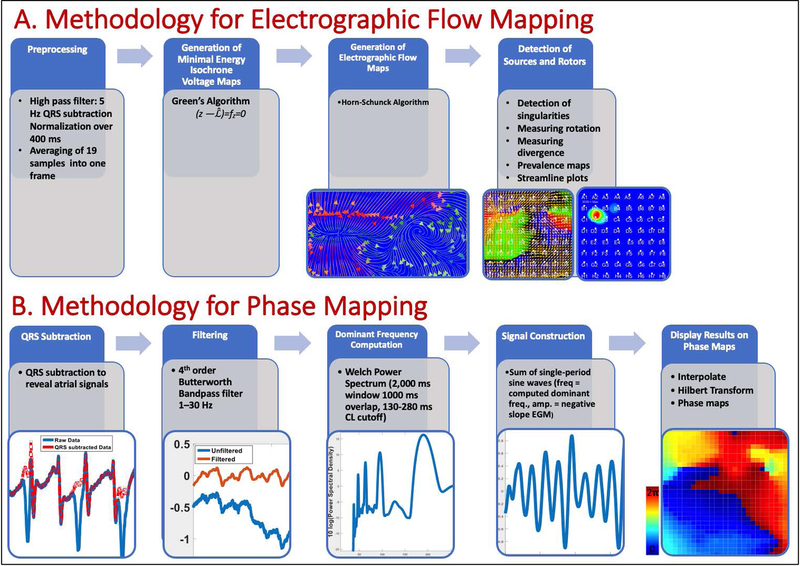
Core Algorithms of EGF mapping are (1) the Green’s Algorithm to generate high resolution isochrone voltage maps from normalized QRS-complex adjusted unipolar electrograms assuming minimal energy electrical field distribution and (2) the reconstruction of velocity vector flow fields from 2 seconds of consecutive voltage maps using the Horn-Schunck Algorithm. Location of sources are determined as singularities in the flow field and sources are classified according their divergence and rotation. Prevalence maps over one-minute show stability of the sources and centripetal Rotors over time. B. Phase mapping: QRS’s are subtracted using a series of methods. High frequency noise and baseline oscillations are removed via filtering, which is used to focus on the signal components that are most characteristic of AF electrograms. Rate of each atrial signal is calculated using dominant frequency and signals were then reconstructed as the sum of sine waves, each having a period corresponding to the dominant frequency. Finally, spatial maps were interpolated by the 64 electrode signals in a 29 by 29-point matrix. Then, the Hilbert transform was used to obtain the phase signal at each pixel to construct a phase map.
Figure 2.
Figure 2.
Two patients in whom electrographic flow and phase mapping showed concordant results. The top panel shows AF in a 56-year-old man and where ablation in the anterior left atrium (A), led to termination of atrial fibrillation (B). Phase mapping and electrographic flow mapping identified a clockwise rotational activation localized at the AF termination site, over electrodes GH23 on the grid (C-D). Movie 1 demonstrates phase and EGF videos of this case. Bottom panel shows AF in a 53-year-old man in whom ablation in the left atrial roof, proximal to the right upper pulmonary vein antrum (E), terminated persistent AF to sinus rhythm (F). Phase mapping and electrographic flow mapping identified clockwise rotational activation localized to the AF termination site, over electrodes BC45 on the grid (G-H).
Figure 3.
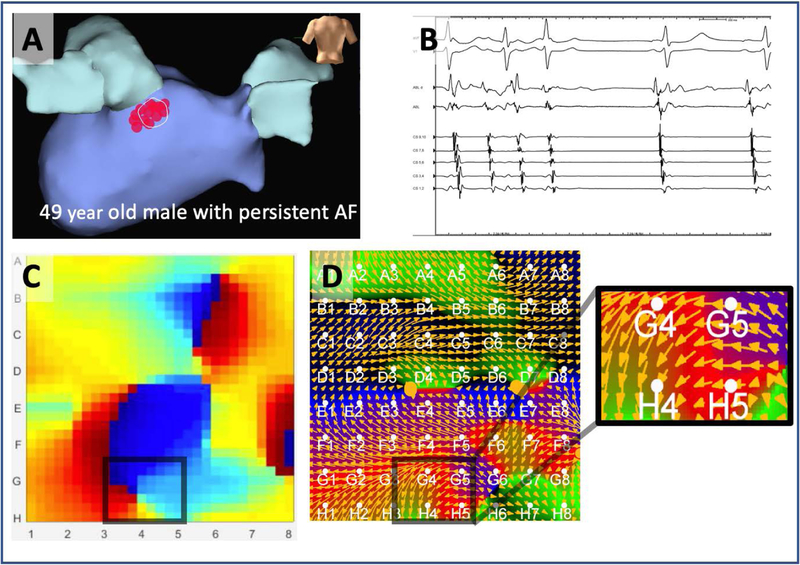
Figure 3.. Disagreement on rotational activity at AF termination site, which revealed rotational source by phase mapping, but not by EGF mapping in a
49 year old man in whom ablation in the left atrium, inferior to the left inferior pulmonary vein (A) terminated persistent AF to sinus rhythm (B) where phase mapping identified a rotational source (electrodes GH45) (C) but electrographic flow mapping showed no clear rotational or focal activation (D).
Figure 4.
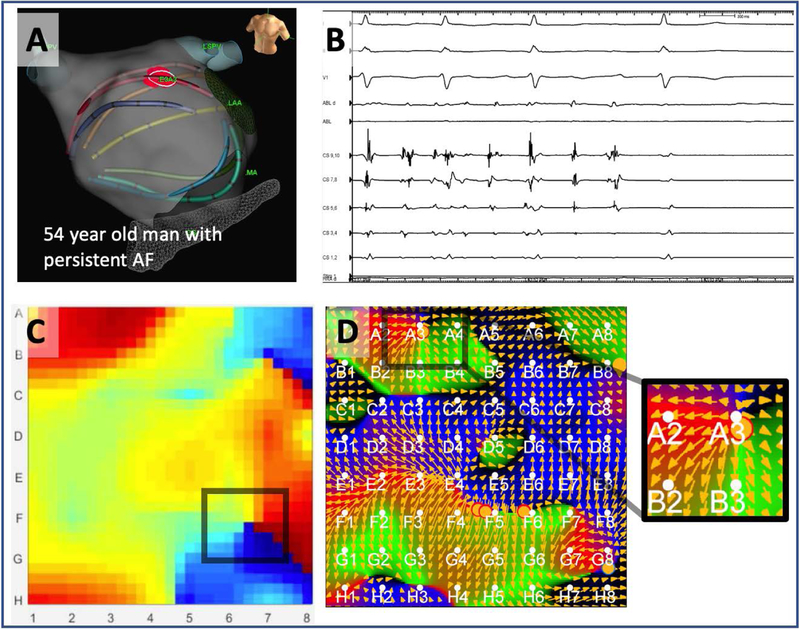
Figure 4.. Disagreement on rotational activity at AF termination site, which revealed rotational source by EGF mapping but missed by phase mapping in
54 year old man in whom ablation anterior to left atrial appendage terminated persistent AF (A-B). Mapping at this site did not identify a rotational source by phase (C), but electrographic flow shows a clear rotational source at the A3 electrode overlying the termination site (D). Both methods agree on a non-terminating AF source on this map, at electrode F6.

References

    1. Calkins H, Hindricks G, Cappato R, et al. 2017 HRS/EHRA/ECAS/APHRS/SOLAECE expert consensus statement on catheter and surgical ablation of atrial fibrillation: Executive summary. Europace 2018; 20:157–208. - PMC - PubMed
    1. Verma A, Jiang C-Y, Betts TR, Chen J, Deisenhofer I, Mantovan R, Macle L, Morillo C a, Haverkamp W, Weerasooriya R, Albenque J-P, Nardi S, Menardi E, Novak P, Sanders P. Approaches to Catheter Ablation for Persistent Atrial Fibrillation. NEJM 2015; 372:1812–1822. - PubMed
    1. Ramirez FD, Birnie DH, Nair GM, Szczotka A, Redpath CJ, Sadek MM, Nery PB. Efficacy and safety of driver-guided catheter ablation for atrial fibrillation: A systematic review and meta-analysis. JCE 2017; 28:1371–1378. - PubMed
    1. Baykaner T, Rogers AJ, Meckler GL, Zaman J, Navara R, Rodrigo M, Alhusseini M, Kowalewski CAB, Viswanathan MN, Narayan SM, Clopton P, Wang PJ, Heidenreich PA. Clinical Implications of Ablation of Drivers for Atrial Fibrillation. Circ: AE 2018; 11:e006119. - PMC - PubMed
    1. Umapathy K, Nair K, Masse S, Krishnan S, Rogers J, Nash MP, Nanthakumar K. Phase mapping of cardiac fibrillation. Circ: AE 2010; 3:105–114. - PubMed

Publication types