


The regulatory network of Vibrio parahaemolyticus type VI secretion system 1
- PMID: 30882997
- PMCID: PMC6618117
- DOI: 10.1111/1462-2920.14594
The regulatory network of Vibrio parahaemolyticus type VI secretion system 1
Abstract
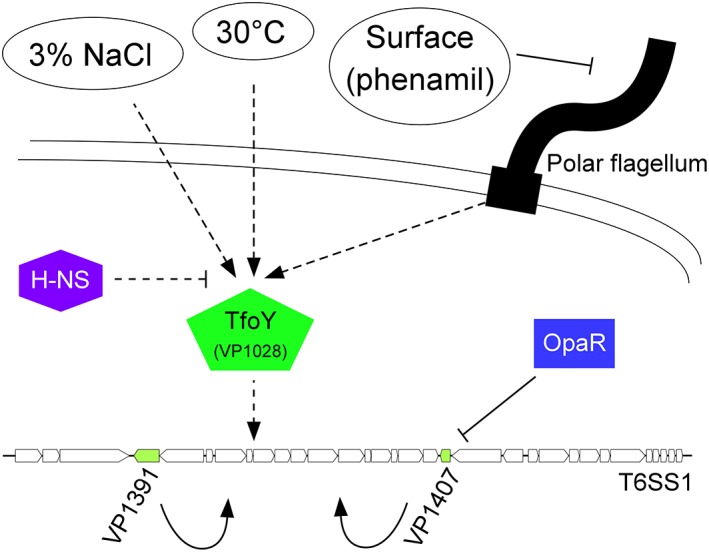
Type VI secretion systems (T6SSs) are widespread, tightly regulated, protein delivery apparatuses used by Gram-negative bacteria to outcompete their neighbours. The pathogen, Vibrio parahaemolyticus, encodes two T6SSs. These T6SSs are differentially regulated by external conditions. T6SS1, an antibacterial system predominantly found in pathogenic isolates, requires warm marine-like conditions and surface sensing for activation. The regulatory network that governs this activation is not well understood. In this work, we devised a screening methodology that allows us to easily monitor the outcome of bacterial competitions and thus to identify mutants that are defective in T6SS1-mediated bacterial killing. The methodology, termed Bacterial Competition Fluorescence (BaCoF), relies on detection of a fluorescent signal as an indicator of the survival and growth of a T6SS-sensitive, GFP-expressing prey that has been co-cultured with mutants derived from a T6SS+ attacker of interest. Using BaCoF, we screened a random transposon insertion mutant library and identified genes required for V. parahaemolyticus T6SS1 activation, among them TfoY and Tmk. We used epistasis experiments to determine the relationships between the newly identified components and other regulators that were previously described. Thus, we present here a detailed biological understanding of the T6SS1 regulatory network.
© 2019 The Authors. Environmental Microbiology published by Society for Applied Microbiology and John Wiley & Sons Ltd.
Conflict of interest statement
The authors declare that they have no conflict of interest.
Figures


Comment in
-
Should I kill or should I go: T6SS regulation networks in Vibrio.Environ Microbiol. 2020 Jan;22(1):1-4. doi: 10.1111/1462-2920.14830. Epub 2019 Oct 25. Environ Microbiol. 2020. PMID: 31621177 No abstract available.
References
Publication types
MeSH terms
Substances
Grants and funding
LinkOut - more resources
Full Text Sources
Molecular Biology Databases
Research Materials
