


Age and cognitive decline in the UK Biobank
- PMID: 30883587
- PMCID: PMC6422276
- DOI: 10.1371/journal.pone.0213948
Age and cognitive decline in the UK Biobank
Abstract
Objectives: Age-related cognitive decline is a well-known phenomenon after age 65 but little is known about earlier changes and prior studies are based on relatively small samples. We investigated the impact of age on cognitive decline in the largest population sample to date including young to old adults.
Method: Between 100,352 and 468,534 participants aged 38-73 years from UK Biobank completed at least one of seven self-administered cognitive functioning tests: prospective memory (PM), pairs matching (Pairs), fluid intelligence (FI), reaction time (RT), symbol digit substitution, trail making A and B. Up to 26,005 participants completed at least one of two follow-up assessments of PM, Pairs, FI and RT. Multivariable regression models examined the association between age (<45[reference], 45-49, 50-54, 55-59, 60-64, 65+) and cognition scores at baseline. Mixed models estimated the impact of age on cognitive decline over follow-up (~5.1 years).
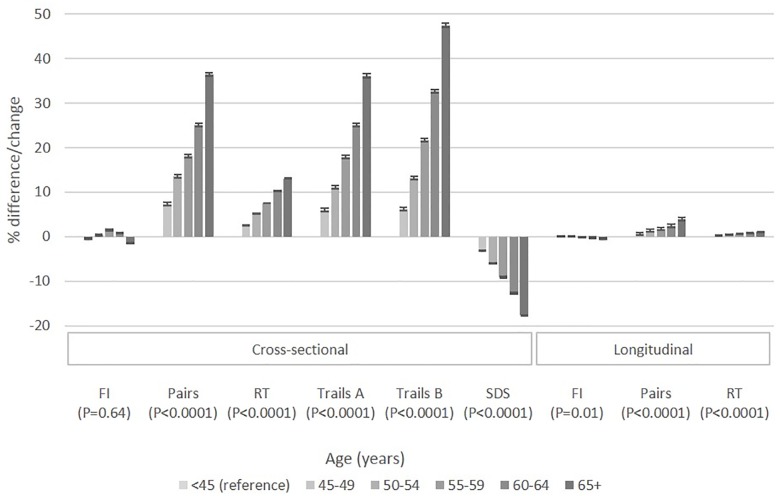
Results: FI was higher between ages 50 and 64 and lower at 65+ compared to <45 at baseline. Performance on all other baseline tests was lower with older age: with increasing age category, difference in test scores ranged from 2.5 to 7.8%(P<0.0001). Compared to <45 at baseline, RT and Pairs performance declined faster across all older age cohorts (3.0 and 1.2% change, respectively, with increasing age category, P<0.0001). Cross-sectional results yielded 8 to 12-fold higher differences in RT and Pairs with age compared to longitudinal results.
Conclusions: Our findings suggest that declines in cognitive abilities <65 are small. The cross-sectional differences in cognition scores for middle to older adult years may be due in part to age cohort effects.
Conflict of interest statement
The authors have declared that no competing interests exist.
Figures
References
-
- Sperling RA, Aisen PS, Beckett LA, Bennett DA, Craft S, Fagan AM, et al. Toward defining the preclinical stages of Alzheimer’s disease: Recommendations from the National Institute on Aging-Alzheimer’s Association workgroups on diagnostic guidelines for Alzheimer’s disease. Alzheimer’s & dementia: the journal of the Alzheimer’s Association. 2011;7(3):280–92. - PMC - PubMed
Publication types
MeSH terms
Grants and funding
LinkOut - more resources
Full Text Sources
Medical
