Review
. 2019 Mar 16;10(3):223.
doi: 10.3390/genes10030223.

Centromere Repeats: Hidden Gems of the Genome

Affiliations
Review

Centromere Repeats: Hidden Gems of the Genome

Gabrielle Hartley et al. Genes (Basel). .

Abstract

Satellite DNAs are now regarded as powerful and active contributors to genomic and chromosomal evolution. Paired with mobile transposable elements, these repetitive sequences provide a dynamic mechanism through which novel karyotypic modifications and chromosomal rearrangements may occur. In this review, we discuss the regulatory activity of satellite DNA and their neighboring transposable elements in a chromosomal context with a particular emphasis on the integral role of both in centromere function. In addition, we discuss the varied mechanisms by which centromeric repeats have endured evolutionary processes, producing a novel, species-specific centromeric landscape despite sharing a ubiquitously conserved function. Finally, we highlight the role these repetitive elements play in the establishment and functionality of de novo centromeres and chromosomal breakpoints that underpin karyotypic variation. By emphasizing these unique activities of satellite DNAs and transposable elements, we hope to disparage the conventional exemplification of repetitive DNA in the historically-associated context of 'junk'.

Keywords: CENP-A; centromere drive; centromeric transcription; chromosome evolution; genetic conflict; repetitive DNA; satellite; transposable element.


Conflict of interest statement

The authors declare no conflict of interest. The funders had no role in the design of the study; in the collection, analyses, or interpretation of data; in the writing of the manuscript, or in the decision to publish the results.

Figures
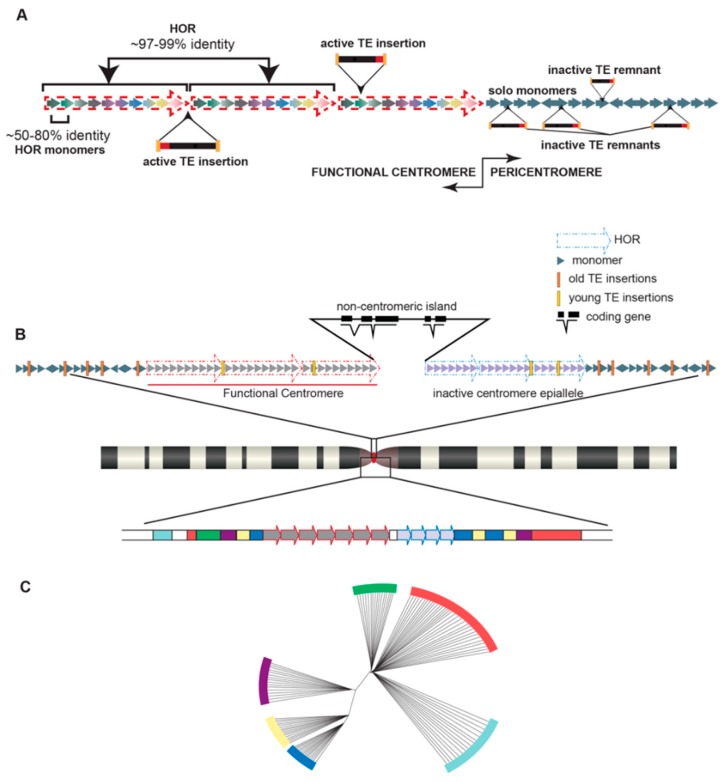
Figure 1
Figure 1
Overview of satellite DNA structure in a human centromere/pericentromere. (a) α satellite monomers (colored solid arrows) are organized into a repeating unit, called a higher order repeat (HOR) (red dashed arrows). In this example, 10 monomers are in each HOR (10-mers). HOR units are repeated in a chromosome-specific manner 100–1000 s of times within a functional centromere core. Within a single HOR, monomers share anywhere from 50–80% sequence identity with one another. The same monomer within different HORs in the same array may share up to 99% identity. Solo monomers (solid arrows) are found in the pericentromeric region and are highly variable in terms of sequence and orientation. Within the centromere, transposable elements (TE) insertions typically include recently active or active (hot) elements, while the TE insertions found in the pericentromere are older, inactive elements. (b) The core centromere structure (red dot, chromosome schematic) of human chromosomes (a generic chromosome ideogram is indicated, middle) consists of different α satellite arrays arranged in HORs (dashed arrows). Each HOR array may contain a different monomer number; in this example, the functional centromere (i.e., assembles CENP-A nucleosomes) at a 10-mer HOR (red dashed arrows). A 7-mer HOR is found nearby but is an inactive epiallele. Both HORs are separated by non-centromeric DNA, which may contain genes. α satellites are also found throughout the pericentromere (bottom schematic, different colored blocks). (c) Representative cladogram of the phylogenetic relationship of the non-HOR α monomers shown in (b). In this example, strata of newer satellites are closer to the HOR arrays, while older satellites are found more distally. Relative age of satellites is indicated by tree branch length; shorter branches are younger elements and deeper branches are older.
Figure 2
Figure 2
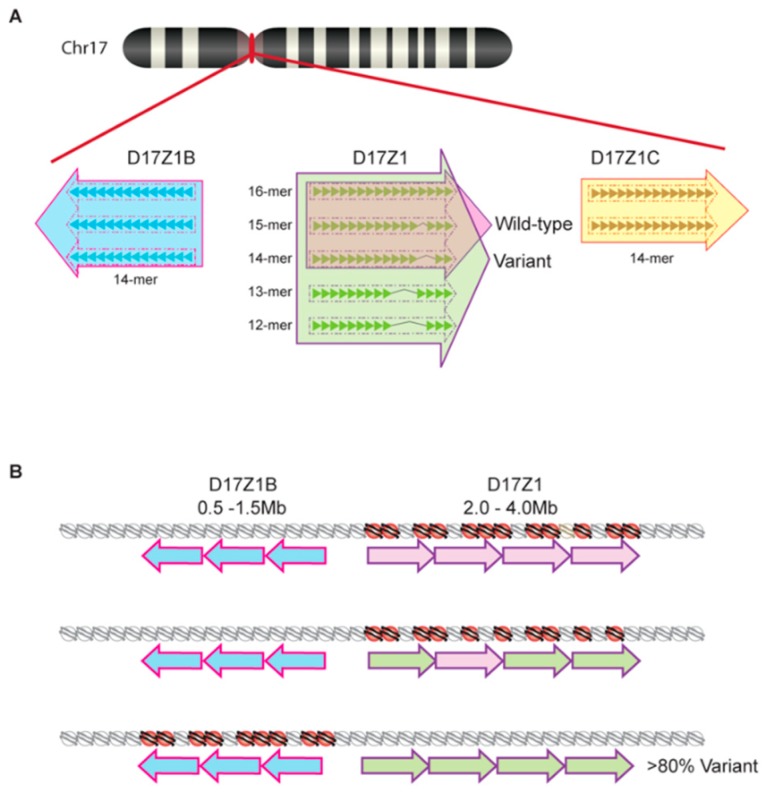
Chromosome 17 epialleles. (a) Ideogram of chromosome 17 (top). Zoom inset of epialleles showing monomer number for HORs and orientation. D17Z1B HORs carry 14 monomers, as do D17Z1C HORs. D17Z1 HORs are variable in the human population, with wild type epialleles containing 16-mer, 15-mer, and 14-mer HORs (pink) and variant epialleles containing wild type HORs in addition to 13-mer and 12-mer HORs (green). (b) Variation of the D17Z1 epiallele is linked to centromere activity. When the variation in D17Z1 increases, CENP-A nucleosomes (red) decrease; when variation exceeds 80%, the centromere assembles on the D17Z1B epiallele.
Figure 3
Figure 3
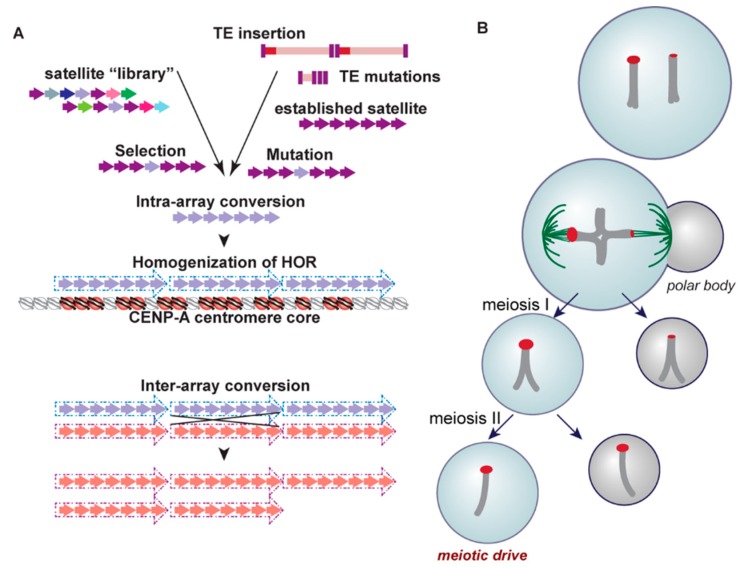
Schematic of the evolutionary mechanisms that impact centromere repeats. (a) Two models for the derivation of species-specific satellites are shown: (left) A satellite array evolves from a library of satellites, culminating in a dominant satellite; (right) TE insertion(s) followed by mutations, such as deletions, lead to the evolution of new satellites. In both cases, a homogenized array evolves through molecular drive mechanisms, such as intra-array concerted evolution. Stabilization of the arrays into HOR arrays defines the active centromere core, where CENP-A nucleosomes (red) are assembled. Other events, such as inter-array conversion, can lead to the spread of new HORs or changes in HOR copy number (bottom). (b) Two homologous chromosomes share the same satellite repeat (red), but one homolog experiences an expansion of that repeat through de novo mutations. During female meiosis, the larger centromere attracts more microtubules, resulting in the loss of the homolog with the weaker centromere into the polar body during meiosis I. The larger centromere is preferentially driven to the viable egg following unequal distribution of chromatids during meiosis II.
Figure 4
Figure 4
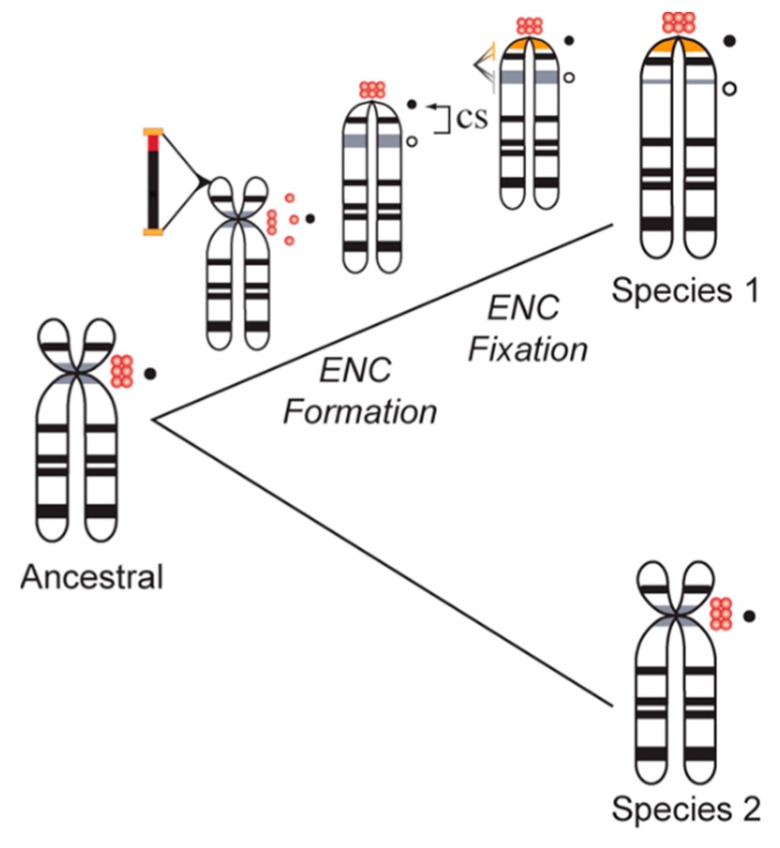
The hypothetical evolution of new centromeres. The ancestral chromosome in this example is submetacentric (the centromere is indicated with red ‘nucleosomes’). The active locus (black dot) carries satellite arrays. Some individual(s) in a population experience the destabilization of the active centromere and formation of a neocentromere, perhaps through the activation of a new TE, resulting in a centric shift (CS). The new centromere is indicated with a black dot, while the latent centromere is indicated with an open circle. The new centromere becomes fixed in a population and eventually gains new satellite arrays (orange), either by interchromosomal seeding from the old centromere (grey) or from the TE itself. Over time, the latent centromere loses its HORs while the new centromere becomes stabilized. In some cases, the ENC can lead to a new species karyotype.

References

    1. Biscotti M.A., Olmo E., Heslop-Harrison J.S. Repetitive DNA in eukaryotic genomes. Chromosome Res. 2015;23:415–420. doi: 10.1007/s10577-015-9499-z. - DOI - PubMed
    1. Charlesworth B., Sniegowski P., Stephan W. The evolutionary dynamics of repetitive DNA in eukaryotes. Nature. 1994;371:215–220. doi: 10.1038/371215a0. - DOI - PubMed
    1. Lopez-Flores I., Garrido-Ramos M.A. The repetitive DNA content of eukaryotic genomes. Genome Dyn. 2012;7:1–28. doi: 10.1159/000337118. - DOI - PubMed
    1. Bourque G., Burns K.H., Gehring M., Gorbunova V., Seluanov A., Hammell M., Imbeault M., Izsvak Z., Levin H.L., Macfarlan T.S., et al. Ten things you should know about transposable elements. Genome Biol. 2018;19:199. doi: 10.1186/s13059-018-1577-z. - DOI - PMC - PubMed
    1. Garrido-Ramos M.A. Satellite DNA: An Evolving Topic. Genes. 2017;8:230. doi: 10.3390/genes8090230. - DOI - PMC - PubMed

Publication types

LinkOut - more resources