Review
. 2019 Mar 17;20(6):1345.
doi: 10.3390/ijms20061345.

Plant Serine Protease Inhibitors: Biotechnology Application in Agriculture and Molecular Farming

Affiliations
Review

Plant Serine Protease Inhibitors: Biotechnology Application in Agriculture and Molecular Farming

Marina Clemente et al. Int J Mol Sci. .

Abstract

The serine protease inhibitors (SPIs) are widely distributed in living organisms like bacteria, fungi, plants, and humans. The main function of SPIs as protease enzymes is to regulate the proteolytic activity. In plants, most of the studies of SPIs have been focused on their physiological role. The initial studies carried out in plants showed that SPIs participate in the regulation of endogenous proteolytic processes, as the regulation of proteases in seeds. Besides, it was observed that SPIs also participate in the regulation of cell death during plant development and senescence. On the other hand, plant SPIs have an important role in plant defense against pests and phytopathogenic microorganisms. In the last 20 years, several transgenic plants over-expressing SPIs have been produced and tested in order to achieve the increase of the resistance against pathogenic insects. Finally, in molecular farming, SPIs have been employed to minimize the proteolysis of recombinant proteins expressed in plants. The present review discusses the potential biotechnological applications of plant SPIs in the agriculture field.

Keywords: molecular farming; pathogen resistance; plants; serine protease inhibitors.


Conflict of interest statement

The authors declare no conflict of interest.

Figures
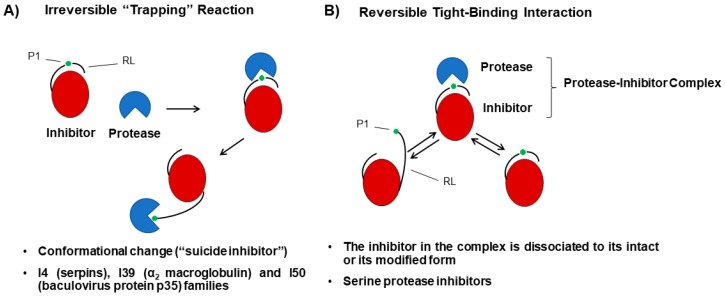
Figure 1
Figure 1
Mechanisms of protease-inhibitor interactions. (A) Irreversible “trapping” reactions. The protease–inhibitor interaction induces the cleavage of an internal peptide bond in the inhibitor triggering a conformational change. This reaction is not reversible, and the inhibitor never recovers its initial structure. For this reason, the inhibitors that participate in trapping reactions are also known as suicide inhibitors. The inhibitors never recover the initial structure. (B) Reversible tight-binding interactions. The inhibitor interacts with the protease active site in a similar way to the enzyme-substrate interaction. The protease-inhibitor complex co-exists in a stable equilibrium among the intact form of the inhibitor and the modified forms of the inhibitor where the peptide bond of the reactive site is cleaved. Therefore, the inhibitor in the complex is dissociated to its intact or its modified form. P1: PI reactive site; RL: reactive loop.
Figure 2
Figure 2
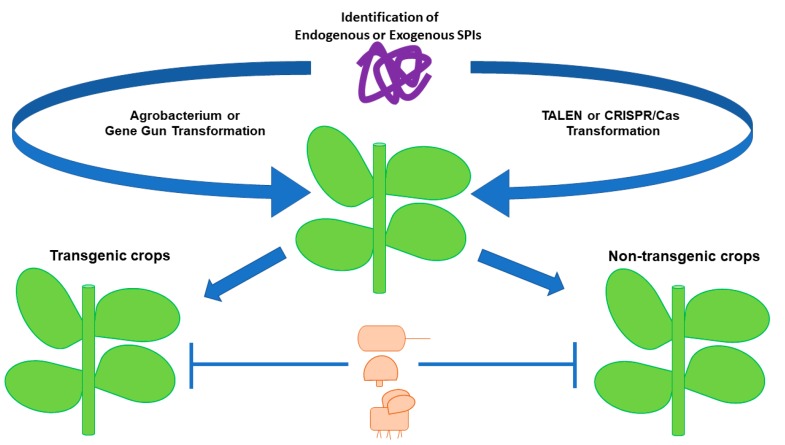
Serine proteases inhibitors identified in plants (endogenous SPIs) or in other organisms (exogenous SPIs) can be introduced by conventional transformation (Agrobacterium tumefaciens or gene gun transformation) or by novel editing technologies to increase the resistance to insect pest and phytopathogenic microorganisms. The application of these technologies can be used to produce new resistant sources of important crops.
Figure 3
Figure 3
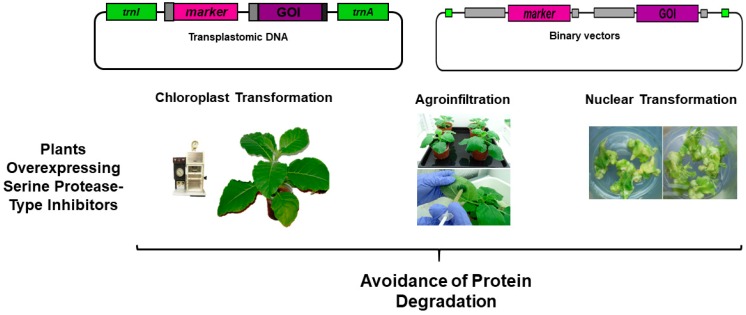
Co-expression of serine protease inhibitors could help to minimize the proteolytic activity and to avoid the recombinant protein degradation in transplastomic, transgenic plants or in plants that transiently express recombinant proteins. The protease inhibitor can be targeted in the same organelle (chloroplast transformation) where the recombinant protein would be expressed or co-expressed. Transgenic plants over-expressing protease inhibitors would be more suitable to express recombinant proteins by agroinfiltration.

References

    1. Santamaría M.E., Diaz-Mendoza M., Diaz I., Martinez M. Plant protein peptidase inhibitors: An evolutionary overview based on comparative genomics. BMC Genom. 2014;15:812. doi: 10.1186/1471-2164-15-812. - DOI - PMC - PubMed
    1. Ivanov D., Emonet C., Foata F., Affolter M., Delley M., Fisseha M., Blum-Sperisen S., Kochhar S., Arigoni F. A serpin from the gut bacterium Bifidobacterium longum inhibits eukaryotic elastase-like serine proteases. J. Biol. Chem. 2006;281:17246–17252. doi: 10.1074/jbc.M601678200. - DOI - PubMed
    1. Rawlings N.D., Tolle D.P., Barrett A.J. Evolutionary families of peptidase inhibitors. Biochem. J. 2004;378:705–716. doi: 10.1042/bj20031825. - DOI - PMC - PubMed
    1. Qi R.F., Song Z.W., Chi C.W. Structural features and molecular evolution of Bowman-Birk protease inhibitors and their potential application. Acta Biochim. Biophys. Sin. (Shanghai) 2005;37:283–292. doi: 10.1111/j.1745-7270.2005.00048.x. - DOI - PubMed
    1. Bitoun E., Chavanas S., Irvine A.D., Lonie L., Bodemer C., Paradisi M., Hamel-Teillac D., Ansai S., Mitsuhashi Y., Taïeb A., et al. Netherton syndrome: Disease expression and spectrum of SPINK5 mutations in 21 families. J. Investig. Dermatol. 2002;118:352–361. doi: 10.1046/j.1523-1747.2002.01603.x. - DOI - PubMed

MeSH terms

LinkOut - more resources