


Health expectancies among non-white and white populations living in Havana, 2000-2004
- PMID: 30886557
- PMCID: PMC6397105
- DOI: 10.1007/s10433-018-0472-5
Health expectancies among non-white and white populations living in Havana, 2000-2004
Abstract
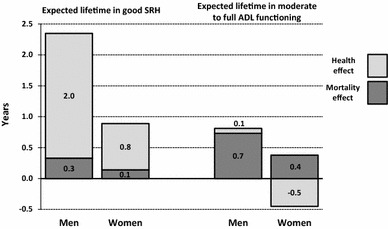
This study explored the role of skin color in health expectancies by computing average lifetime in self-rated good health and lifetime without functional limitations in activities of daily living (ADL) among non-white and white 60+ adults living in Havana (Cuba) in 2000-2004. The Sullivan method was used to estimate health expectancies. The contributions from the mortality and health effect to the differences in health expectancies were assessed by decomposition. White males aged 60 were expected to live longer in self-rated good health than non-white males, white and non-white females. Most of the differences among males are attributed to the health effect. No differences were found between white and non-white females in expected lifetime in moderate to full ADL functioning while a difference in ADL functioning of 0.8 years favored white over non-white males. The mortality effect accounted for most difference across the two male groups. From age 80, both non-white groups could expect to live longer than their white counterparts. The results showed that skin color is a risk marker of mortality and morbidity among older adults living in Havana. Although health behaviors vary, the differences were not anticipated due to high social equity and equal health care provision in Cuba. This finding calls for further research on health expectancies by skin color that is representative of the Cuban population and includes information on different diseases and conditions.
Keywords: Disability; Health expectancies; Self-rated health; Skin color.
Figures
References
-
- Albizu-Campos JC (2008) The mortality and skin color paradigm in Cuba. Rev Nov Pob, 7
-
- Albizu-Campos JC, Cabrera F (2014) Mortality in Cuba according to the color of the skin. Rev Nov Pob, 10
-
- Alfonso AC (2011) Health risk factors of the Cuban population. Dissertation, University of Havana
-
- Alfonso León A (2009) Dossier of population and development studies: Skin color. ONE-CEPDE. http://www.one.cu/publicaciones/cepde/cuaderno2/pob_cua_13.pdf. Accessed 17 Aug 2017
LinkOut - more resources
Full Text Sources
