Review
. 2019 Sep;13(3):476-484.
doi: 10.1007/s12105-019-01010-8. Epub 2019 Mar 18.

Challenges in Minor Salivary Gland Biopsies: A Practical Approach to Problematic Histologic Patterns

Affiliations
Review

Challenges in Minor Salivary Gland Biopsies: A Practical Approach to Problematic Histologic Patterns

Lisa M Rooper. Head Neck Pathol. 2019 Sep.

Abstract

Evaluation of minor salivary gland biopsy can be fraught with a wide range of problems, including technical limitations due to the small size and distorted nature of tissue received and interpretive difficulties navigating the considerable morphologic and immunohistochemical overlap between widely disparate entities. As such, common pathologic findings can evoke a perplexing differential diagnosis that encompasses malignant, benign, and non-neoplastic processes. This review will present the diagnostic considerations that arise from four histologic patterns that are frequently encountered on minor salivary gland biopsies: squamous differentiation, tubular and cribriform growth, mucin production, and myxoid stroma. The discussion herein will emphasize practical strategies and priorities for navigating these differential diagnoses in a clinically-relevant and cost-effective manner.

Keywords: Adenoid cystic carcinoma; Clear cell carcinoma; Minor salivary glands; Mucoepidermoid carcinoma; Pleomorphic adenoma; Polymorphous adenocarcinoma.


Conflict of interest statement

The author has no conflicts of interest to declare. This work is exempt from IRB review.

Figures
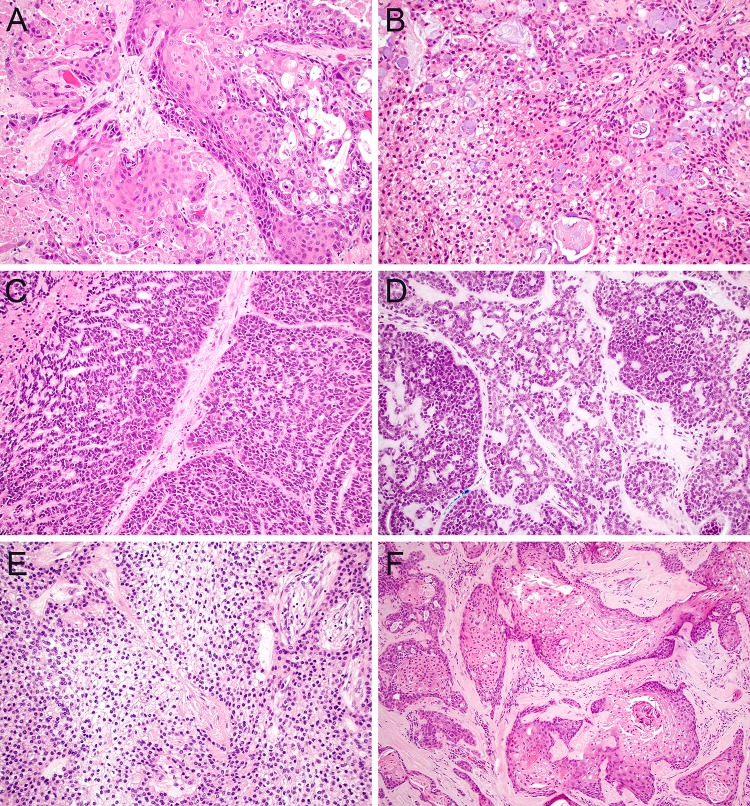
Fig. 1
Fig. 1
Squamous differentiation. Adenosquamous carcinoma demonstrates overt squamous differentiation with glandular features that are generally restricted to the deeper aspect of the tumor (a, × 20), while MEC lacks true keratinization with an intimate admixture of epidermoid and goblet cells throughout the tumor (b, × 20). Basaloid SCC can show adenoidal growth with myxoid to hyaline matrix deposition but also has marked nuclear pleomorphism, focal keratinization, and comedo-pattern necrosis (c, × 20) whereas ACC usually shows at least focal cribriform architecture and greater cytological monotony (d, × 20). CCC also demonstrates a squamoid appearance but consistently has low-grade cytology and lacks overt keratinization (e, × 20). Prominent squamous metaplasia can frequently be seen in PA, but residual ductal and myoepithelial elements are generally evident (f, × 10)
Fig. 2
Fig. 2
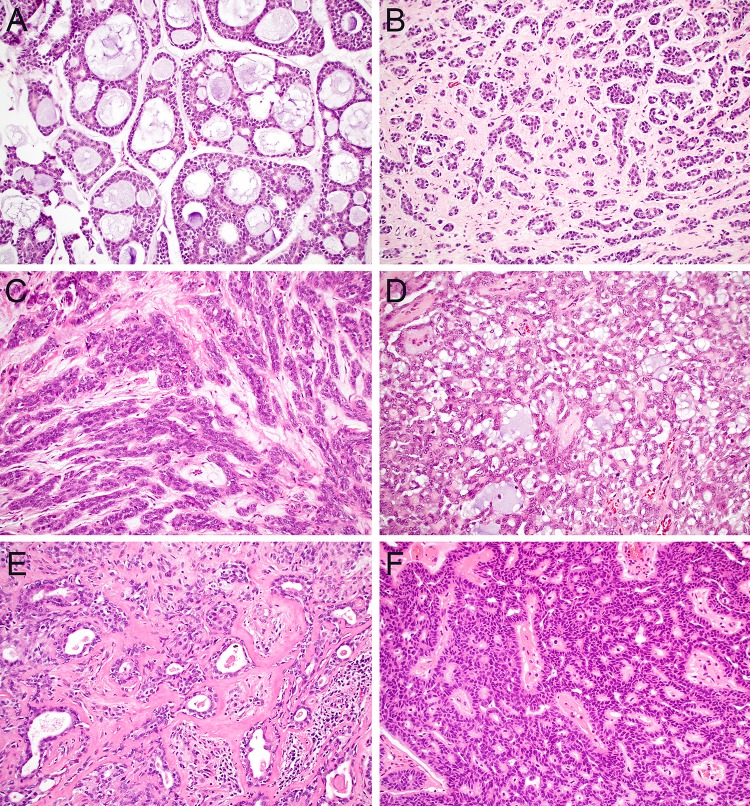
Cribriform and tubular growth. ACC contains cells with hyperchromatic angulated nuclei that generally form at least focal well-formed cribriform spaces (a, × 20); tubular growth in ACC tends to be biphasic with distinct ductal and myoepithelial elements (b, × 20). Classic PAC is comprised of monophasic strands and tubules that show a streaming appearance (c, × 20) while CAMSG has mostly poorly-formed cribriform spaces with additional glomeruloid and tubular patterns (d, × 20). PA demonstrates a broad range of architectural patterns and stromal appearances with both ductal and myoepithelial components (e, × 20). CA consists of anastomosing cords of basaloid cells with a beaded appearance (f, × 20)
Fig. 3
Fig. 3
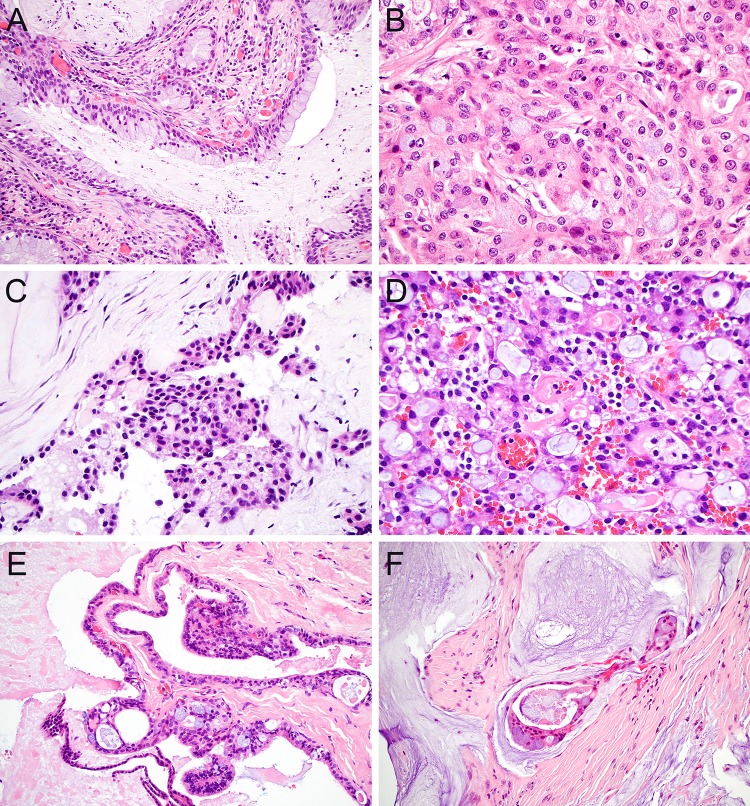
Mucin production. Low-grade MEC classically contains prominent goblet cells and cyst formation with abundant luminal mucin (a; × 20); goblet cells can be much more sparse in the oncocytic variant of MEC (b, × 40). CCC frequently demonstrate at least focal mucin production (c, × 40). SC has characteristic luminal secretions that can be both eosinophilic and mucinous (d, × 40). Although salivary duct cysts can demonstrate mucinous metaplasia, the presence of papillary and cribriform elements confirms the diagnosis of MEC (e, × 20). While mucoceles can demonstrate prominent extravasated mucin, floating epithelium with complex architecture favors MEC (d, × 20)
Fig. 4
Fig. 4
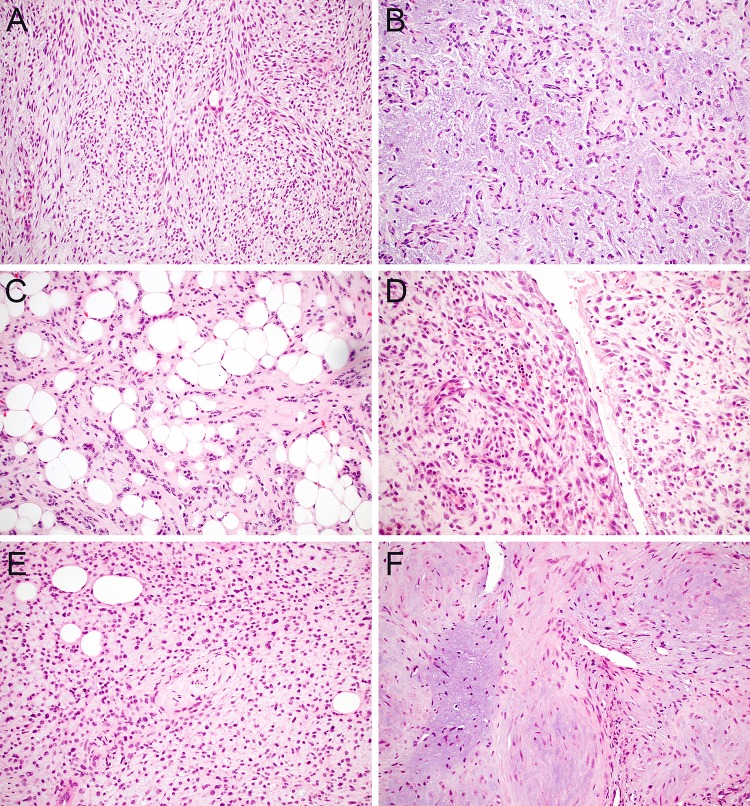
Myxoid stroma. A defining feature of PA is myxoid to chondromyxoid stroma embedded with myoepithelial cells that demonstrate a spindled to stellate morphology (a, × 20); myoepitheliomas also can have myxoid stroma and often show plasmacytoid myoepithelial morphology (b, × 20). PA frequently lacks myxoid stroma in minor salivary glands, and the presence of fatty stromal metaplasia should not be mistaken for invasive growth (c, × 20). Extravasational mucoceles can mimic a myxoid neoplasm due to extensive stromal mucin deposition, prominent muciphages, and synovial metaplasia (d, × 20). ECMT contains a net-like array of ovoid, stellate, and spindled cells in a myxoid stroma (e, × 20). Myofibromas have myxoid stroma with hypocellular myoid nodules and more hypercellular peripheral aggregates of spindled to epithelioid cells (f, × 20)

References

    1. Griffith CC, Schmitt AC, Little JL, Magliocca KR. New developments in salivary gland pathology: clinically useful ancillary testing and new potentially targetable molecular alterations. Arch Pathol Lab Med. 2017;141(3):381–395. - PubMed
    1. Jo VY, Krane JF. Ancillary testing in salivary gland cytology: a practical guide. Cancer Cytopathol. 2018;126(Suppl 8):627–642. - PubMed
    1. Seethala RR. Salivary gland tumors: current concepts and controversies. Surg Pathol Clin. 2017;10(1):155–176. - PubMed
    1. Skalova A, Stenman G, Simpson RHW, Hellquist H, Slouka D, Svoboda T, et al. The role of molecular testing in the differential diagnosis of salivary gland carcinomas. Am J Surg Pathol. 2018;42(2):e11–e27. - PubMed
    1. Pires FR, Pringle GA, de Almeida OP, Chen SY. Intra-oral minor salivary gland tumors: a clinicopathological study of 546 cases. Oral Oncol. 2007;43(5):463–470. - PubMed