


doi: 10.1039/c9cc00682f.
New insights into the metal-induced oxidative degradation pathways of transthyretin
Affiliations
- PMID: 30887985
- PMCID: PMC6452628
- DOI: 10.1039/c9cc00682f
Item in Clipboard
New insights into the metal-induced oxidative degradation pathways of transthyretin
Chem Commun (Camb).
.
Abstract
The amyloidogenic mechanism of transthyretin is still debated but understanding it fully could lend insight into disease progression and potential therapeutics. Transthyretin was investigated revealing a metal-induced (Cr/Cu) oxidation pathway leading to N-terminal backbone fragmentation and oligomer formation; previously hidden details were revealed only by FT-IM-Orbitrap MS and surface-induced dissociation.
Conflict of interest statement
Conflicts of interest
There are no conflicts to declare.
Figures
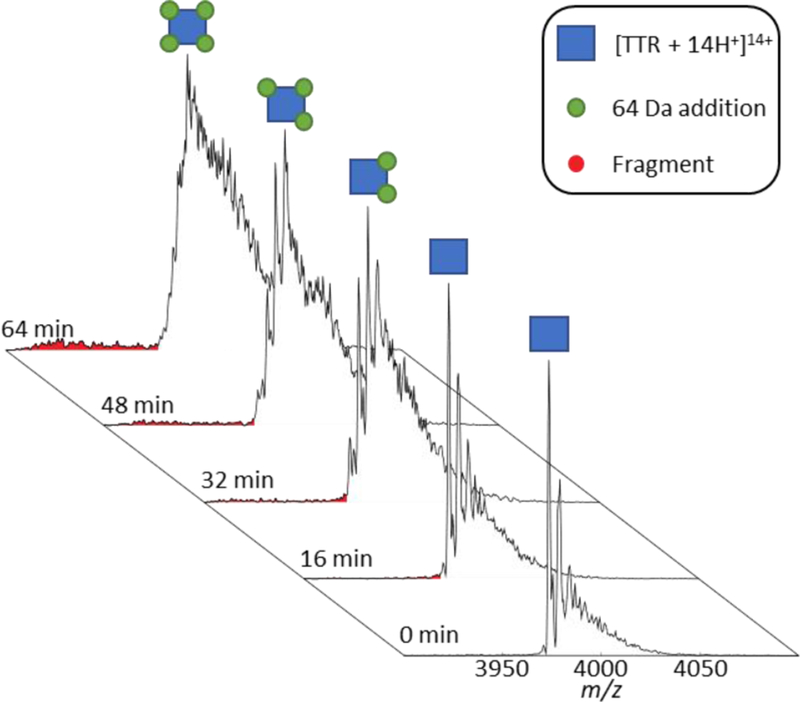
Time evolution of TTR under ambient nano-ESI conditions showing the sequential addition of 64 Da corresponding to either one zinc or four oxidations. At t = 0 min, the peaks to the right of the apo peak correspond to Zn(II) binding; however, at later times, the mass shifts are attributed to Cys-10 oxidation. The red peaks correspond to the backbone fragmentation of TTR between Cys-10 and Pro-11 which occurs simultaneously with TTR oxidation.

(A) ATDs for the [TTR + 14H+ + n*64 Da]14+ ions (where n = 0–4) directly after loading (black) and after 20 hours of continuous analysis by a theta emitter (red). ATDs are the average of 8 IM-MS runs. (B) Deconvoluted ATDs of the incubated sample showing two additional conformations populated by TTR after 20 hours.
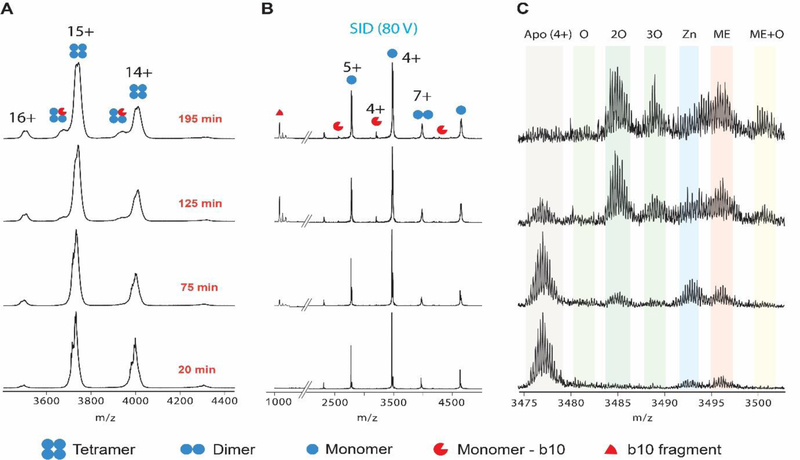
(A) Mass spectra of TTR tetramer as a function of time collected on a Waters Synapt G2 equipped with a custom SID cell. (B) The SID products of the [TTR + 15H+]15+ tetramer. Monomers, dimers, and b10/y117 fragments are observed. The b10 fragment is doubly oxidized. (C) A magnified look at the [M + 4H+]4+ monomer of TTR reveals a time dependent oxidation of TTR monomer as well as Zn(II) and 2-mercaptoethanol (ME) binding. [TTR + 15H+]15+ retains the native conformation (Figure S1) and is used for SID to retain higher ion abundances.
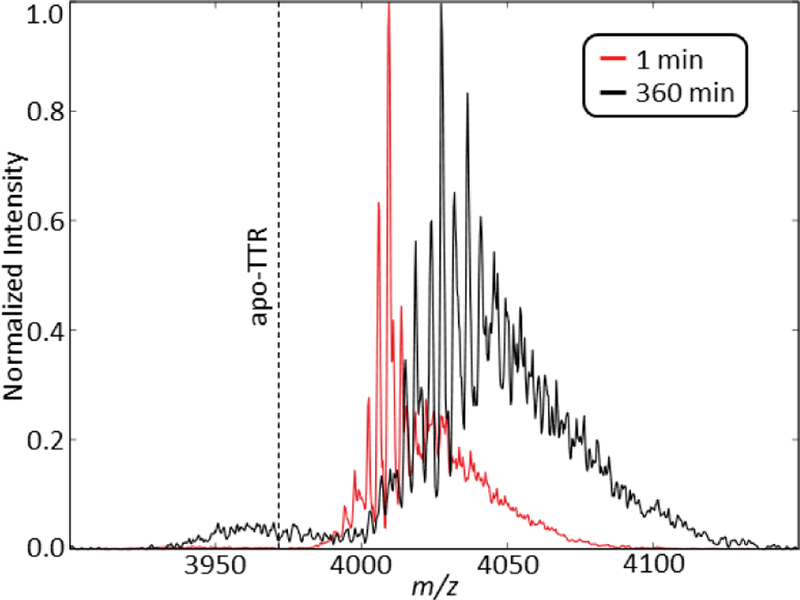
The mass spectra of [TTR + 14 H+ + 4 NEM]14+ at 0 and 360 minutes. Equivalent backbone fragmentation occurs at 360 minutes compared to 64 minutes for TTR with Zn(II) and no NEM (Figure 1). The dotted line represents the m/z for apo-TTR.
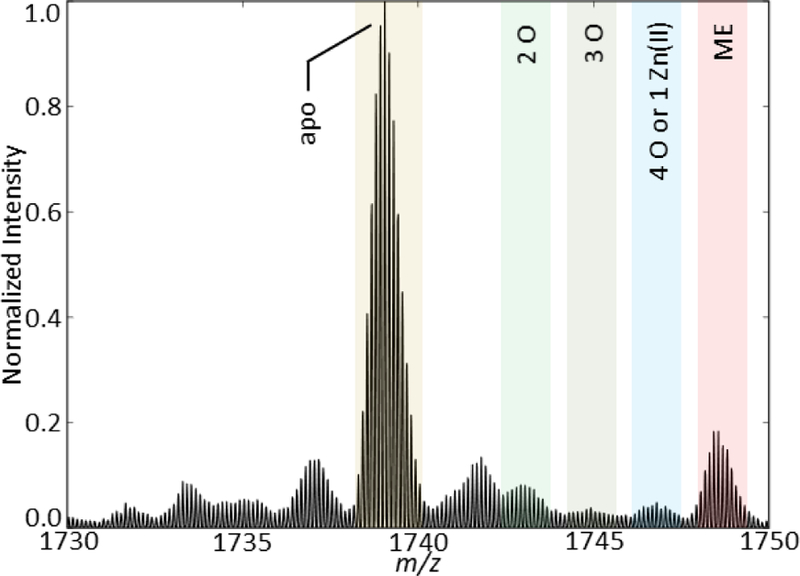
[TTR + 8H+]8+ monomer fragment obtained directly after the addition of equimolar Cr. This addition of Cr in solution immediately induces oxidation without the need for an applied potential.
References
-
- Palha Joana A., Clinical Chemistry and Laboratory Medicine, 2002, 40, 1292. - PubMed
-
- Monaco HL, Biochimica et Biophysica Acta (BBA) - Protein Structure and Molecular Enzymology, 2000, 1482, 65–72. - PubMed
-
- Lai Z, Colón W and Kelly JW, Biochemistry, 1996, 35, 6470–6482. - PubMed
-
- Yoshiki S, Jeffery WK and Shu-ichi I, Current Pharmaceutical Design, 2008, 14, 3219–3230. - PubMed
Grants and funding
LinkOut - more resources
Full Text Sources
Research Materials
