


Meta-Analysis of Heterogeneity in the Effects of Wildfire Smoke Exposure on Respiratory Health in North America
- PMID: 30889810
- PMCID: PMC6466235
- DOI: 10.3390/ijerph16060960
Meta-Analysis of Heterogeneity in the Effects of Wildfire Smoke Exposure on Respiratory Health in North America
Abstract
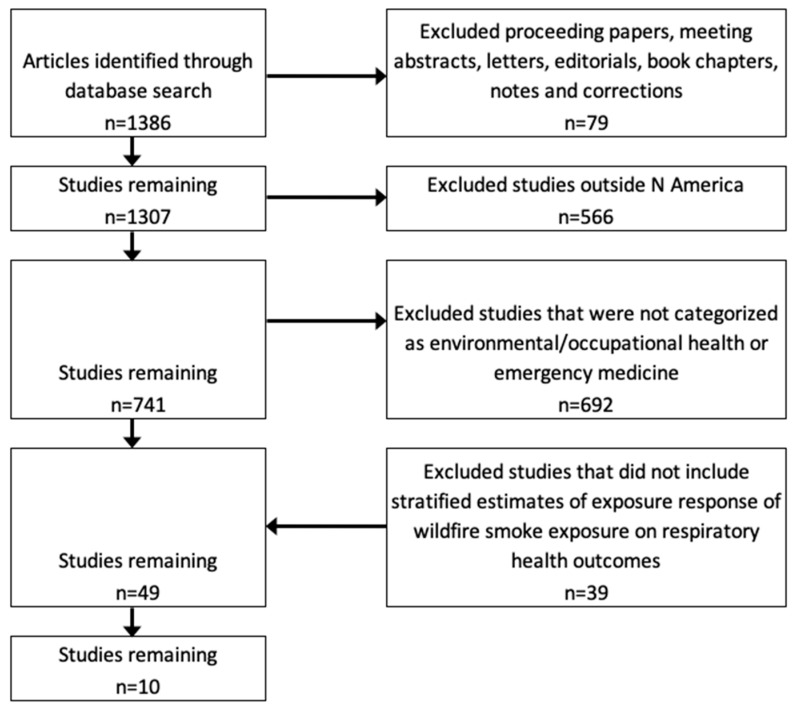
Epidemiological studies consistently show an association between wildfire-related smoke exposure and adverse respiratory health. We conducted a systematic review of evidence in published literature pertaining to heterogeneity of respiratory effects from this exposure in North America. We calculated the within-study ratio of relative risks (RRR) and 95% confidence intervals (CI) to examine heterogeneity of effect by population subgroup, and then summarized the RRRs using meta-analysis. We found evidence of a greater effect of wildfire smoke on respiratory health among females relative to males for asthma (RRR: 1.035, 95% CI: 1.013, 1.057) and chronic obstructive pulmonary disease (RRR: 1.018, 95% CI: 1.003, 1.032). There was evidence of a lower relative risk for all respiratory outcomes among youth compared to adults (RRR: 0.976, 95% CI: 0.963, 0.989). We also found wildfire smoke effects stratified by income, race, education, health behaviors, access to care, housing occupancy, geographic region, and urban/rural status. However, data were insufficient to quantitatively evaluate effect modification by these characteristics. While we found evidence that certain demographic subgroups of the population are more susceptible to respiratory health outcomes from wildfire smoke, it is unclear whether this information can be used to inform policy aimed to reduce health impact of wildfires.
Keywords: heterogeneity of effects; ratio of relative risk; respiratory health; wildfire smoke.
Conflict of interest statement
The authors declare no conflict of interest.
Figures
References
-
- Dennison P.E., Brewer S.C., Arnold J.D., Moritz M.A. Large wildfire trends in the western United States, 1984–2011. Geophys. Res. Lett. 2014;41:2928–2933. doi: 10.1002/2014GL059576. - DOI
-
- Radeloff V.C., Helmers D.P., Kramer H.A., Mockrin M.H., Alexandre P.M., Bar-Massada A., Butsic V., Hawbaker T.J., Martinuzzi S., Syphard A.D. Rapid growth of the US wildland-urban interface raises wildfire risk. Proc. Natl. Acad. Sci. USA. 2018;115:3314–3319. doi: 10.1073/pnas.1718850115. - DOI - PMC - PubMed
-
- Spracklen D.V., Mickley L.J., Logan J.A., Hudman R.C., Yevich R., Flannigan M.D., Westerling A.L. Impacts of climate change from 2000 to 2050 on wildfire activity and carbonaceous aerosol concentrations in the western United States. J. Geophys. Res. Atmos. 2009;114:D20. doi: 10.1029/2008JD010966. - DOI
Publication types
MeSH terms
Substances
LinkOut - more resources
Full Text Sources
Medical
