


Northern bottlenose whales in a pristine environment respond strongly to close and distant navy sonar signals
- PMID: 30890101
- PMCID: PMC6452067
- DOI: 10.1098/rspb.2018.2592
Northern bottlenose whales in a pristine environment respond strongly to close and distant navy sonar signals
Abstract
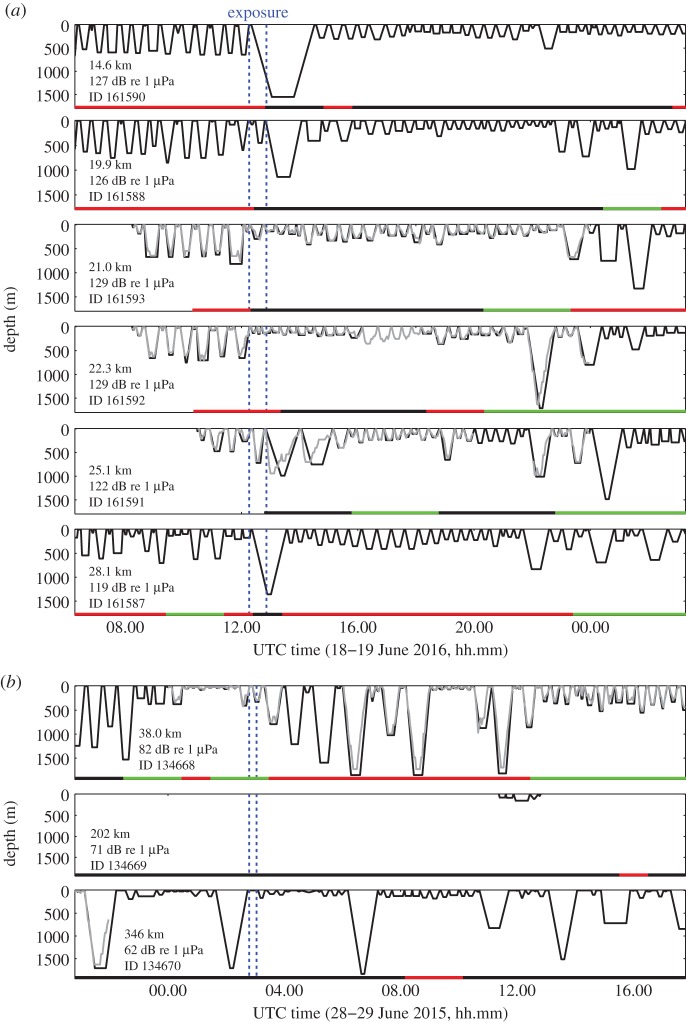
Impact assessments for sonar operations typically use received sound levels to predict behavioural disturbance in marine mammals. However, there are indications that cetaceans may learn to associate exposures from distant sound sources with lower perceived risk. To investigate the roles of source distance and received level in an area without frequent sonar activity, we conducted multi-scale controlled exposure experiments ( n = 3) with 12 northern bottlenose whales near Jan Mayen, Norway. Animals were tagged with high-resolution archival tags ( n = 1 per experiment) or medium-resolution satellite tags ( n = 9 in total) and subsequently exposed to sonar. We also deployed bottom-moored recorders to acoustically monitor for whales in the exposed area. Tagged whales initiated avoidance of the sound source over a wide range of distances (0.8-28 km), with responses characteristic of beaked whales. Both onset and intensity of response were better predicted by received sound pressure level (SPL) than by source distance. Avoidance threshold SPLs estimated for each whale ranged from 117-126 dB re 1 µPa, comparable to those of other tagged beaked whales. In this pristine underwater acoustic environment, we found no indication that the source distances tested in our experiments modulated the behavioural effects of sonar, as has been suggested for locations where whales are frequently exposed to sonar.
Keywords: Hyperoodon ampullatus; cetacean; disturbance; marine mammal; military sonar.
Conflict of interest statement
We declare we have no competing interests.
Figures



References
-
- Heide-Jørgensen MP, Hansen RG, Westdal K, Reeves RR, Mosbech A. 2013. Narwhals and seismic exploration: is seismic noise increasing the risk of ice entrapments? Biol. Conserv. 158, 50–54. ( 10.1016/j.biocon.2012.08.005) - DOI
-
- Miller PJO, et al. 2012. The severity of behavioral changes observed during experimental exposures of killer (Orcinus orca), long-finned pilot (Globicephala melas), and sperm (Physeter macrocephalus) whales to naval sonar. Aquat. Mamm. 38, 362–401. ( 10.1578/AM.38.4.2012.362) - DOI
-
- Ocean Studies Board. 2017. Approaches to understanding the cumulative effects of stressors on marine mammals. Washington, DC: National Academies Press; ( 10.17226/23479) - DOI
Publication types
MeSH terms
Associated data
LinkOut - more resources
Full Text Sources
Other Literature Sources
Medical
Miscellaneous
