


Implementation fidelity of a strategy to integrate service delivery: learnings from a transitional care program for individuals with complex needs in Singapore
- PMID: 30890134
- PMCID: PMC6425607
- DOI: 10.1186/s12913-019-3980-x
Implementation fidelity of a strategy to integrate service delivery: learnings from a transitional care program for individuals with complex needs in Singapore
Abstract
Background: To cope with rising demand for healthcare services in Singapore, Regional Health Systems (RHS) comprising of health and social care providers across care settings were set up to integrate service delivery. Tasked with providing care for the western region, in 2012, the National University Health System (NUHS) - RHS developed a transitional care program for elderly patients with complex healthcare needs who consumed high levels of hospital resources. Through needs assessment, development of personalized care plans and care coordination, the program aimed to: (i) improve quality of care, (ii) reduce hospital utilization, and (iii) reduce healthcare-related costs. In this study, recognizing the need for process evaluation in conjunction with outcome evaluation, we aim to evaluate the implementation fidelity of the NUHS-RHS transitional care program to explain the outcomes of the program and to inform further development of (similar) programs.
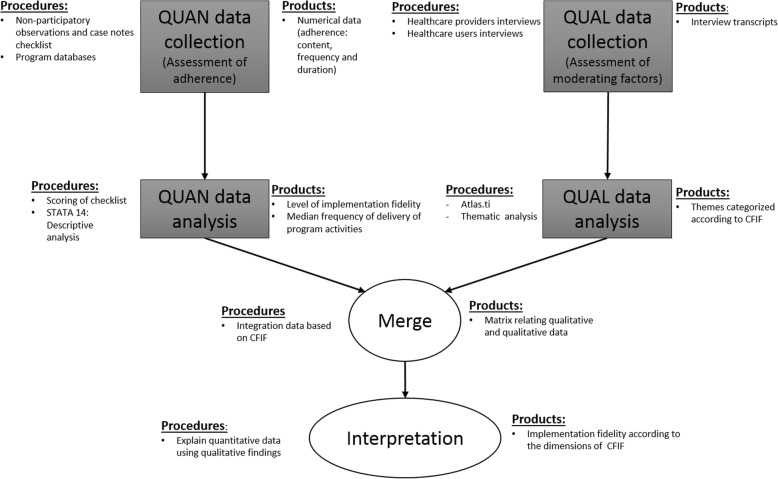
Methods: Guided by the modified version of the Conceptual Framework for Implementation Fidelity (CFIF), adherence and moderating factors influencing implementation were assessed using non-participatory observations, reviews of medical records and program databases.
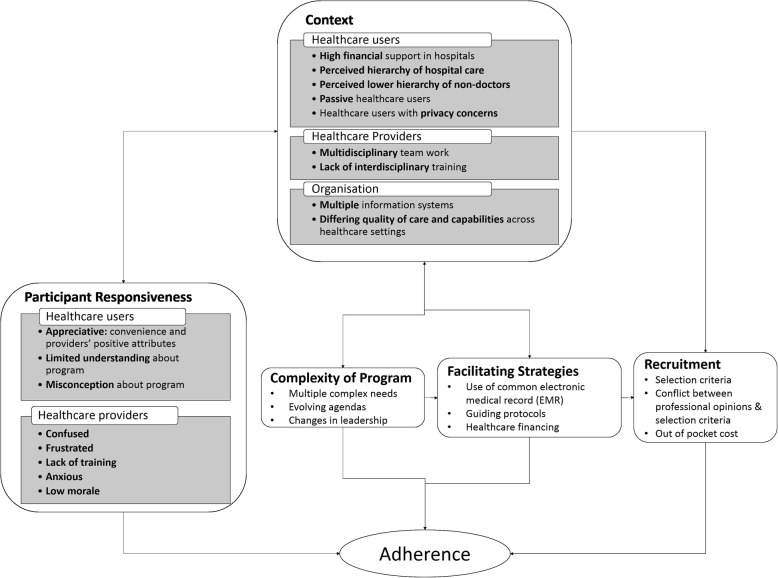
Results: Most (10 out of 14) components of the program were found to be implemented with low or moderate level of fidelity. The frequency or duration of the program components were observed to vary based on the needs of users, availability of care coordinators (CC) and their confidence. Variation in fidelity was influenced predominantly by: (1) complexity of the program, (2) extent of facilitation through guiding protocols, (3) facilitation of program implementation through CCs' level of training and confidence, (4) evolving healthcare participant responsiveness, and (5) the context of suboptimal capability among community providers.
Conclusion: This is the first study to assess the context-specific implementation process of a transitional care program in the context of Southeast Asia. It provides important insights to facilitate further development and scaling up of transitional care programs within the NUHS-RHS and beyond. Our findings highlight the need for greater focus on engaging both healthcare providers and users, training CCs to equip them with the relevant skills required for their jobs, and building the capability of the community providers to implement such programs.
Keywords: Implementation fidelity; Integrated care; Mixed methods; Post-discharge care; Transitional care.
Conflict of interest statement
Ethical approval and consent to participate
The National Healthcare Group, Singapore, Domain Specific Review Board (DSRB) reviewed and approved this study protocol (DSRB Ref: 2016/00410). Written informed consent were obtained from participants included in interviews and non-participatory observations. Waiver of consent was granted by DSRB for retrospective reviews of medical records. To maintain confidentiality of the research participants, analysis was conducted only on de-identified data.
Consent for publication
Not applicable.
Competing interests
PS, IYHA, FS, and SAT are a part of the NUHS-RHS planning office which is involved in the planning and development of programs under the purview of the NUHS-RHS.
Publisher’s Note
Springer Nature remains neutral with regard to jurisdictional claims in published maps and institutional affiliations.
Figures

References
-
- Population and Vital Statistics. https://www.moh.gov.sg/resources-statistics/singapore-health-facts/popul....
-
- Tan W. Singapore healthcare: challenges today and building a better tomorrow. Singapore Med Assoc News. 2009;2009:34–43.
Publication types
MeSH terms
Grants and funding
LinkOut - more resources
Full Text Sources
Medical
