


Breast cancer risk prediction in women aged 35-50 years: impact of including sex hormone concentrations in the Gail model
- PMID: 30890167
- PMCID: PMC6425605
- DOI: 10.1186/s13058-019-1126-z
Breast cancer risk prediction in women aged 35-50 years: impact of including sex hormone concentrations in the Gail model
Abstract
Background: Models that accurately predict risk of breast cancer are needed to help younger women make decisions about when to begin screening. Premenopausal concentrations of circulating anti-Müllerian hormone (AMH), a biomarker of ovarian reserve, and testosterone have been positively associated with breast cancer risk in prospective studies. We assessed whether adding AMH and/or testosterone to the Gail model improves its prediction performance for women aged 35-50.
Methods: In a nested case-control study including ten prospective cohorts (1762 invasive cases/1890 matched controls) with pre-diagnostic serum/plasma samples, we estimated relative risks (RR) for the biomarkers and Gail risk factors using conditional logistic regression and random-effects meta-analysis. Absolute risk models were developed using these RR estimates, attributable risk fractions calculated using the distributions of the risk factors in the cases from the consortium, and population-based incidence and mortality rates. The area under the receiver operating characteristic curve (AUC) was used to compare the discriminatory accuracy of the models with and without biomarkers.
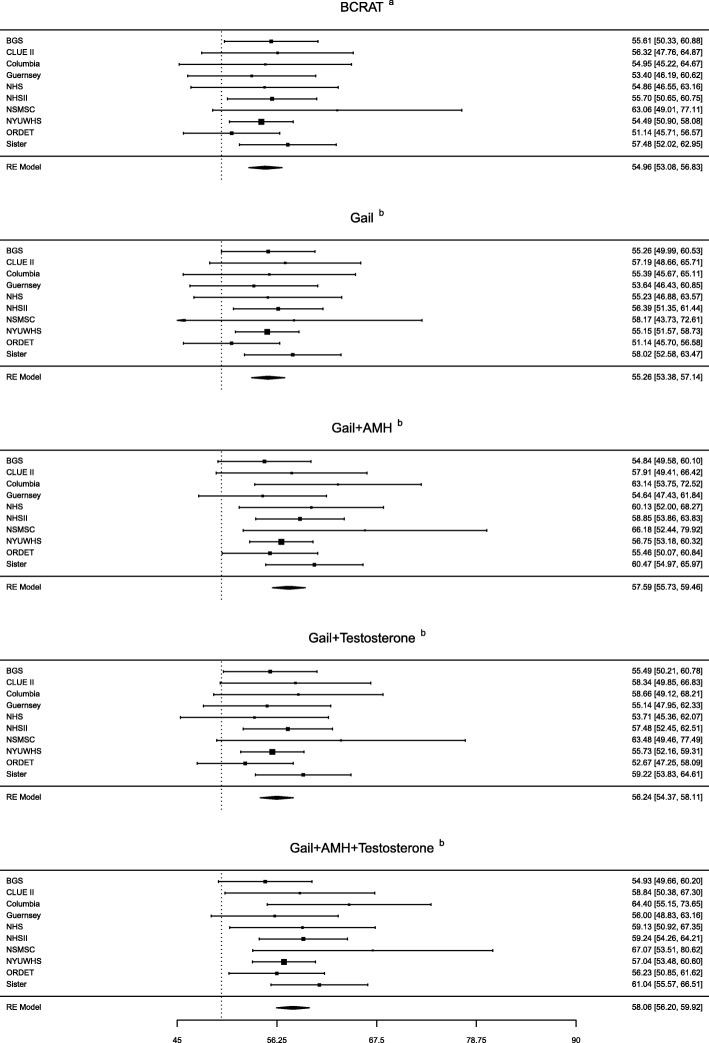
Results: The AUC for invasive breast cancer including only the Gail risk factor variables was 55.3 (95% CI 53.4, 57.1). The AUC increased moderately with the addition of AMH (AUC 57.6, 95% CI 55.7, 59.5), testosterone (AUC 56.2, 95% CI 54.4, 58.1), or both (AUC 58.1, 95% CI 56.2, 59.9). The largest AUC improvement (4.0) was among women without a family history of breast cancer.
Conclusions: AMH and testosterone moderately increase the discriminatory accuracy of the Gail model among women aged 35-50. We observed the largest AUC increase for women without a family history of breast cancer, the group that would benefit most from improved risk prediction because early screening is already recommended for women with a family history.
Keywords: Anti-Müllerian hormone; Breast cancer risk prediction; Gail model; Testosterone.
Conflict of interest statement
Ethics approval and consent to participate
Each cohort was approved by its institutional ethical review board.
Consent for publication
Not applicable.
Competing interests
The authors declare that they have no competing interests.
Publisher’s Note
Springer Nature remains neutral with regard to jurisdictional claims in published maps and institutional affiliations.
Figures
References
-
- U.S. Preventive Services Task Force Screening for breast cancer: U.S. Preventive Services Task Force recommendation statement. Ann Intern Med. 2009;151(10):716–726. - PubMed
-
- Smith R, Cokkinides V, Brooks D, Saslow D, Brawley O. Cancer screening in the United States, 2010: a review of current American Cancer Society guidelines and issues in cancer screening. Ca. 2010;60(2):99–119. - PubMed
-
- Hauk L. Practice guidelines: American College of Obstetricians and Gynecologists updates Breast Cancer screening guidelines. Am Fam Physician. 2012;85:654–655.
-
- American College of Obstetricians and gynecologists Practice bulletin no. 122: breast cancer screening. Obstet Gynecol. 2011;118:372–382. - PubMed
Publication types
MeSH terms
Substances
Grants and funding
LinkOut - more resources
Full Text Sources
Medical
