Subclinical Cognitive Impairment and Listing for Kidney Transplantation
- PMID: 30890576
- PMCID: PMC6450345
- DOI: 10.2215/CJN.11010918
Subclinical Cognitive Impairment and Listing for Kidney Transplantation
Abstract
Background and objectives: Cognitive impairment is common in patients with kidney disease and can affect physicians' perception and/or patients' ability to complete the pretransplant evaluation. We examined whether cognitive impairment influences the likelihood for transplant listing and whether patients with cognitive impairment take longer to be listed.
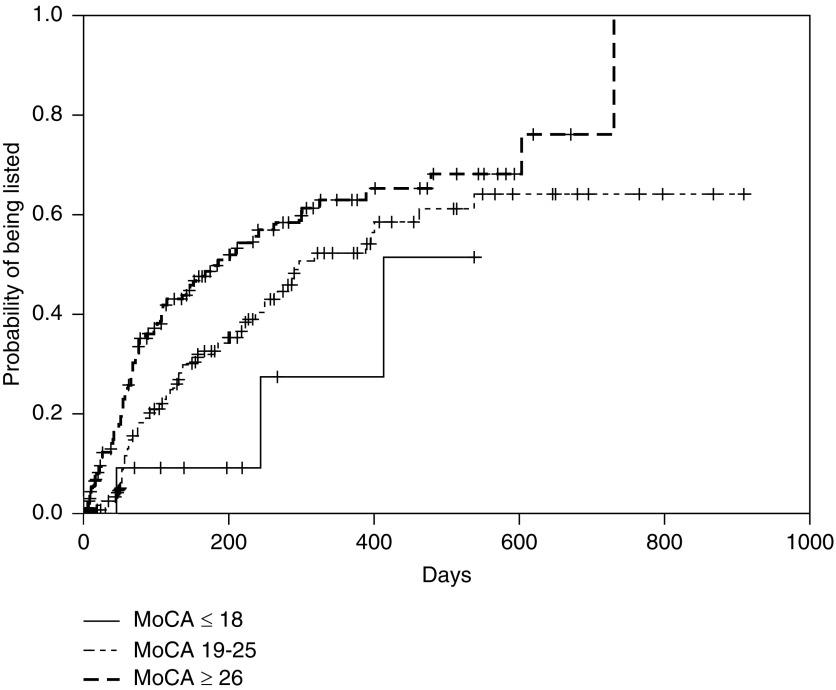
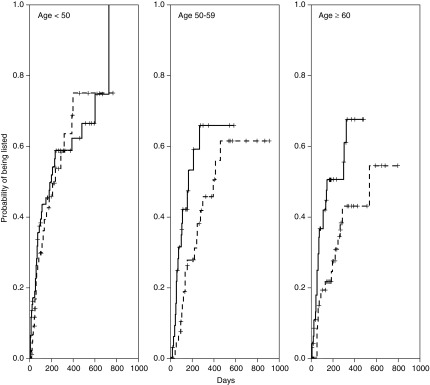
Design, setting, participants, & measurements: We conducted a single-center longitudinal cohort study. Patients presenting for their index kidney transplant evaluation were screened for cognitive impairment using the Montreal Cognitive Assessment. A score <26 indicated cognitive impairment. The transplant selection committee was blinded to the scores. Kaplan-Meier analysis assessed time to active listing by level of cognition. A Cox proportional hazards model that included age, sex, race/ethnicity, smoking, coronary artery disease, and diabetes was constructed to evaluate the association between Montreal Cognitive Assessment score and listing for transplant.
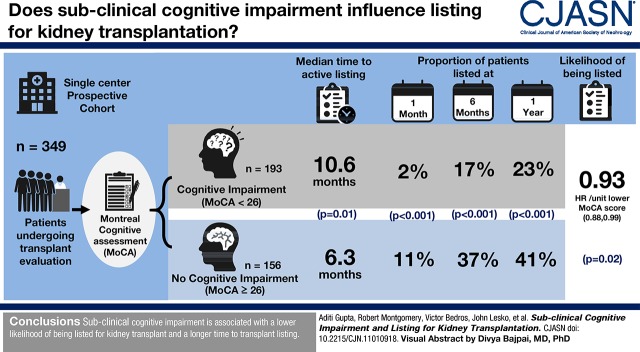
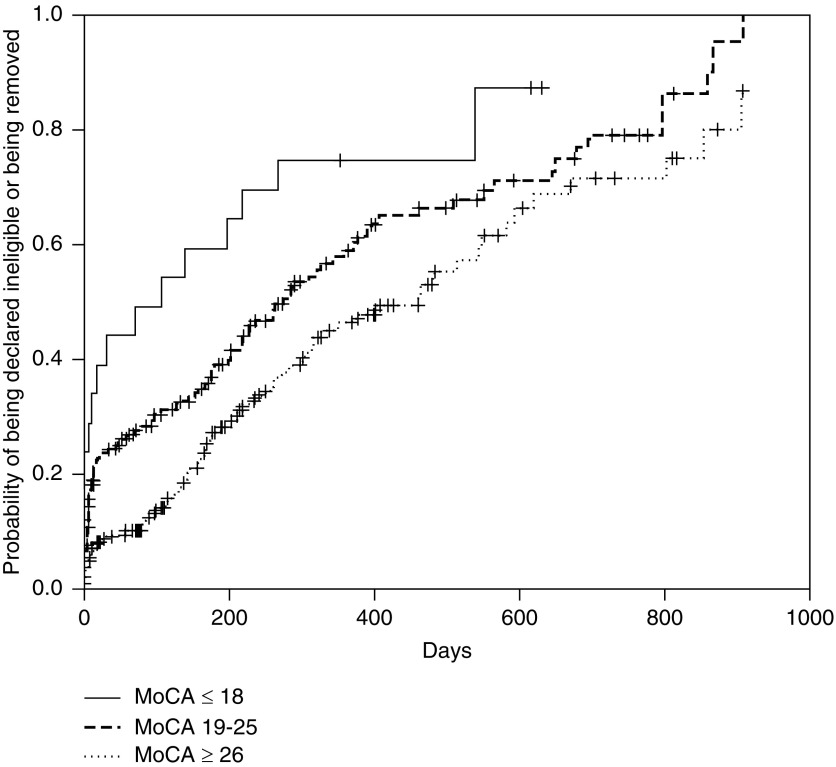
Results: In total, 349 patients who underwent Montreal Cognitive Assessment testing at their initial visit were included in the analysis. Patients with cognitive impairment were more likely to be older, black, and smokers. The time to listing in patients with cognitive impairment was longer than the time to listing in those with no cognitive impairment (median time, 10.6 versus 6.3 months; log rank test P=0.01). Cognitive impairment was independently associated with a lower likelihood of being listed for transplant (hazard ratio, 0.93 per unit lower Montreal Cognitive Assessment score; 95% confidence interval, 0.88 to 0.99; P=0.02). A lower proportion of patients with cognitive impairment were listed compared with patients without cognitive impairment at 1 month (2% versus 11%), 6 months (17% versus 37%), and 1 year (23% versus 41%), (P<0.001 for all).
Conclusions: Cognitive impairment is associated with a lower likelihood of being listed for kidney transplant, and is associated with longer time to transplant listing.
Keywords: Cognition; Cognitive Dysfunction; Cohort Studies; ESKD; Kaplan-Meier Estimate; Kidney Diseases; Longitudinal Studies; Mental Status and Dementia Tests; Proportional Hazards Models; Smokers; Smoking; cognition; coronary artery disease; diabetes mellitus; eligibility; kidney transplantation.
Copyright © 2019 by the American Society of Nephrology.
Figures
Comment in
-
Frailty and Cognitive Deficits Limit Access to Kidney Transplantation: Unfair or Unavoidable?Clin J Am Soc Nephrol. 2019 Apr 5;14(4):493-495. doi: 10.2215/CJN.02390219. Epub 2019 Mar 19. Clin J Am Soc Nephrol. 2019. PMID: 30890579 Free PMC article. No abstract available.
References
-
- Murray AM, Tupper DE, Knopman DS, Gilbertson DT, Pederson SL, Li S, Smith GE, Hochhalter AK, Collins AJ, Kane RL: Cognitive impairment in hemodialysis patients is common. Neurology 67: 216–223, 2006 - PubMed
-
- Bremer BA, Wert KM, Durica AL, Weaver A: Neuropsychological, physical, and psychosocial functioning of individuals with end-stage renal disease. Ann Behav Med 19: 348–352, 1997 - PubMed
-
- Lopez-Vargas PA, Tong A, Phoon RK, Chadban SJ, Shen Y, Craig JC: Knowledge deficit of patients with stage 1-4 CKD: A focus group study. Nephrology (Carlton) 19: 234–243, 2014 - PubMed
Publication types
MeSH terms
Grants and funding
LinkOut - more resources
Full Text Sources
Medical