Meta-Analysis
. 2019 Mar 19;9(1):4882.
doi: 10.1038/s41598-019-41292-0.

Transsphenoidal versus Transcranial Approach for Treatment of Tuberculum Sellae Meningiomas: A Systematic Review and Meta-analysis of Comparative Studies

Affiliations
Meta-Analysis

Transsphenoidal versus Transcranial Approach for Treatment of Tuberculum Sellae Meningiomas: A Systematic Review and Meta-analysis of Comparative Studies

Chengxian Yang et al. Sci Rep. .

Abstract

There is controversy regarding the surgical route selection for tuberculum sellae meningiomas (TSMs): the transsphenoidal (TS) or transcranial (TC) approach? We conducted a systematic review and meta-analysis to compare clinical outcomes and postoperative complications between two surgical approaches. Literature search was performed. Relevant articles were selected and evaluated. Data were extracted and analyzed. Eight articles comprising 550 patients met the inclusion criteria. Traditionally, the rates of gross total resection, tumor recurrence, visual improvement, and cerebrospinal fluid leakage were the most common outcomes of interest. We demonstrated that the TS approach was significantly associated with better visual outcomes but more frequent cerebrospinal fluid leakage, while the rates of tumor resection and recurrence showed no significant difference between groups. In addition to surgical results that were consistent with previous studies, we further evaluated the impact of approach selection on common postoperative complications, which were closely related to the recovery course and quality of life. We revealed that the risk of dysosmia was significantly higher in the TS group. There was no significant difference between groups regarding infection, intracranial hemorrhage, and endocrine disorders. Because of the relatively low evidence levels of included retrospective studies, it was difficult to reach a categorical conclusion about the optimal surgical approach for TSMs. Finally, we recommended that the TS approach was an alternative option in patients with smaller TSMs (<30 mm) and limited invasion of optic canals in experienced neurosurgical centers.


Conflict of interest statement

The authors declare no competing interests.

Figures

Figure 1
Figure 1
Flow diagram of search strategy.
Figure 2
Figure 2
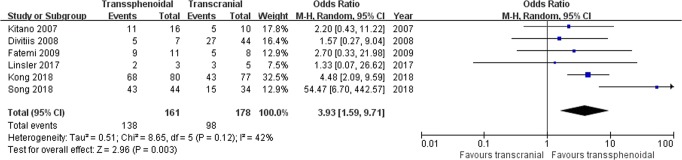
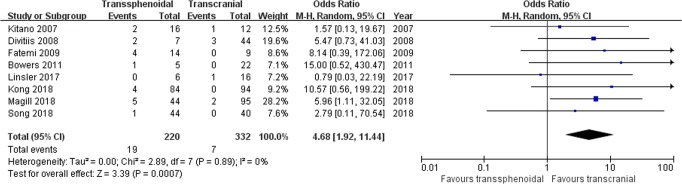
Forest plot of all studies with their respective OR and 95% CI, the number of events (visual improvement), and overall OR. OR = odds ratio; CI = confidence interval; M-H = Mantel-Haenszel.
Figure 3
Figure 3
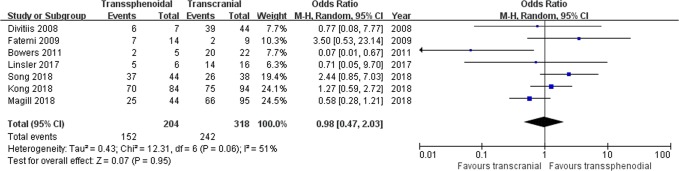
Forest plot of all studies with their respective OR and 95% CI, the number of events (gross total resection), and overall OR.
Figure 4
Figure 4
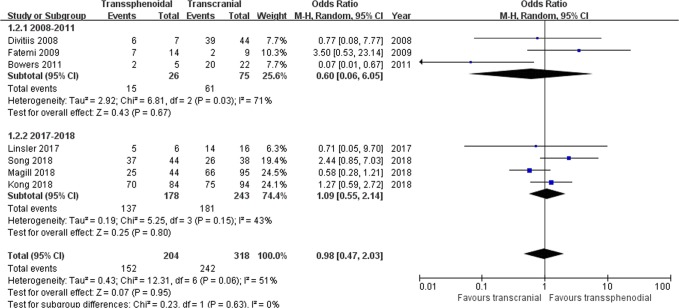
Subgroup analysis of gross total resection by the publication year.
Figure 5
Figure 5
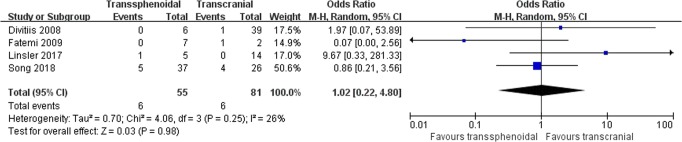
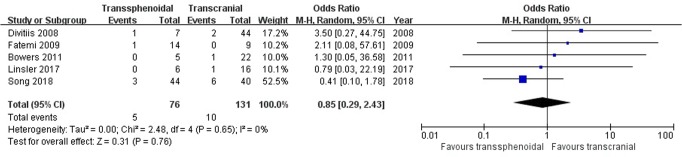
Forest plot of all studies with their respective OR and 95% CI, the number of events (tumor recurrence), and overall OR.
Figure 6
Figure 6
Forest plot of all studies with their respective OR and 95% CI, the number of events (cerebrospinal fluid leakage), and overall OR.
Figure 7
Figure 7
Forest plot of all studies with their respective OR and 95% CI, the number of events (infection), and overall OR.
Figure 8
Figure 8
Forest plot of all studies with their respective OR and 95% CI, the number of events (dysosmia), and overall OR.
Figure 9
Figure 9
Forest plot of all studies with their respective OR and 95% CI, the number of events (intracranial hemorrhage), and overall OR.
Figure 10
Figure 10
Forest plot of all studies with their respective OR and 95% CI, the number of events (endocrine disorders), and overall OR.

References

    1. Gokalp HZ, Arasil E, Kanpolat Y, Balim T. Meningiomas of the tuberculum sella. Neurosurgical review. 1993;16:111–114. doi: 10.1007/BF00258241. - DOI - PubMed
    1. Andrews BT, Wilson CB. Suprasellar meningiomas: the effect of tumor location on postoperative visual outcome. Journal of neurosurgery. 1988;69:523–528. doi: 10.3171/jns.1988.69.4.0523. - DOI - PubMed
    1. Karsy M, Raheja A, Eli I, Guan J, Couldwell WT. Clinical Outcomes with Transcranial Resection of the Tuberculum Sellae Meningioma. World neurosurgery. 2017;108:748–755. doi: 10.1016/j.wneu.2017.09.090. - DOI - PubMed
    1. Telera S, et al. Supraorbital keyhole approach for removal of midline anterior cranial fossa meningiomas: A series of 20 consecutive cases. Neurosurgical review. 2012;35:67–83. doi: 10.1007/s10143-011-0340-7. - DOI - PubMed
    1. Mortazavi MM, et al. Planum Sphenoidale and Tuberculum Sellae Meningiomas: Operative Nuances of a Modern Surgical Technique with Outcome and Proposal of a New Classification System. World neurosurgery. 2016;86:270–286. doi: 10.1016/j.wneu.2015.09.043. - DOI - PubMed