


Curcumin Nanoformulations for Colorectal Cancer: A Review
- PMID: 30890933
- PMCID: PMC6412150
- DOI: 10.3389/fphar.2019.00152
Curcumin Nanoformulations for Colorectal Cancer: A Review
Abstract
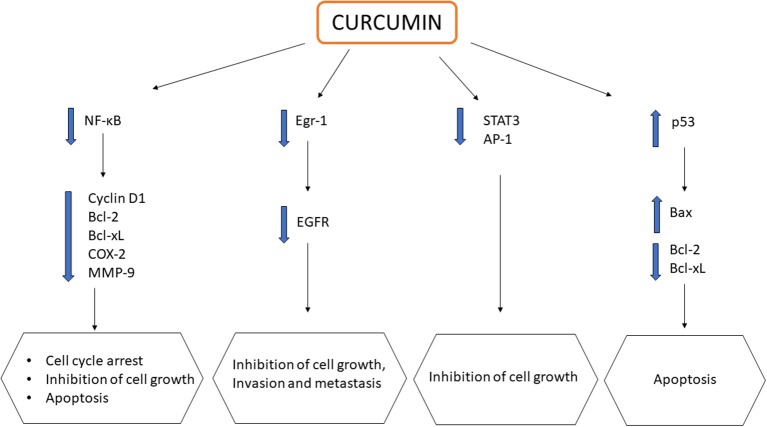
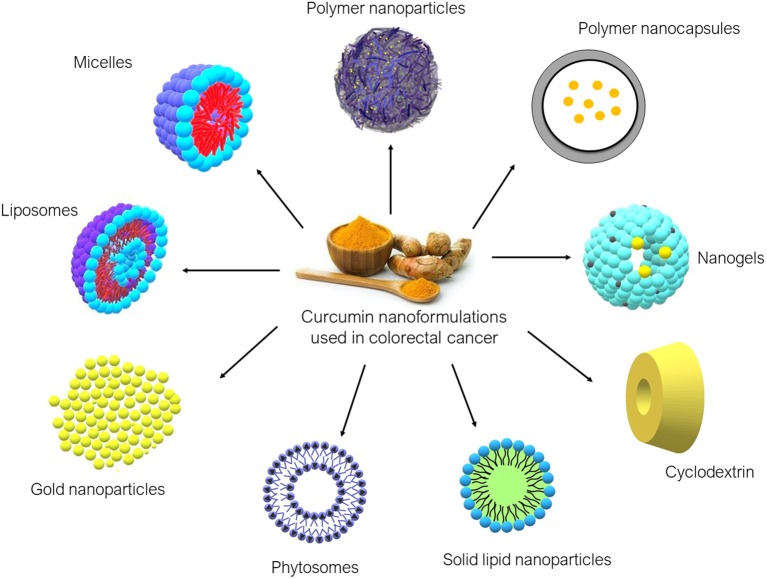
Colorectal cancer (CRC) is the third most prevalent form of cancer, after lung cancer and breast cancer, with the second highest death incidence. Over the years, natural compounds have been explored as an alternative to conventional cancer therapies such as surgery, radiotherapy, and chemotherapy. Curcumin, an active constituent of turmeric has been associated with various health benefits. It has gained much attention as an anticancer agent due to its ability to regulate multiple cell signaling pathways, including NF-κB, STAT3, activated protein-1 (AP-1), epidermal growth response-1 (Egr-1), and p53, which are crucial in cancer development and progression. Nevertheless, the clinical application of curcumin is greatly restricted because of its low water solubility, poor oral absorption, and rapid metabolism. These issues have led to the development of curcumin nanoformulations to overcome the limitations of the compound. Nanotechnology-based delivery systems have been widely used in improving the delivery of poorly-water soluble drugs. Besides, these systems also come with the added benefits of possible cellular targeting and improvement in cellular uptake. An ideal improved formulation should display a greater anticancer activity compared to free curcumin, and at the same time be non-toxic to the normal cells. In this review, we focus on the design and development of various nanoformulations to deliver curcumin for use in CRC such as liposomes, micelles, polymer nanoparticles, nanogels, cyclodextrin complexes, solid lipid nanoparticles (SLN), phytosomes, and gold nanoparticles. We also discuss the current pre-clinical and clinical evidences of curcumin nanoformulations in CRC therapy, analyse the research gap, and address the future direction of this research area.
Keywords: colon cancer; colorectal cancer; curcumin; liposomes; micelles; nanoformulations; nanogels; nanoparticles.
Figures
References
-
- Abruzzo A., Zuccheri G., Belluti F., Provenzano S., Verardi L., Bigucci F., et al. (2016). Chitosan nanoparticles for lipophilic anticancer drug delivery: development, characterization and in vitro studies on HT29 cancer cells. Colloids Surf. B Biointerfaces 145, 362–372. 10.1016/j.colsurfb.2016.05.023 - DOI - PubMed
-
- American Cancer Society (2017). Colorectal Cancer Facts & Figures 2017-2019. Atlanta, GA: American Cancer Society; Available online at: https://www.cancer.org/content/dam/cancer-org/research/cancer-facts-and-... (Accessed November 21, 2018).
-
- Anitha A., Sreeranganathan M., Chennazhi K. P., Lakshmanan V. K., Jayakumar R. (2014). In vitro combinatorial anticancer effects of 5-fluorouracil and curcumin loaded N,O-carboxymethyl chitosan nanoparticles toward colon cancer and in vivo pharmacokinetic studies. Eur. J. Pharm. Biopharm. 88, 238–251. 10.1016/j.ejpb.2014.04.017 - DOI - PubMed
Publication types
LinkOut - more resources
Full Text Sources
Research Materials
Miscellaneous
