


Power spectrum of spontaneous cerebral homodynamic oscillation shows a distinct pattern in autism spectrum disorder
- PMID: 30891353
- PMCID: PMC6420268
- DOI: 10.1364/BOE.10.001383
Power spectrum of spontaneous cerebral homodynamic oscillation shows a distinct pattern in autism spectrum disorder
Abstract
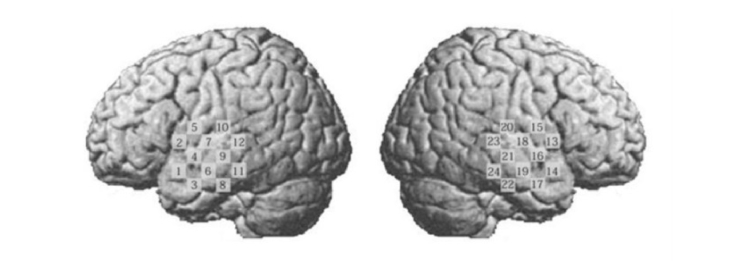
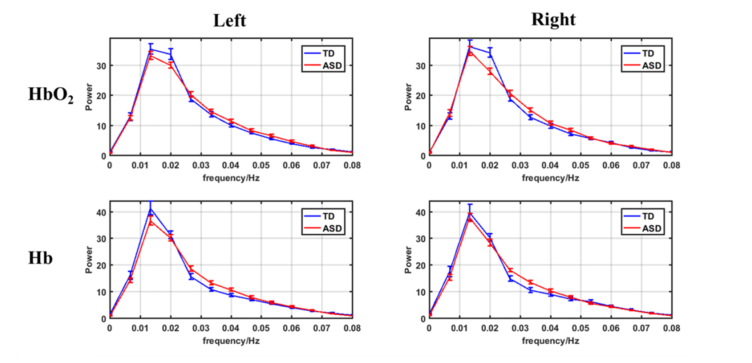
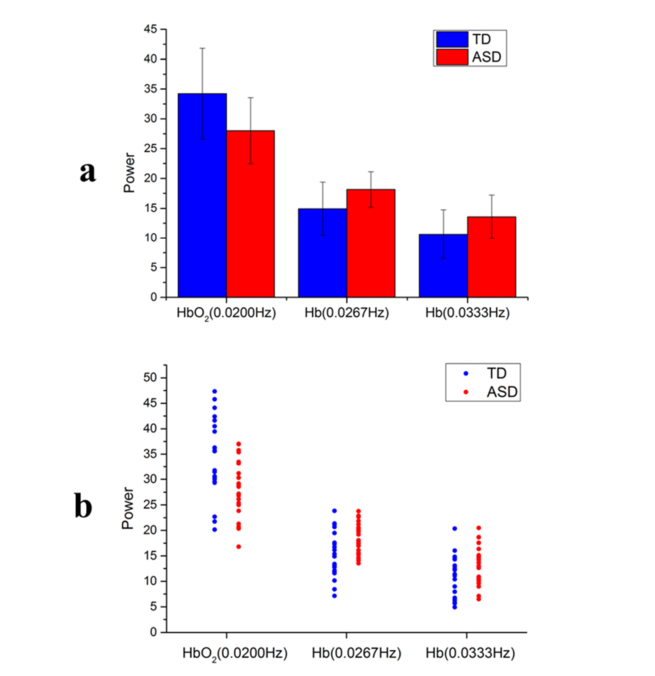
Spontaneous hemodynamic fluctuations recorded by functional near-infrared spectroscopy (fNIRS) from bilateral temporal lobes were analyzed on 25 children with autism spectrum disorder (ASD) and 22 typically developing (TD) children. By frequency domain analysis, a new characteristic was uncovered that the power spectrum of low frequency cerebral hemodynamic oscillation showed a distinct pattern in ASD. More specifically, at the frequency of 0.0200 Hz, the power of oxygenated hemoglobin was larger for TD than ASD, whereas in the band of 0.0267-0.0333 Hz, the power of deoxygenated hemoglobin was larger for ASD than TD. Using these new features and those identified previously together as feature variables for the support vector machine (SVM) classifier, accurate classification between ASD and TD was achieved with a sensitivity of 90.2%, specificity of 95.1% and accuracy of 92.7%.
Conflict of interest statement
The authors declare that there are no conflicts of interest related to this article.
Figures
References
-
- Luyster R., Gotham K., Guthrie W., Coffing M., Petrak R., Pierce K., Bishop S., Esler A., Hus V., Oti R., Richler J., Risi S., Lord C., “The Autism Diagnostic Observation Schedule-toddler module: a new module of a standardized diagnostic measure for autism spectrum disorders,” J. Autism Dev. Disord. 39(9), 1305–1320 (2009). 10.1007/s10803-009-0746-z - DOI - PMC - PubMed
LinkOut - more resources
Full Text Sources