Clinical Trial
. 2019 Jun 1;37(16):1370-1379.
doi: 10.1200/JCO.18.02236. Epub 2019 Mar 20.

ALK Resistance Mutations and Efficacy of Lorlatinib in Advanced Anaplastic Lymphoma Kinase-Positive Non-Small-Cell Lung Cancer

Affiliations
Clinical Trial

ALK Resistance Mutations and Efficacy of Lorlatinib in Advanced Anaplastic Lymphoma Kinase-Positive Non-Small-Cell Lung Cancer

Alice T Shaw et al. J Clin Oncol. .

Abstract

Purpose: Lorlatinib is a potent, brain-penetrant, third-generation anaplastic lymphoma kinase (ALK)/ROS1 tyrosine kinase inhibitor (TKI) with robust clinical activity in advanced ALK-positive non-small-cell lung cancer, including in patients who have failed prior ALK TKIs. Molecular determinants of response to lorlatinib have not been established, but preclinical data suggest that ALK resistance mutations may represent a biomarker of response in previously treated patients.

Patients and methods: Baseline plasma and tumor tissue samples were collected from 198 patients with ALK-positive non-small-cell lung cancer from the registrational phase II study of lorlatinib. We analyzed plasma DNA for ALK mutations using Guardant360. Tumor tissue DNA was analyzed using an ALK mutation-focused next-generation sequencing assay. Objective response rate, duration of response, and progression-free survival were evaluated according to ALK mutation status.

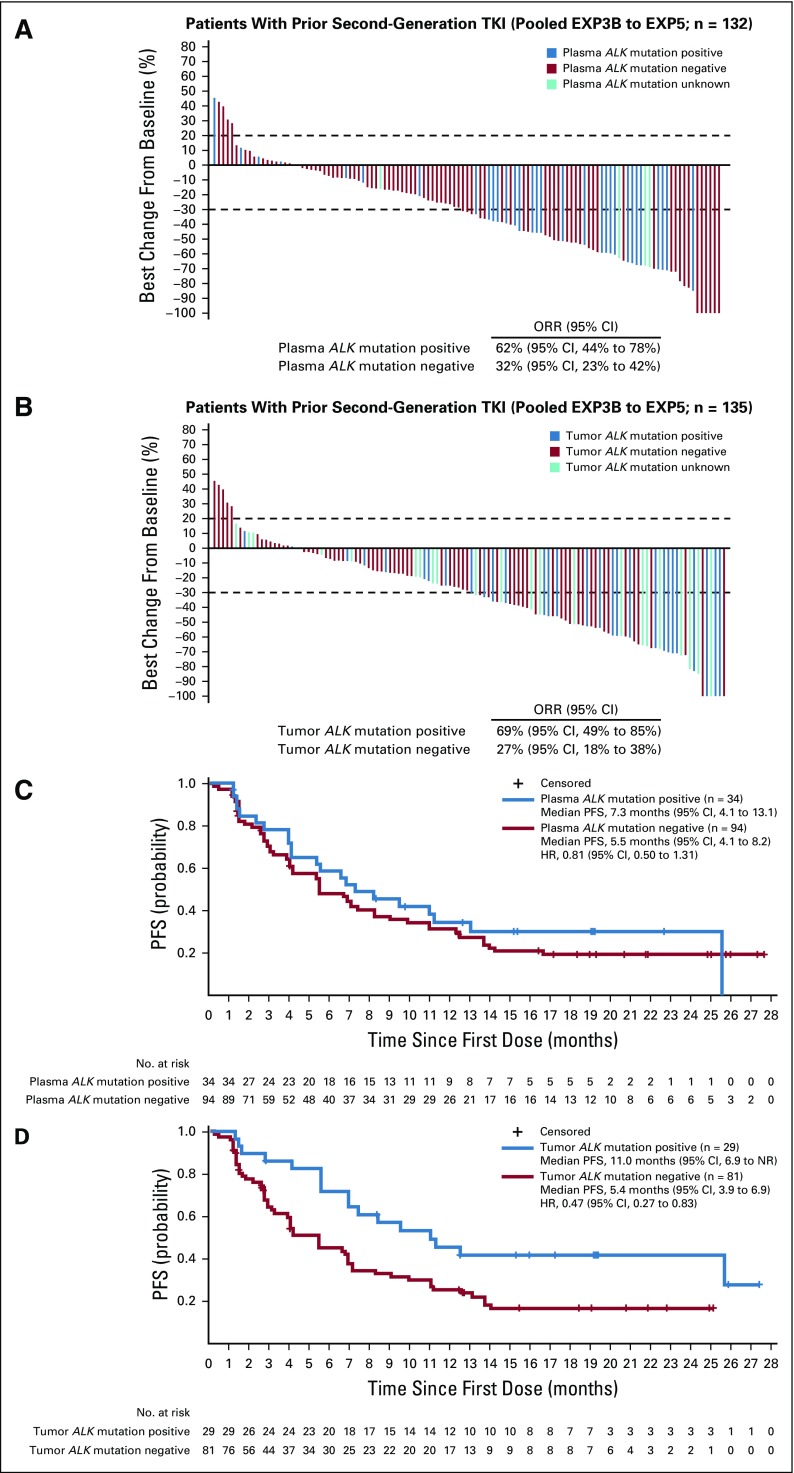
Results: Approximately one quarter of patients had ALK mutations detected by plasma or tissue genotyping. In patients with crizotinib-resistant disease, the efficacy of lorlatinib was comparable among patients with and without ALK mutations using plasma or tissue genotyping. In contrast, in patients who had failed 1 or more second-generation ALK TKIs, objective response rate was higher among patients with ALK mutations (62% v 32% [plasma]; 69% v 27% [tissue]). Progression-free survival was similar in patients with and without ALK mutations on the basis of plasma genotyping (median, 7.3 months v 5.5 months; hazard ratio, 0.81) but significantly longer in patients with ALK mutations identified by tissue genotyping (median, 11.0 months v 5.4 months; hazard ratio, 0.47).

Conclusion: In patients who have failed 1 or more second-generation ALK TKIs, lorlatinib shows greater efficacy in patients with ALK mutations compared with patients without ALK mutations. Tumor genotyping for ALK mutations after failure of a second-generation TKI may identify patients who are more likely to derive clinical benefit from lorlatinib.


Figures
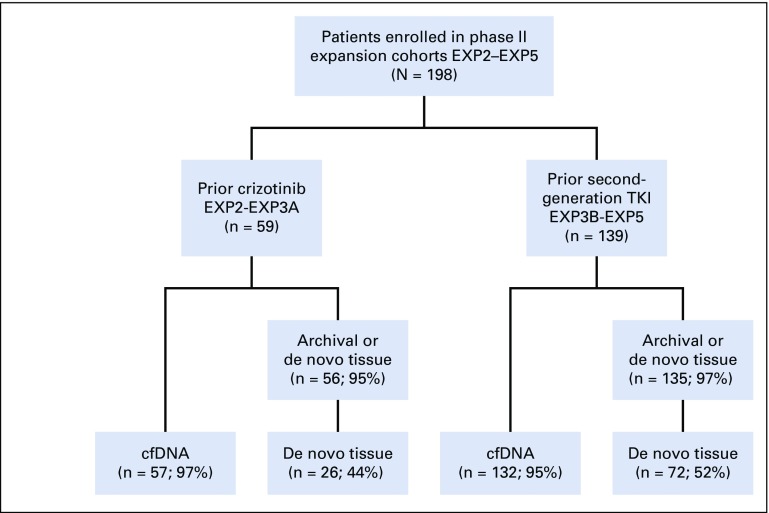
FIG 1.
FIG 1.
CONSORT diagram. A total of 198 anaplastic lymphoma kinase (ALK)-positive patients in expansion cohorts EXP2 to EXP5 were treated. Of these, 59 had received prior crizotinib and 139 had received one or more second-generation inhibitors, often in addition to crizotinib. The numbers of patients with cell-free DNA (cfDNA) and tissue samples are shown. De novo tissue refers to a biopsy obtained within 28 days of starting lorlatinib. EXP2, prior crizotinib only; EXP3A, prior crizotinib and chemotherapy; EXP3B, one prior non-crizotinib ALK tyrosine kinase inhibitor (TKI) with or without chemotherapy; EXP4, two prior ALK TKIs with or without chemotherapy; EXP5, three prior ALK TKIs with or without chemotherapy.
FIG 2.
FIG 2.
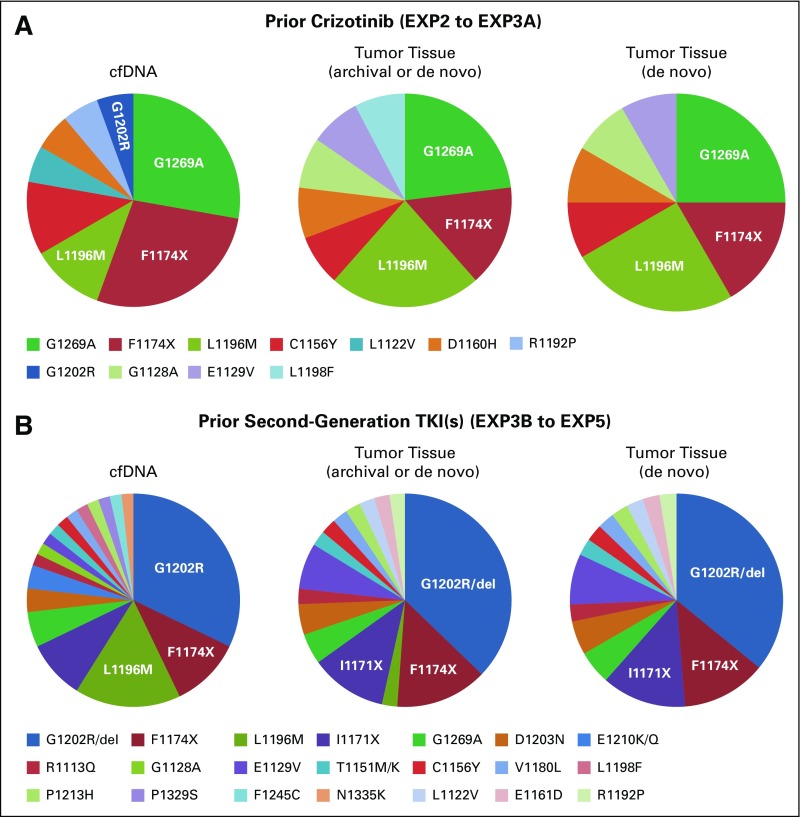
Summary of anaplastic lymphoma kinase (ALK) mutations identified by plasma and tumor genotyping. (A) Post-crizotinib patients (expansion cohorts EXP2 to EXP3A). The most common ALK mutation observed in cell-free DNA (cfDNA) and tumor tissue was G1269A. ALK G1202R was detected in one cfDNA sample. (B) Patients who have failed 1 or more second-generation ALK TKIs (EXP3B–5). The most common ALK mutation observed in cfDNA and tumor tissue was G1202R/del. (Note: only one G1202del mutation was detected.) Pie charts display the frequency of indicated ALK mutations as a percentage of the total number of patients with ALK mutations.
FIG 3.
FIG 3.
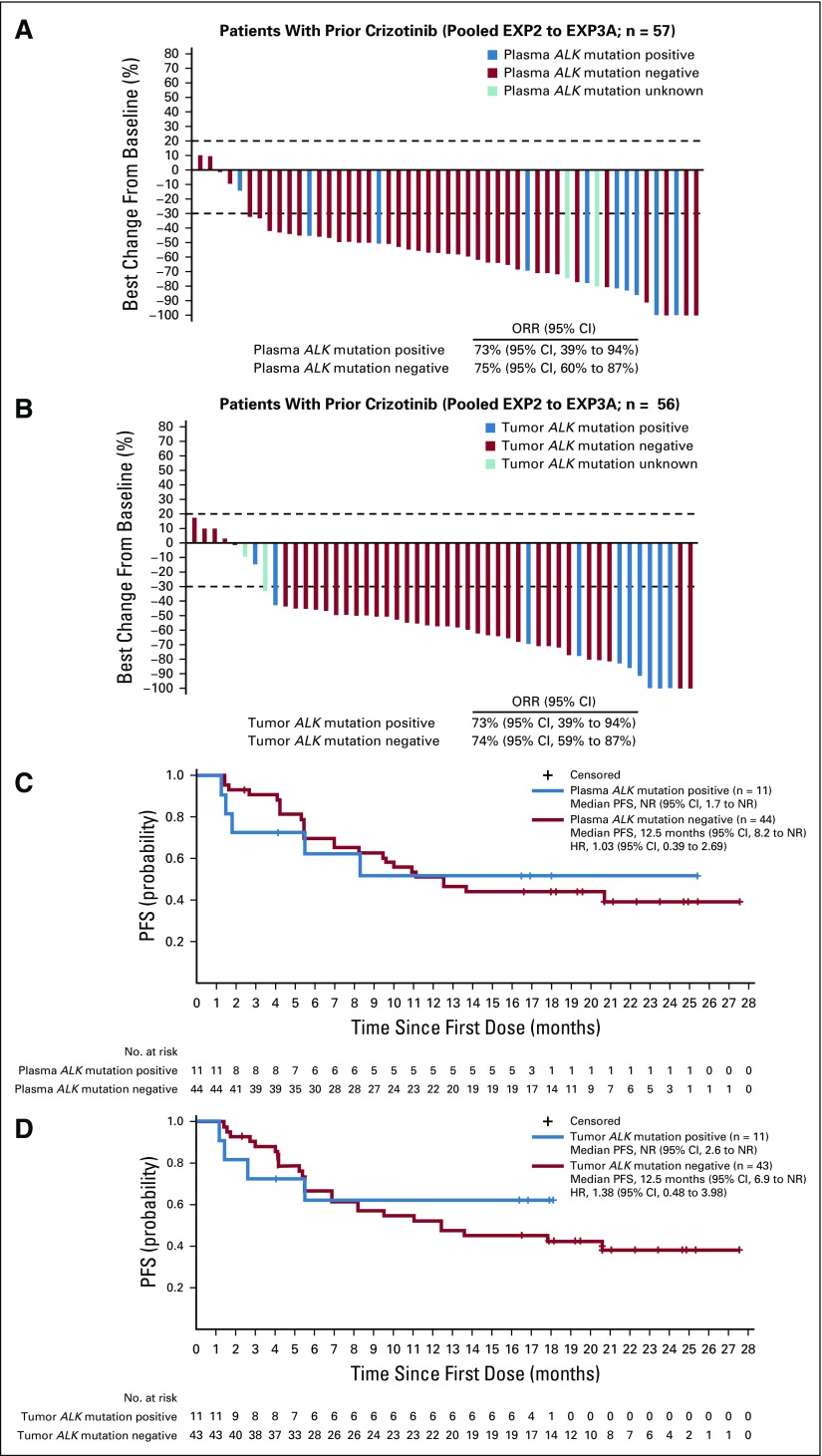
Efficacy of lorlatinib in crizotinib-resistant patients (expansion cohorts EXP2 to EXP3A), according to anaplastic lymphoma kinase (ALK) mutation status. Shown are waterfall plots summarizing the best percentage change in target lesions, with ALK mutation status determined by (A) plasma genotyping or (B) tissue genotyping. Blue bars indicate patients with one or more ALK mutations, red bars indicate patients without detectable ALK mutations, and aqua bars indicate two samples that failed analysis. Two patients in EXP2 to EXP3A did not have plasma samples for cell-free DNA analysis. Patients with at least one on-study target lesion assessment were included. If any assessment procedures differed from or were not interchangeable with the procedure at screening, the change from baseline could not be calculated and is not displayed. Kaplan-Meier curves of progression-free survival (PFS) are also shown according to ALK mutation status, as determined by (C) plasma genotyping or (D) tissue genotyping. Vertical lines on the curves indicate censoring of data. HR, hazard ratio; NR, not reached; ORR, objective response rate.
FIG 4.
FIG 4.
Efficacy of lorlatinib in patients who have failed 1 or more second-generation ALK inhibitors (EXP3B–5), according to ALK mutation status. Shown are waterfall plots summarizing the best percentage change in target lesions, with ALK mutation status determined by (A) plasma genotyping or (B) tissue genotyping. Blue bars indicate patients with one or more ALK mutations, red bars indicate patients without detectable ALK mutations, and aqua bars indicate four samples that failed analysis. Seven patients in EXP3B to EXP5 did not have plasma samples for cell-free DNA analysis. Patients with at least one on-study target lesion assessment were included. If any assessment procedures differed from or were not interchangeable with the procedure at screening, the change from baseline could not be calculated and is not displayed. Kaplan-Meier curves of progression-free survival (PFS) are also shown according to ALK mutation status, as determined by (C) plasma genotyping or (D) tissue genotyping. Vertical lines on the curves indicate censoring of data. HR, hazard ratio; NR, not reached; ORR, objective response rate; TKI, tyrosine kinase inhibitor.
FIG 5.
FIG 5.
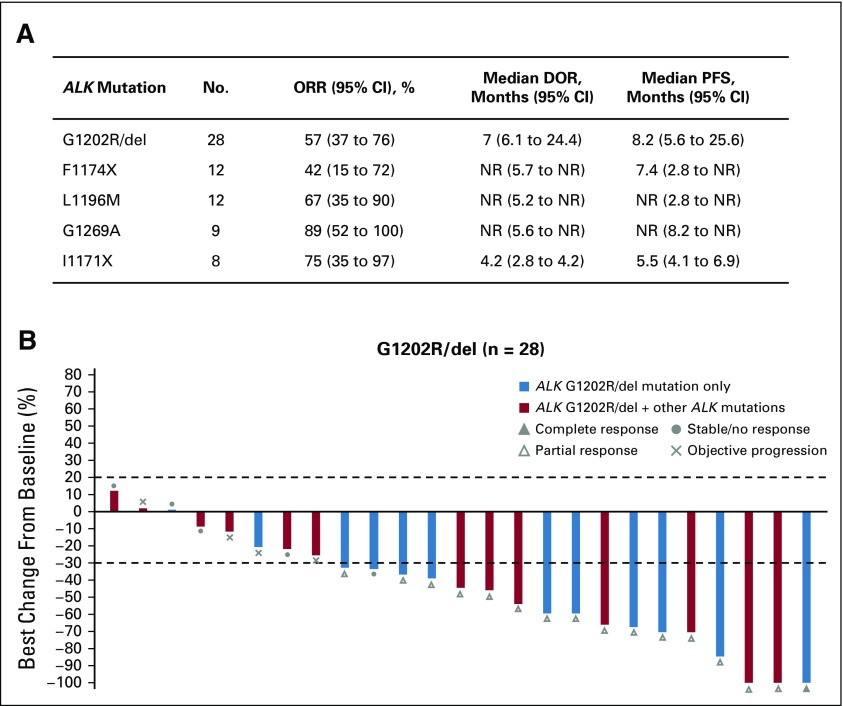
Clinical activity of lorlatinib against common anaplastic lymphoma kinase (ALK) resistance mutations. (A) Efficacy of lorlatinib in patients in expansion cohorts EXP2 to EXP5 harboring the indicated ALK mutations, as detected by plasma or tissue genotyping. (B) Waterfall plot showing the best percentage change in target lesions in patients harboring G1202R/del. Blue bars indicate patients with G1202R/del only and red bars indicate patients with G1202R/del and one or more other ALK mutations. Patients with at least one on-study target lesion assessment were included. If any assessment procedures differed from or were not interchangeable with the procedure at screening, the change from baseline could not be calculated and is not displayed. ALK, anaplastic lymphoma kinase; cfDNA, cell-free plasma DNA; CI, confidence interval; DOR, duration of response; EXP, expansion cohort; HR, hazard ratio; NR, not reached; ORR, objective response rate; PFS, progression-free survival.

Comment in

References

    1. Kwak EL, Bang YJ, Camidge DR, et al. Anaplastic lymphoma kinase inhibition in non–small-cell lung cancer. N Engl J Med. 2010;363:1693–1703. - PMC - PubMed
    1. Lin JJ, Riely GJ, Shaw AT. Targeting ALK: Precision medicine takes on drug resistance. Cancer Discov. 2017;7:137–155. - PMC - PubMed
    1. Soda M, Choi YL, Enomoto M, et al. Identification of the transforming EML4-ALK fusion gene in non–small-cell lung cancer. Nature. 2007;448:561–566. - PubMed
    1. Shaw AT, Kim DW, Mehra R, et al. Ceritinib in ALK-rearranged non–small-cell lung cancer. N Engl J Med. 2014;370:1189–1197. - PMC - PubMed
    1. Ou SH, Ahn JS, De Petris L, et al. Alectinib in crizotinib-refractory ALK-rearranged non–small-cell lung cancer: A phase II global study. J Clin Oncol. 2016;34:661–668. - PubMed

Publication types

MeSH terms