


Genotype-phenotype correlations in pheochromocytoma and paraganglioma: a systematic review and individual patient meta-analysis
- PMID: 30893643
- PMCID: PMC6717695
- DOI: 10.1530/ERC-19-0024
Genotype-phenotype correlations in pheochromocytoma and paraganglioma: a systematic review and individual patient meta-analysis
Abstract
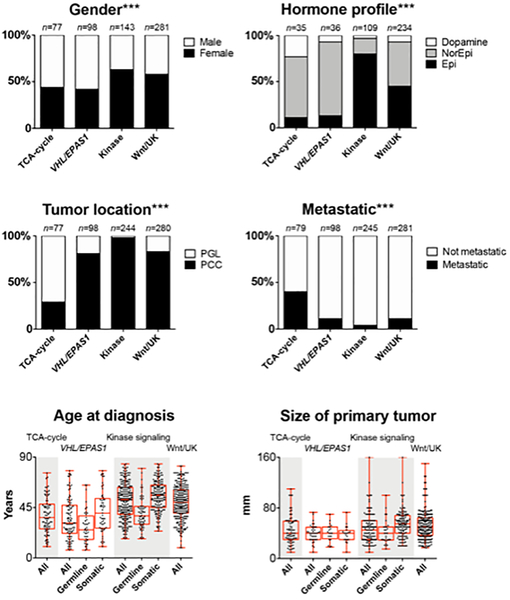
Pheochromocytoma and paraganglioma (PPGL) can be divided into at least four molecular subgroups. Whether such categorizations are independent factors for prognosis or metastatic disease is unknown. We performed a systematic review and individual patient meta-analysis aiming to estimate if driver mutation status can predict metastatic disease and survival. Driver mutations were used to categorize patients according to three different molecular systems: two subgroups (SDHB mutated or wild type), three subgroups (pseudohypoxia, kinase signaling or Wnt/unknown) and four subgroups (tricarboxylic acid cycle, VHL/EPAS1, kinase signaling or Wnt/unknown). Twenty-one studies and 703 patients were analyzed. Multivariate models for association with metastasis showed correlation with SDHB mutation (OR 5.68 (95% CI 1.79-18.06)) as well as norepinephrine (OR 3.01 (95% CI 1.02-8.79)) and dopamine (OR 6.39 (95% CI 1.62-25.24)) but not to PPGL location. Other molecular systems were not associated with metastasis. In multivariate models for association with survival, age (HR 1.04 (95% CI 1.02-1.06)) and metastases (HR 6.13 (95% CI 2.86-13.13)) but neither paraganglioma nor SDHB mutation remained significant. Other molecular subgroups did not correlate with survival. We conclude that molecular categorization accordingly to SDHB provided independent information on the risk of metastasis. Driver mutations status did not correlate independently with survival. These data may ultimately be used to guide current and future risk stratification of PPGL.
Keywords: driver mutations; meta-analysis; molecular genetics; paraganglioma; pheochromocytoma.
Figures
References
-
- Amar L, Baudin E, Burnichon N, Peyrard S, Silvera S, Bertherat J, Bertagna X, Schlumberger M, Jeunemaitre X, Gimenez-Roqueplo AP, et al. 2007. Succinate dehydrogenase B gene mutations predict survival in patients with malignant pheochromocytomas or paragangliomas. J Clin Endocrinol Metab. 92 3822–3828. Epub 2007 Jul 3824. - PubMed
-
- Assadipour Y, Sadowski SM, Alimchandani M, Quezado M, Steinberg SM, Nilubol N, Patel D, Prodanov T, Pacak K & Kebebew E 2017. SDHB mutation status and tumor size but not tumor grade are important predictors of clinical outcome in pheochromocytoma and abdominal paraganglioma. Surgery 161 230–239. - PMC - PubMed
-
- Ayala-Ramirez M, Feng L, Johnson MM, Ejaz S, Habra MA, Rich T, Busaidy N, Cote GJ, Perrier N, Phan A, et al. 2011. Clinical risk factors for malignancy and overall survival in patients with pheochromocytomas and sympathetic paragangliomas: primary tumor size and primary tumor location as prognostic indicators. J Clin Endocrinol Metab. 96 717–725. Epub 2010 Dec 2029. - PubMed
-
- Bausch B, Schiavi F, Ni Y, Welander J, Patocs A, Ngeow J, Wellner U, Malinoc A, Taschin E, Barbon G, et al. 2017. Clinical Characterization of the Pheochromocytoma and Paraganglioma Susceptibility Genes SDHA, TMEM127, MAX, and SDHAF2 for Gene-Informed Prevention. JAMA Oncol 3 1204–1212. - PMC - PubMed
-
- Buffet A, Morin A, Castro-Vega LJ, Habarou F, Lussey-Lepoutre C, Letouze E, Lefebvre H, Guilhem I, Haissaguerre M, Raingeard I, et al. 2018. Germline Mutations in the Mitochondrial 2-Oxoglutarate/Malate Carrier SLC25A11 Gene Confer a Predisposition to Metastatic Paragangliomas. Cancer Res 78 1914–1922. - PubMed
Publication types
MeSH terms
Substances
Grants and funding
LinkOut - more resources
Full Text Sources
Medical
