


Methods and Challenges of Using the Greater Wax Moth (Galleria mellonella) as a Model Organism in Antimicrobial Compound Discovery
- PMID: 30893839
- PMCID: PMC6463077
- DOI: 10.3390/microorganisms7030085
Methods and Challenges of Using the Greater Wax Moth (Galleria mellonella) as a Model Organism in Antimicrobial Compound Discovery
Abstract
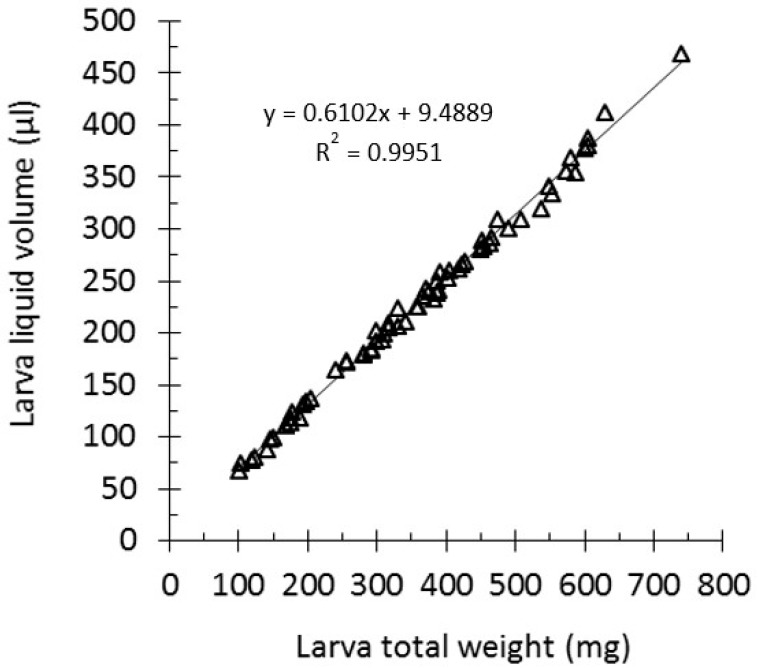
Among non-mammalian infection model organisms, the larvae of the greater wax moth Galleria mellonella have seen increasing popularity in recent years. Unlike other invertebrate models, these larvae can be incubated at 37 °C and can be dosed relatively precisely. Despite the increasing number of publications describing the use of this model organism, there is a high variability with regard to how the model is produced in different laboratories, with respect to larva size, age, origin, storage, and rest periods, as well as dosing for infection and treatment. Here, we provide suggestions regarding how some of these factors can be approached, to facilitate the comparability of studies between different laboratories. We introduce a linear regression curve correlating the total larva weight to the liquid volume in order to estimate the in vivo concentration of pathogens and the administered drug concentration. Finally, we discuss several other aspects, including in vivo antibiotic stability in larvae, the infection doses for different pathogens and suggest guidelines for larvae selection.
Keywords: Galleria mellonella; antimicrobial compound; infection model; invertebrate model.
Conflict of interest statement
The authors declare no conflict of interest.
Figures




References
-
- Schmidt O., Theopold U., Beckage N.E. Insect and vertebrate immunity: Key similarities versus differences. In: Beckage N.E., editor. Insect Immunology. Elsevier; Amsterdam, The Netherlands: 2008. pp. 1–23. - DOI
-
- Müller U., Vogel P., Alber G., Schaub G. The innate immune system of mammals and insects. Contrib. Microbiol. 2008;15:21–44. - PubMed
-
- Kavanagh K., Reeves E.P. Insect and mammalian innate immune responses are much alike. Microbe. 2007;2:596–599. doi: 10.1128/microbe.2.596.1. - DOI
LinkOut - more resources
Full Text Sources
Other Literature Sources
