Review
. 2019 Mar 19;7(1):22.
doi: 10.3390/biomedicines7010022.

Assessment and Impact of Cognitive Impairment in Multiple Sclerosis: An Overview

Affiliations
Review

Assessment and Impact of Cognitive Impairment in Multiple Sclerosis: An Overview

Miguel Ángel Macías Islas et al. Biomedicines. .

Abstract

Cognitive impairment affects 40⁻60% of patients with multiple sclerosis. It may be present early in the course of the disease and has an impact on a patient's employability, social interactions, and quality of life. In the last three decades, an increasing interest in diagnosis and management of cognitive impairment has arisen. Neuropsychological assessment and neuroimaging studies focusing on cognitive impairment are now being incorporated as primary outcomes in clinical trials. However, there are still key uncertainties concerning the underlying mechanisms of damage, neural basis, sensitivity and validity of neuropsychological tests, and efficacy of pharmacological and non-pharmacological interventions. The present article aimed to present an overview of the assessment, neural correlates, and impact of cognitive impairment in multiple sclerosis.

Keywords: cognitive dysfunction; cognitive impairment; demyelinating diseases; multiple sclerosis.


Conflict of interest statement

The authors declare no conflict of interest.

Figures
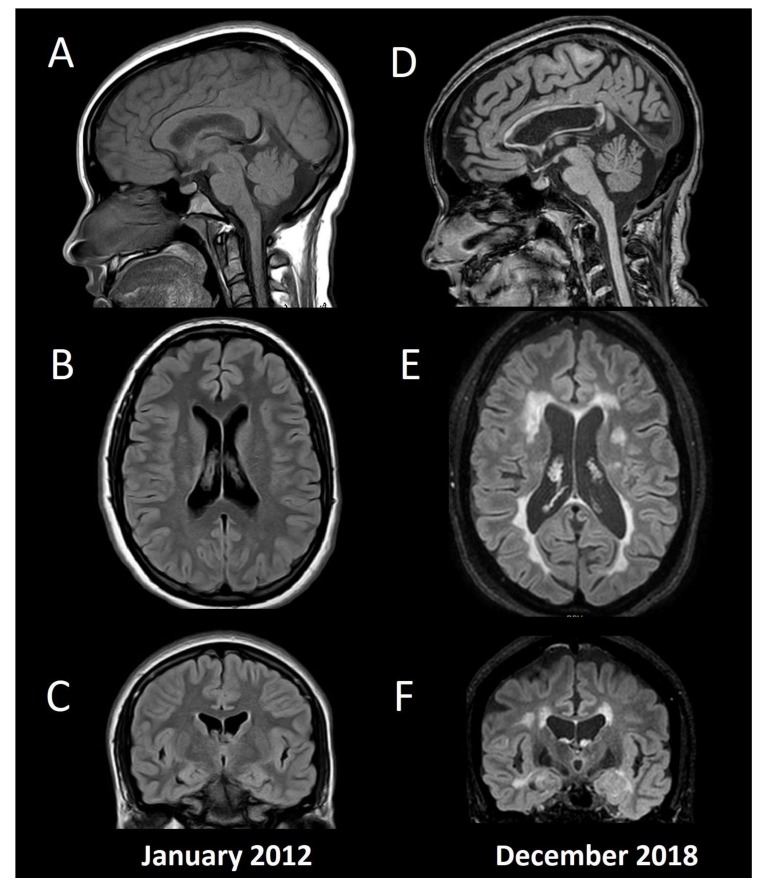
Figure 1
Figure 1
Conventional MRI in a patient with multiple sclerosis and cognitive impairment. Baseline MRI (A: Sagittal T1, B: Axial FLAIR, C: Coronal FLAIR) from a 15-year-old female with fulminant MS (Marburg variant, EDSS 8.0). After initial aggressive treatment in 2012, including myeloablation with cyclophosphamide, the patient remained asymptomatic without disease modifying treatment, until a second supratentorial motor relapse in 2015, confirming her MS diagnosis and beginning fingolimod. Since then, no relapses or new T2/enhancing lesions have appeared, and she had an EDSS 1.0 by the time of the second MRI in 2018 (D: Sagittal T1, E: Axial FLAIR, F: Coronal FLAIR). Her Mini-Mental State Examination was 30 (normal), Beck Depression Inventory 4 (without depression), and her fatigue severity score was 4 (significative fatigue). She had below normal performance (≤1.5 standard deviation) in verbal and visual episodic memory, and in information processing speed tests, with the diagnosis of cognitive impairment according to the MACFIMS battery. Note the widespread brain volume loss including cortical grey matter, ventricular width, and corpus callosum atrophy. The patient gave her written informed consent to present this data.

References

    1. Cree B.A., Gourraud P.A., Oksenberg J.R., Bevan C., Crabtree-Hartman E., Gelfand J.M., Goodin D.S., Graves J., Green A.J., Mowry E., et al. Long-term evolution of multiple sclerosis disability in the treatment era. Ann. Neurol. 2016;80:499–510. - PMC - PubMed
    1. Thompson A.J., Baranzini S.E., Geurts J., Hemmer B., Ciccarelli O. Multiple sclerosis. Lancet. 2018;391:1622–1636. doi: 10.1016/S0140-6736(18)30481-1. - DOI - PubMed
    1. Miller D.H., Leary S.M. Primary-progressive multiple sclerosis. Lancet Neurol. 2007;6:903–912. doi: 10.1016/S1474-4422(07)70243-0. - DOI - PubMed
    1. Kakalacheva K., L€unemann J.D. Enviromental triggers of multiple sclerosis. FEBS Lett. 2011;585:3724–3729. doi: 10.1016/j.febslet.2011.04.006. - DOI - PubMed
    1. Chitnis T. Role of puberty in multiple sclerosis risk and course. Clin. Immunol. 2013;149:192–200. doi: 10.1016/j.clim.2013.03.014. - DOI - PubMed

LinkOut - more resources
