Review
. 2019 Mar 19;20(6):1386.
doi: 10.3390/ijms20061386.

Nutritional Regulation of Gene Expression: Carbohydrate-, Fat- and Amino Acid-Dependent Modulation of Transcriptional Activity

Affiliations
Review

Nutritional Regulation of Gene Expression: Carbohydrate-, Fat- and Amino Acid-Dependent Modulation of Transcriptional Activity

Diego Haro et al. Int J Mol Sci. .

Abstract

The ability to detect changes in nutrient levels and generate an adequate response to these changes is essential for the proper functioning of living organisms. Adaptation to the high degree of variability in nutrient intake requires precise control of metabolic pathways. Mammals have developed different mechanisms to detect the abundance of nutrients such as sugars, lipids and amino acids and provide an integrated response. These mechanisms include the control of gene expression (from transcription to translation). This review reports the main molecular mechanisms that connect nutrients' levels, gene expression and metabolism in health. The manuscript is focused on sugars' signaling through the carbohydrate-responsive element binding protein (ChREBP), the role of peroxisome proliferator-activated receptors (PPARs) in the response to fat and GCN2/activating transcription factor 4 (ATF4) and mTORC1 pathways that sense amino acid concentrations. Frequently, alterations in these pathways underlie the onset of several metabolic pathologies such as obesity, insulin resistance, type 2 diabetes, cardiovascular diseases or cancer. In this context, the complete understanding of these mechanisms may improve our knowledge of metabolic diseases and may offer new therapeutic approaches based on nutritional interventions and individual genetic makeup.

Keywords: TORC1 signaling; activating transcription factor 4; amino acid response; amino acids; carbohydrate-responsive element binding protein; carbohydrates; fatty acids; peroxisome proliferator-activated receptors.


Conflict of interest statement

The authors declare no conflict of interest.

Figures
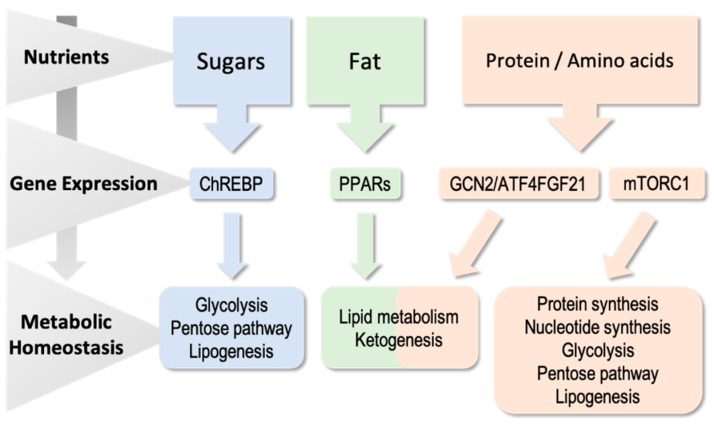
Figure 1
Figure 1
Mammals detect an abundance of nutrients such as sugars, fat and amino acids, and provide a metabolic response most times through the control of gene expression (from transcription to translation). Sugars signaling mainly goes through the carbohydrate-responsive element binding protein (ChREBP). Peroxisome proliferator-activated receptors (PPARs) are the responsible response to fat, and the GCN2/activating transcription factor 4 (ATF4) and mTORC1 pathways sense amino acid concentrations.
Figure 2
Figure 2
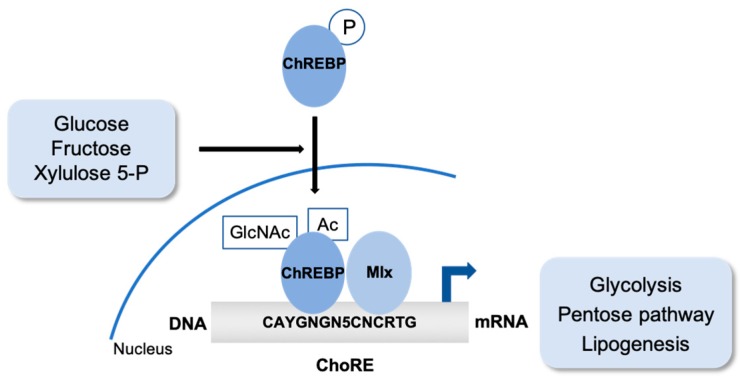
ChREBP is a basic helix–loop–helix leucine zipper transcription factor. In response to glucose and fructose, this protein forms a heterodimer with its partner Mlx and binds and activates the transcription of target genes that contain carbohydrate response element (ChoRE) motifs. This regulation plays a critical role in sugar-induced lipogenesis and global glucose homeostasis. The mechanisms of ChREBP activation involve several glucose metabolites, pathways and post-translational modifications including phosphorylation, acetylation and O–GlcNAcylation.
Figure 3
Figure 3
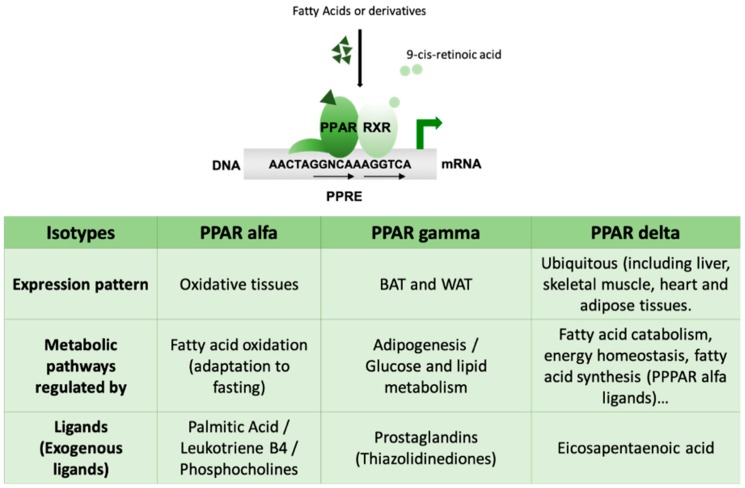
PPARs belong to the ligand-activated nuclear receptor (NR) family. They are transcription factors that exert their effects as heterodimers with the retinoid X receptor (RXR) by binding to a specific sequence of DNA called PPAR-responsive element (PPRE) with a repetitive consensus hexamer (AGGTCA). Three PPAR isotypes are described (α, β and γ) with different expression patterns and metabolic functions. PPARs are lipid sensors and can be activated by both dietary fatty acids (FAs) and their derivatives in the body and, consequently, redirect metabolism. In the liver, PPARα and PPARδ exhibit opposing activities in the control of diurnal lipid metabolism. PPARα is upregulated in the fasted state to regulate fat catabolism. By contrast, PPARδ is most active in the fed state and controls the transcription of lipogenic genes. BAT, brown adipose tissue; WAT, white adipose tissue.
Figure 4
Figure 4
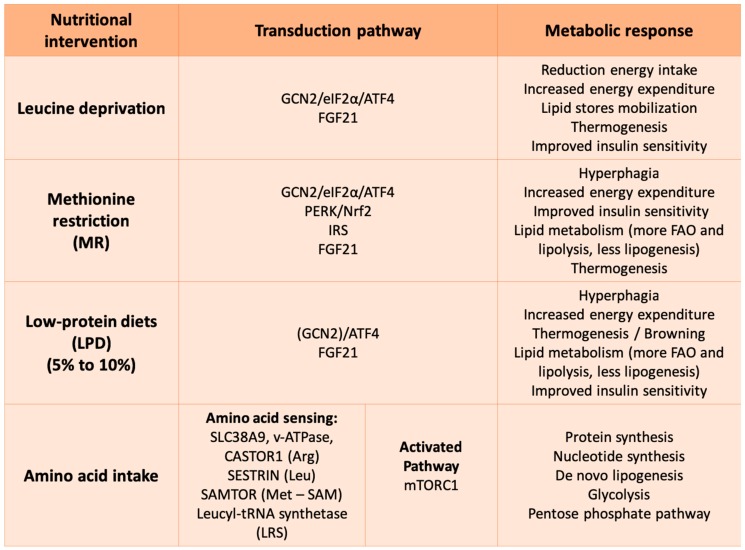
Protein intake is essential for acquiring essential amino acids (EAA) to maintain protein turnover and support almost all cellular processes. The effects of amino acids and proteins on transcriptome and metabolome take place when the protein turnover is unbalanced and there are changes in the amino acid pool. Amino acid-restricted diets, LPD and protein intake have an impact on metabolic homeostasis and directly affect not just protein metabolism but also lipid and glucose metabolism.

References

    1. Jacob F., Monod J. Genetic regulatory mechanisms in the synthesis of proteins. J. Mol. Biol. 1961;3:318–356. doi: 10.1016/S0022-2836(61)80072-7. - DOI - PubMed
    1. Agius L. Hormonal and Metabolite Regulation of Hepatic Glucokinase. Annu. Rev. Nutr. 2016;36:389–415. doi: 10.1146/annurev-nutr-071715-051145. - DOI - PubMed
    1. Vaulont S., Munnich A., Decaux J.F., Kahn A. Transcriptional and post-transcriptional regulation of L-type pyruvate kinase gene expression in rat liver. J. Biol. Chem. 1986;261:7621–7625. - PubMed

    1. Eckert D.T., Zhang P., Collier J.J., O’Doherty R.M., Scott D.K. Detailed molecular analysis of the induction of the L-PK gene by glucose. Biochem. Biophys. Res. Commun. 2008;372:131–136. doi: 10.1016/j.bbrc.2008.05.002. - DOI - PMC - PubMed
    1. Kim K.S., Park S.W., Kim Y.S. Regulation of ATP-citrate lyase at transcriptional and post-transcriptional levels in rat liver. Biochem. Biophys. Res. Commun. 1992;189:264–271. doi: 10.1016/0006-291X(92)91553-3. - DOI - PubMed