Data sharing practices of medicines related apps and the mobile ecosystem: traffic, content, and network analysis
- PMID: 30894349
- PMCID: PMC6425456
- DOI: 10.1136/bmj.l920
Data sharing practices of medicines related apps and the mobile ecosystem: traffic, content, and network analysis
Abstract
Objectives: To investigate whether and how user data are shared by top rated medicines related mobile applications (apps) and to characterise privacy risks to app users, both clinicians and consumers.
Design: Traffic, content, and network analysis.
Setting: Top rated medicines related apps for the Android mobile platform available in the Medical store category of Google Play in the United Kingdom, United States, Canada, and Australia.
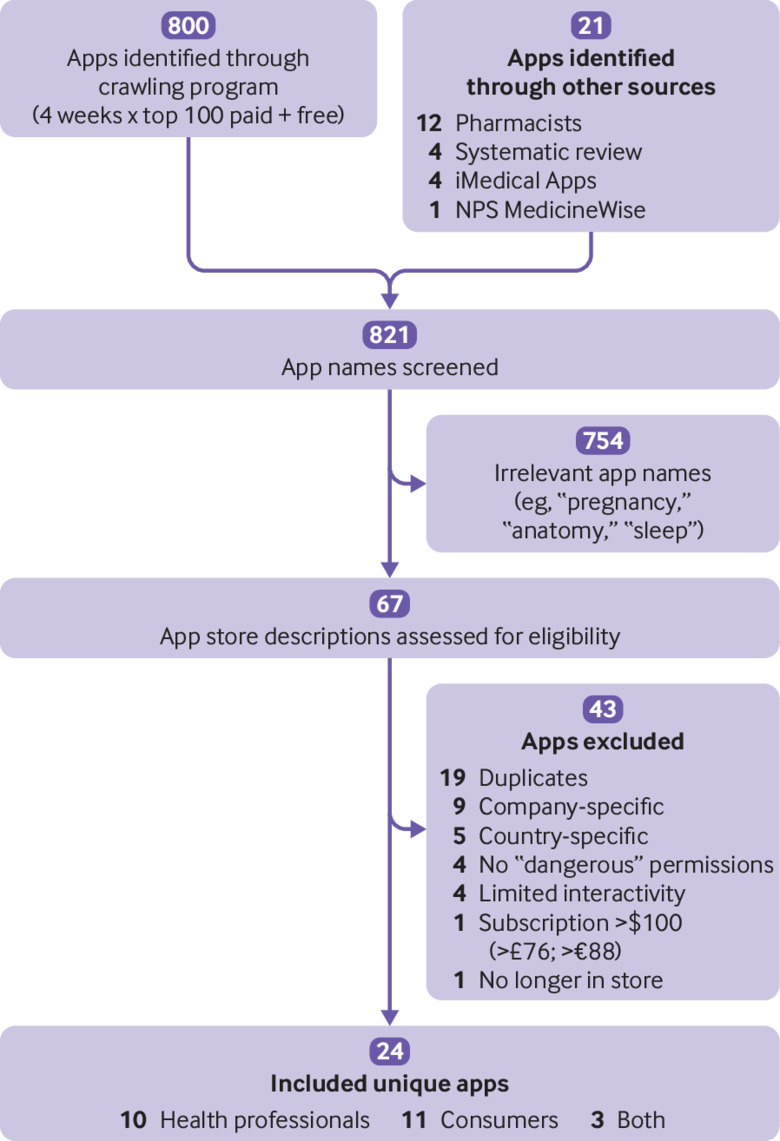
Participants: 24 of 821 apps identified by an app store crawling program. Included apps pertained to medicines information, dispensing, administration, prescribing, or use, and were interactive.
Interventions: Laboratory based traffic analysis of each app downloaded onto a smartphone, simulating real world use with four dummy scripts. The app's baseline traffic related to 28 different types of user data was observed. To identify privacy leaks, one source of user data was modified and deviations in the resulting traffic observed.
Main outcome measures: Identities and characterisation of entities directly receiving user data from sampled apps. Secondary content analysis of company websites and privacy policies identified data recipients' main activities; network analysis characterised their data sharing relations.
Results: 19/24 (79%) of sampled apps shared user data. 55 unique entities, owned by 46 parent companies, received or processed app user data, including developers and parent companies (first parties) and service providers (third parties). 18 (33%) provided infrastructure related services such as cloud services. 37 (67%) provided services related to the collection and analysis of user data, including analytics or advertising, suggesting heightened privacy risks. Network analysis revealed that first and third parties received a median of 3 (interquartile range 1-6, range 1-24) unique transmissions of user data. Third parties advertised the ability to share user data with 216 "fourth parties"; within this network (n=237), entities had access to a median of 3 (interquartile range 1-11, range 1-140) unique transmissions of user data. Several companies occupied central positions within the network with the ability to aggregate and re-identify user data.
Conclusions: Sharing of user data is routine, yet far from transparent. Clinicians should be conscious of privacy risks in their own use of apps and, when recommending apps, explain the potential for loss of privacy as part of informed consent. Privacy regulation should emphasise the accountabilities of those who control and process user data. Developers should disclose all data sharing practices and allow users to choose precisely what data are shared and with whom.
Published by the BMJ Publishing Group Limited. For permission to use (where not already granted under a licence) please go to http://group.bmj.com/group/rights-licensing/permissions.
Conflict of interest statement
Competing interests: All authors have completed the ICMJE uniform disclosure form at www.icmje.org/coi_disclosure.pdf and declare: this work was funded by the Sydney Policy Lab; no financial relationships with any organisations that might have an interest in the submitted work in the previous three years; no other relationships or activities that could appear to have influenced the submitted work.
Figures
Comment in
-
Commercial health apps: in the user's interest?BMJ. 2019 Mar 21;364:l1280. doi: 10.1136/bmj.l1280. BMJ. 2019. PMID: 30898789 No abstract available.
References
-
- McGrath P, Blumer C, Carter J. Medical appointment booking app HealthEngine sharing clients’ personal information with lawyers. ABC News; 2018 June 25.
-
- research2guidance. mHealth developer economics: How mHealth publishers are monetizing their apps. Berlin, Germany: research2guidance; 2018.
-
- Vallina-Rodriguez N, Sundaresan S, Razaghpanah A, et al. Tracking the trackers: Towards understanding the mobile advertising and tracking ecosystem. 1st Data and Algorithm Transparency Workshop; New York, NY, 2016.
-
- Binns R, Lyngs U, Van Kleek M, Zhao J, Libert T, Shadbolt N. Third party tracking in the mobile ecosystem. Proceedings of the 10th ACM Conference on Web Science. 2018. p.23-31.
Publication types
MeSH terms
Grants and funding
LinkOut - more resources
Full Text Sources
Medical