


Genetic differences in host infectivity affect disease spread and survival in epidemics
- PMID: 30894567
- PMCID: PMC6426847
- DOI: 10.1038/s41598-019-40567-w
Genetic differences in host infectivity affect disease spread and survival in epidemics
Abstract
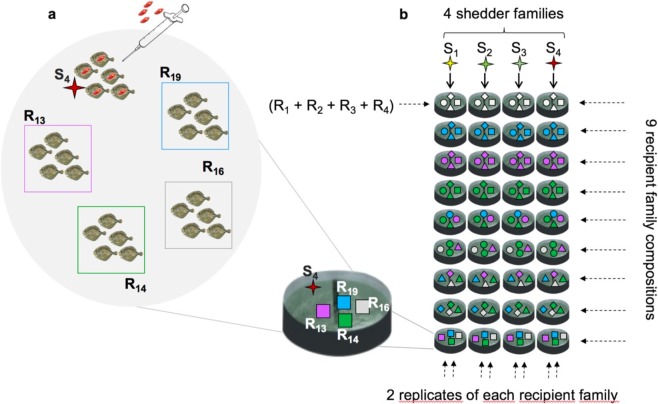
Survival during an epidemic is partly determined by host genetics. While quantitative genetic studies typically consider survival as an indicator for disease resistance (an individual's propensity to avoid becoming infected or diseased), mortality rates of populations undergoing an epidemic are also affected by endurance (the propensity of diseased individual to survive the infection) and infectivity (i.e. the propensity of an infected individual to transmit disease). Few studies have demonstrated genetic variation in disease endurance, and no study has demonstrated genetic variation in host infectivity, despite strong evidence for considerable phenotypic variation in this trait. Here we propose an experimental design and statistical models for estimating genetic diversity in all three host traits. Using an infection model in fish we provide, for the first time, direct evidence for genetic variation in host infectivity, in addition to variation in resistance and endurance. We also demonstrate how genetic differences in these three traits contribute to survival. Our results imply that animals can evolve different disease response types affecting epidemic survival rates, with important implications for understanding and controlling epidemics.
Conflict of interest statement
The authors declare no competing interests.
Figures
References
-
- Bishop, S. C., Axford, R. F. E., Nicholas, F. W. & Owen, J. B. Breeding for Disease Resistance in Farm Animals. (CABI, 2010).
-
- Bishop SC, Morris CA. Genetics of disease resistance in sheep and goats. Small Rumin. Res. 2007;70:48–59. doi: 10.1016/j.smallrumres.2007.01.006. - DOI
Publication types
MeSH terms
Grants and funding
LinkOut - more resources
Full Text Sources
