. 2019 Mar 20;9(1):4651.
doi: 10.1038/s41598-019-40355-6.

Harmonic radar tracking reveals random dispersal pattern of bumblebee (Bombus terrestris) queens after hibernation

Affiliations

Harmonic radar tracking reveals random dispersal pattern of bumblebee (Bombus terrestris) queens after hibernation

James C Makinson et al. Sci Rep. .

Abstract

The dispersal of animals from their birth place has profound effects on the immediate survival and longer-term persistence of populations. Molecular studies have estimated that bumblebee colonies can be established many kilometers from their queens' natal nest site. However, little is known about when and how queens disperse during their lifespan. One possible life stage when dispersal may occur, is directly after emerging from hibernation. Here, harmonic radar tracking of artificially over-wintered Bombus terrestris queens shows that they spend most of their time resting on the ground with intermittent very short flights (duration and distance). We corroborate these behaviors with observations of wild queen bees, which show similar prolonged resting periods between short flights, indicating that the behavior of our radar-monitored bees was not due to the attachment of transponders nor an artifact of the bees being commercially reared. Radar-monitored flights were not continuously directed away from the origin, suggesting that bees were not intentionally trying to disperse from their artificial emergence site. Flights did not loop back to the origin suggesting bees were not trying to remember or get back to the original release site. Most individuals dispersed from the range of the harmonic radar within less than two days and did not return. Flight directions were not different from a uniform distribution and flight lengths followed an exponential distribution, both suggesting random dispersal. A random walk model based on our observed data estimates a positive net dispersal from the origin over many flights, indicating a biased random dispersal, and estimates the net displacement of queens to be within the range of those estimated in genetic studies. We suggest that a distinct post-hibernation life history stage consisting mostly of rest with intermittent short flights and infrequent foraging fulfils the dual purpose of ovary development and dispersal prior to nest searching.


Conflict of interest statement

The authors declare no competing interests.

Figures
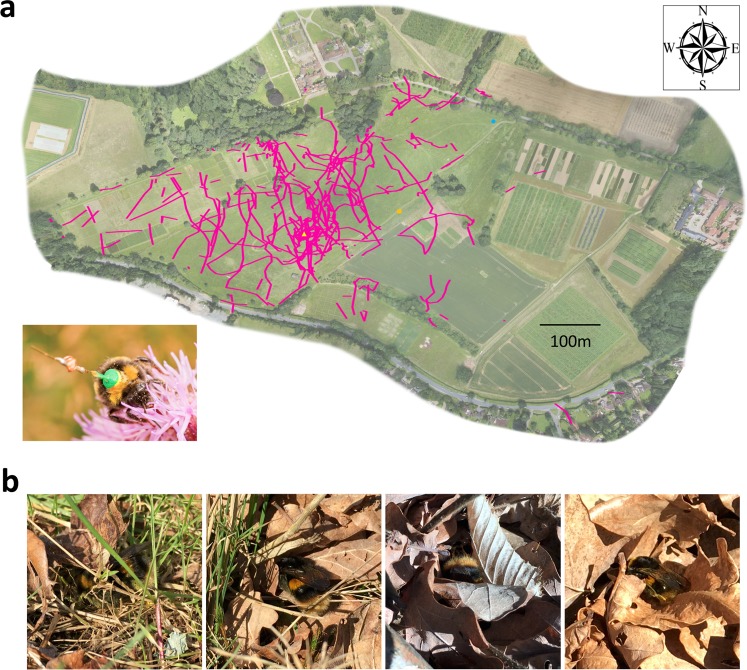
Figure 1
Figure 1
Queen bumblebees (Bombus terrestris) that have recently emerged from artificial or natural hibernation spend more time resting than flying. (a) Aerial view of field site where harmonic radar tracking took place (an orthomosaic created from drone photography; flight tracks overlaid using MATLAB 2015b). Yellow triangle designates position where queen bumblebees were placed prior to the start of experiment (release site). Orange square and blue circle indicate positions of the harmonic radar for the 17 group- and three individually-monitored bees, respectively. Pink lines indicate flight paths of radar tracked bees. Inset photo: queen bumblebee with a transponder fixed to her thorax. (b) Photos show observed behavior of recently emerged queen bumblebees. Most bees we observed landed on the ground after a short flight and proceeded to walk around within a few centimeter radius for several seconds before becoming motionless or, more often, burrowing their body or head into or under vegetation.
Figure 2
Figure 2
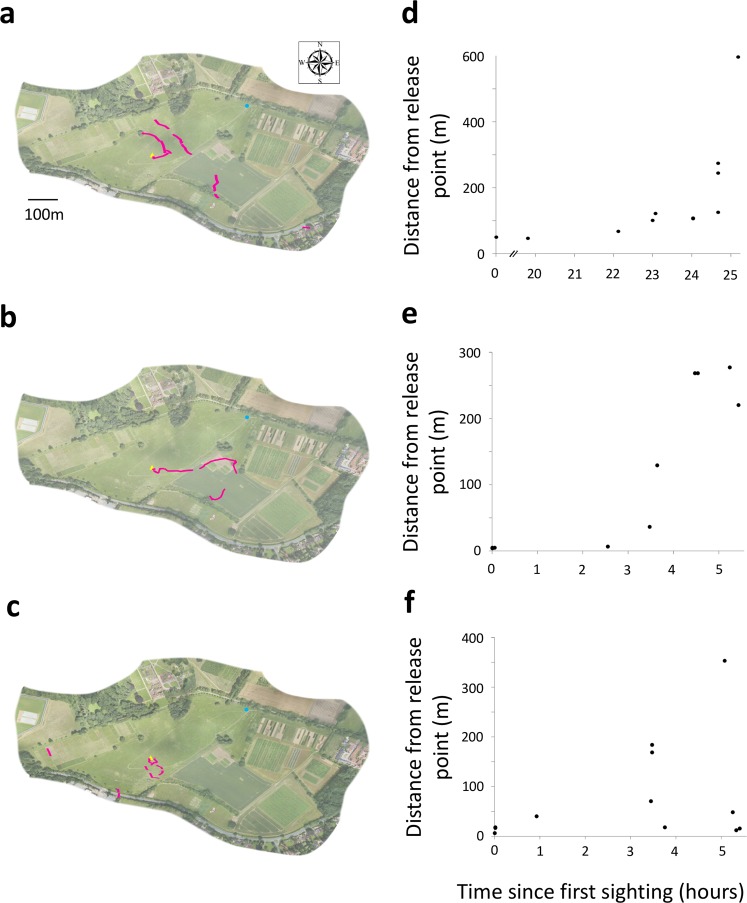
Individually-monitored queen bumblebees disperse slowly from their hibernation site. (ac) Aerial view of field site for radar tracking with the flights (pink lines) of three artificially over-wintered queen bumblebees (an orthomosaic created from drone photography; flight tracks overlaid using MATLAB 2015b). Yellow triangle indicates release site. Blue circle indicates position of the harmonic radar. (e,f) Euclidean distance from the release point to the last positional fix in each flight of each individually-monitored bee.
Figure 3
Figure 3
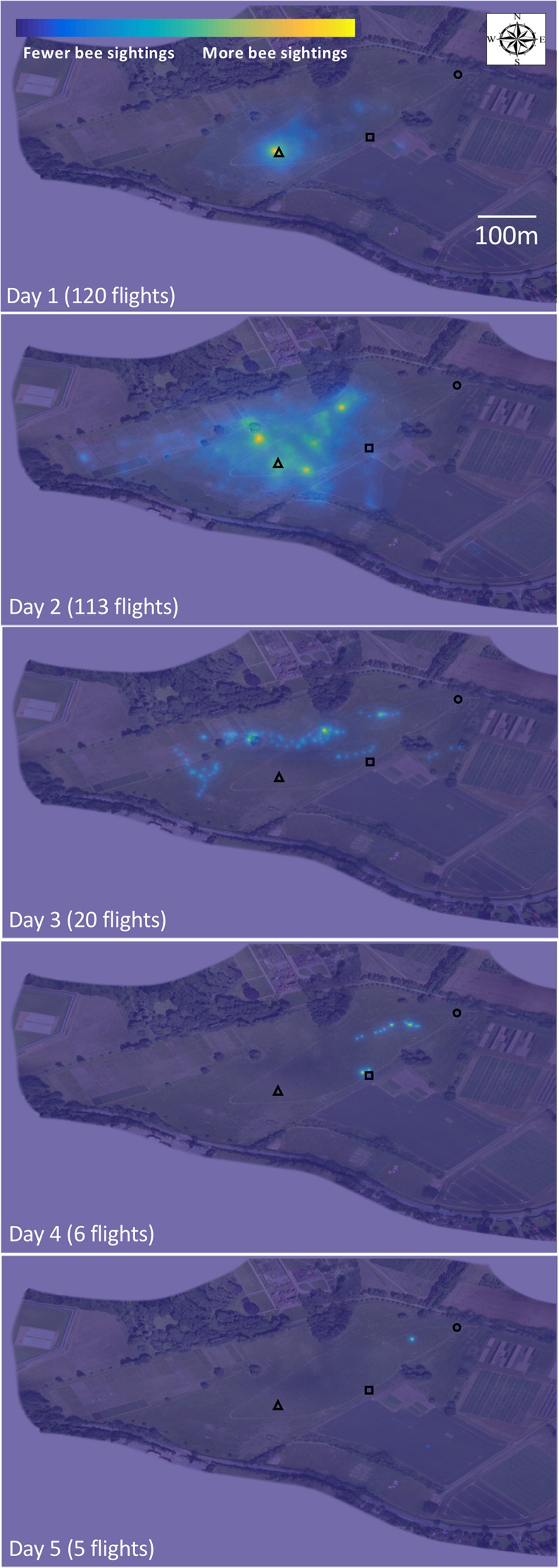
Queen bumblebees disperse from their hibernation site with many short flights between long rest periods. (a) Data density plots of bee positional fixes overlaid onto aerial photos (an orthomosaic created from drone photography) of radar tracking field site, monitoring 17 queen bumblebees simultaneously over five days (flight tracks overlaid using MATLAB 2015b). During the first few hours of the first day, most bees remain near the release point, indicated by the high density of positional fixes (yellow). Bees disperse slowly over a day and a half. Near the end of day two, many bees go past the range of the radar indicated by the dramatic drop in positional fixes. Open black triangle indicates position where queen bumblebees were placed into the ground to emerge from prior to experiment. Open black circle indicates position of the harmonic radar.
Figure 4
Figure 4
Queen bumblebees slowly disperse from their hibernation site in a random manner. (a) Radial histogram of flight directions with cardinal directions indicated. Bees showed no overall directional preference, as the distribution of directions was no different statistically from a uniform distribution. (b) Radial histograms show that the position of the sun had no effect on the directional preferences of bees as the distribution of flight directions before and after solar noon was no different from a uniform distribution. (c) The cumulative probability of flight distances, calculated using the line connecting the first and last positional fix of each flight, followed an exponential distribution, indicative of a random dispersal (black points). Pink line: cumulative probabilities of an exponential distribution for reference. (d) Our random walk model, using the observed flight distances and directions of the harmonic radar monitored bees’ activity combined with the time between flights spent on the ground by our individually radar monitored queen bees, estimates over time an average net dispersal distance per flight from the origin of about five and a half meters. (e) Our model estimates an average total net displacement from the origin in three weeks to be approximately three kilometers (pink line; light grey line = maximum estimated distance, dark grey line = minimum estimated distance over 1000 iterations of the model). (f) Our model’s estimation of overall displacement of bees from the origin is biased towards northerly directions, but varies a lot around an average displacement (pink dot = origin, black dots = 30 example displacement positions from our model).
Figure 5
Figure 5
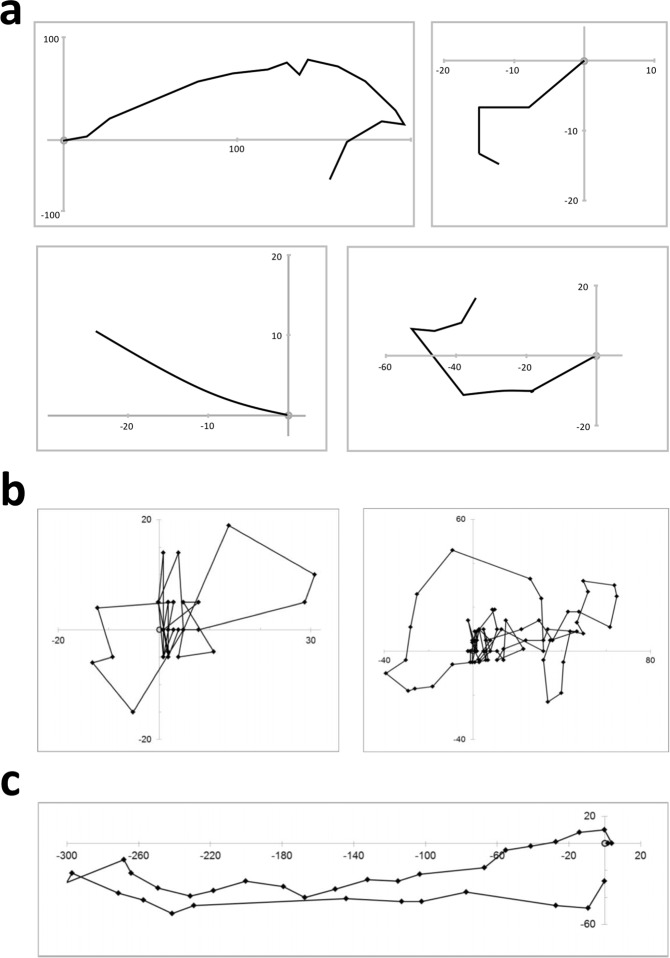
Comparison of bumblebee flight patterns suggest post-hibernation queens disperse in a random manner. (a) Flights of four individual radar tracked queen bumblebees in our study. (b) Flights of two individual bumblebees on their first flights from the hive. (c) Flight of one experienced individual bumblebee on a foraging flight. Closed diamonds indicated positional fixes. Origin is the location of the colony. Axes show distance from the colony in meters. Note that the two orientation flights display loop patterns, while all flights in b and c show returning to the colony, in contrast to flights of post-hibernation queen bees in a and shown in Fig. 1a. Taken from Osborne et al. within the terms of the Creative Commons Attribution License.

References

    1. Winfree R, Bartomeus I, Cariveau DP. Native pollinators in anthropogenic habitats. Annu. Rev. Ecol. Evol. Syst. 2011;42:1–22. doi: 10.1146/annurev-ecolsys-102710-145042. - DOI
    1. Bowler DE, Benton TG. Causes and consequences of animal dispersal strategies: relating individual behaviour to spatial dynamics. Biol. Rev. 2007;80:205–225. doi: 10.1017/S1464793104006645. - DOI - PubMed
    1. Cameron SA, et al. Patterns of widespread decline in North American bumble bees. Proc. Natl. Acad. Sci. USA. 2011;108:662–667. doi: 10.1073/pnas.1014743108. - DOI - PMC - PubMed
    1. Corbet SA, Williams IH, Osborne JL. Bees and the pollination of crops and wild flowers in the european community. Bee World. 1991;72:47–59. doi: 10.1080/0005772X.1991.11099079. - DOI
    1. Fontaine C, Dajoz I, Meriguet J, Loreau M. Functional diversity of plant–pollinator interaction webs enhances the persistence of plant communities. PLOS Biol. 2005;4:e1. doi: 10.1371/journal.pbio.0040001. - DOI - PMC - PubMed

Publication types