Review
. 2019 Mar 6:10:374.
doi: 10.3389/fimmu.2019.00374. eCollection 2019.

Tolerogenic Role of Myeloid Suppressor Cells in Organ Transplantation

Affiliations
Review

Tolerogenic Role of Myeloid Suppressor Cells in Organ Transplantation

Jordi Ochando et al. Front Immunol. .

Abstract

Myeloid-derived suppressor cells (MDSC) are a heterogeneous population of immature cells of myeloid origin with a specific immune inhibitory function that negatively regulates the adaptive immune response. Since MDSC participate in the promotion of tolerance in the context of organ transplantation, therapeutic strategies that regulate the induction and development of MDSC have been the center of scientist attention. Here we review literature regarding induction of MDSC with demonstrated suppressive function among different types of allografts and their mechanism of action. While manipulation of MDSC represents a potential therapeutic approach for the promotion of donor specific tolerance in solid organ transplantation, further characterization of their specific phenotype, which distinguishes MDSC from non-suppressive myeloid cells, and detailed evaluation of the inhibitory mechanism that determines their suppressive function, is necessary for the realistic application of MDSC as biomarkers in health and disease and their potential use as immune cell therapy in organ transplantation.

Keywords: MDSC; immune tolerance; immunophenotyping; myeloid cells; transplantation.


Figures
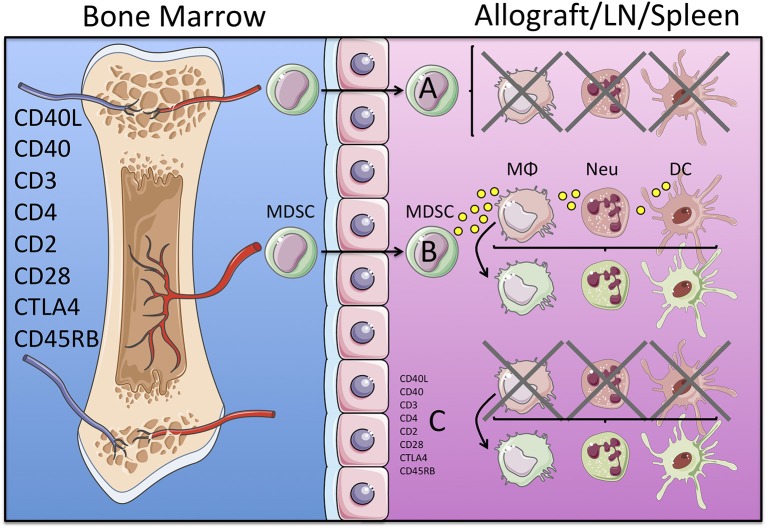
Figure 1
Figure 1
Potential mechanisms of immune regulation mediated by MDSC in organ transplantation. Induction of transplantation tolerance in experimental murine models is achieved by targeting TCR and co-stimulatory blockade with monoclonal antibodies. These therapeutic treatments may induce the development of an MDSC precursor that leaves the bone marrow and may migrate into the allograft, lymph node (LN) and/or the spleen. Once in the tissue MDSC may mediate direct inhibition of immunogenic myeloid cells (macrophages, neutrophils and dendritic cells in red), as depicted in (A); or secrete cytokines and growth factors that convert immunogenic (red) into tolerogenic (green) myeloid cells, as depicted in (B). Alternatively, both processes (direct inhibition of immunogenic and/or conversion into tolerogenic myeloid cells) may be a direct effect of the tolerogenic regimen (monoclonal antibodies) independently of the MSDC, as depicted in (C).

References

    1. Libby P. Inflammatory mechanisms: the molecular basis of inflammation and disease. Nutr Rev. (2007) 65:S140–6. 10.1301/nr.2007.dec.S140-S146 - DOI - PubMed
    1. Gabrilovich DI, Bronte V, Chen SH, Colombo MP, Ochoa A, Ostrand-Rosenberg S, et al. The terminology issue for myeloid-derived suppressor cells. Cancer Res. (2007) 67:425. 10.1158/0008-5472.CAN-06-3037 - DOI - PMC - PubMed
    1. Movahedi K, Laoui D, Gysemans C, Baeten M, Stange G, Van den Bossche J, et al. Different tumor microenvironments contain functionally distinct subsets of macrophages derived from Ly6C(high) monocytes. Cancer Res. (2010) 70:5728–39. 10.1158/0008-5472.CAN-09-4672 - DOI - PubMed
    1. Sawanobori Y, Ueha S, Kurachi M, Shimaoka T, Talmadge JE, Abe J, et al. Chemokine-mediated rapid turnover of myeloid-derived suppressor cells in tumor-bearing mice. Blood. (2008) 111:5457–66. 10.1182/blood-2008-01-136895 - DOI - PubMed
    1. Youn JI, Nagaraj S, Collazo M, Gabrilovich DI. Subsets of myeloid-derived suppressor cells in tumor-bearing mice. J Immunol. (2008) 181:5791–802. 10.4049/jimmunol.181.8.5791 - DOI - PMC - PubMed

Publication types
