. 2019 May;33(4):490-498.
doi: 10.1037/neu0000527. Epub 2019 Mar 21.

Ego- and allocentric visuospatial neglect: Dissociations, prevalence, and laterality in acute stroke

Affiliations

Ego- and allocentric visuospatial neglect: Dissociations, prevalence, and laterality in acute stroke

Nele Demeyere et al. Neuropsychology. 2019 May.

Abstract

Objective: Visuospatial neglect, whereby patients are unable to attend to stimuli on their contralesional side, is a neuropsychological condition commonly experienced after stroke. We aimed to investigate whether egocentric and allocentric neglect are functionally dissociable and differ in prevalence and laterality in the early poststroke period.

Method: A consecutive sample of 366 acute stroke patients completed the Broken Hearts test from the Oxford Cognitive Screen. We evaluated the association between egocentric and allocentric neglect and contrasted the prevalence and severity of left-sided versus right-sided neglect.

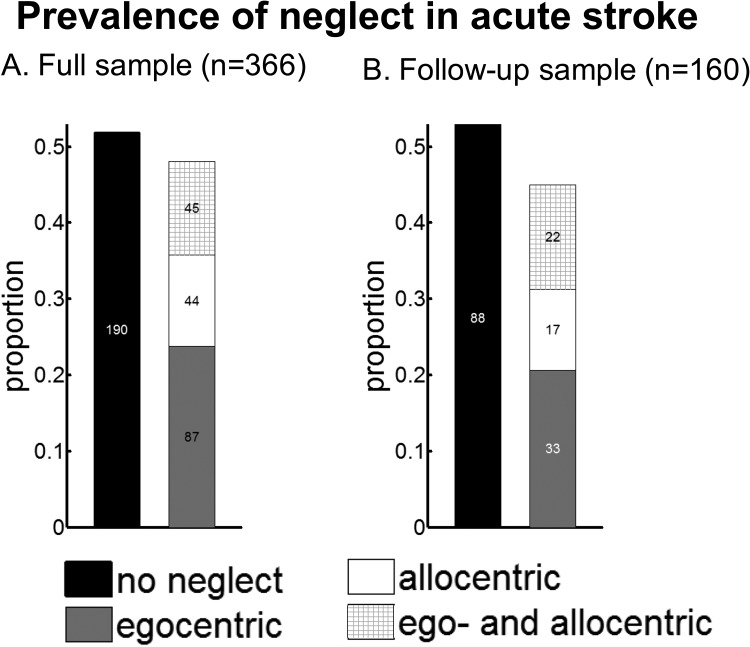
Results: Clinically, we found a double dissociation between ego- and allocentric neglect, with 50% of the neglect patients showing only egocentric neglect and 25% only allocentric neglect. Left-sided egocentric neglect was more prevalent and more severe than was right-sided egocentric neglect, though right-sided neglect was still highly prevalent in the acute stroke sample (35%). Left-sided allocentric neglect was more severe but not more prevalent than was right-sided allocentric neglect. At 6 months, in a representative subsample of 160 patients, we found neglect recovery rates to be 81% and 74% for egocentric and allocentric neglect, respectively.

Conclusion: Dissociable ego- and allocentric neglect symptoms support a heterogeneous account of visuospatial neglect, which was shown to be highly prevalent for both the left and the right hemifields. (PsycINFO Database Record (c) 2019 APA, all rights reserved).


Figures
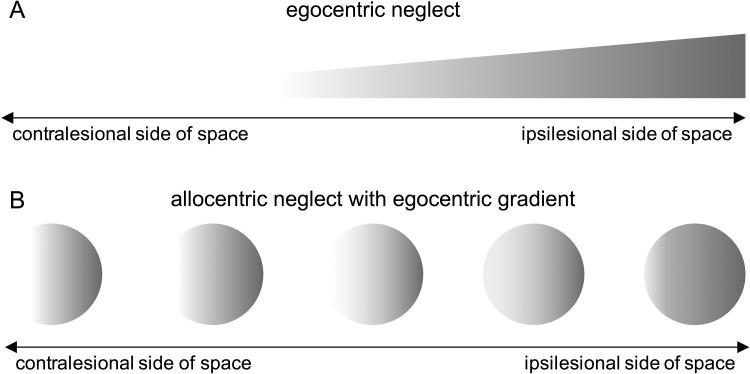
Figure 1
Figure 1
Illustration of how an egocentric spatial gradient (Panel A) could account for allocentric errors (Panel B).
Figure 2
Figure 2
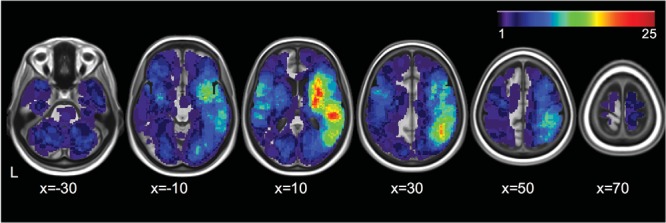
Overlay of the lesions of a subsample where scans were available (N = 201 stroke patients) in stereotaxic space (see Varjacic, Mantini, Demeyere, & Gillebert, 2018, for more information on the lesion delineation procedure). The color bar indicates the number of patients with lesions at each voxel. Images are displayed in neurological convention.
Figure 3
Figure 3
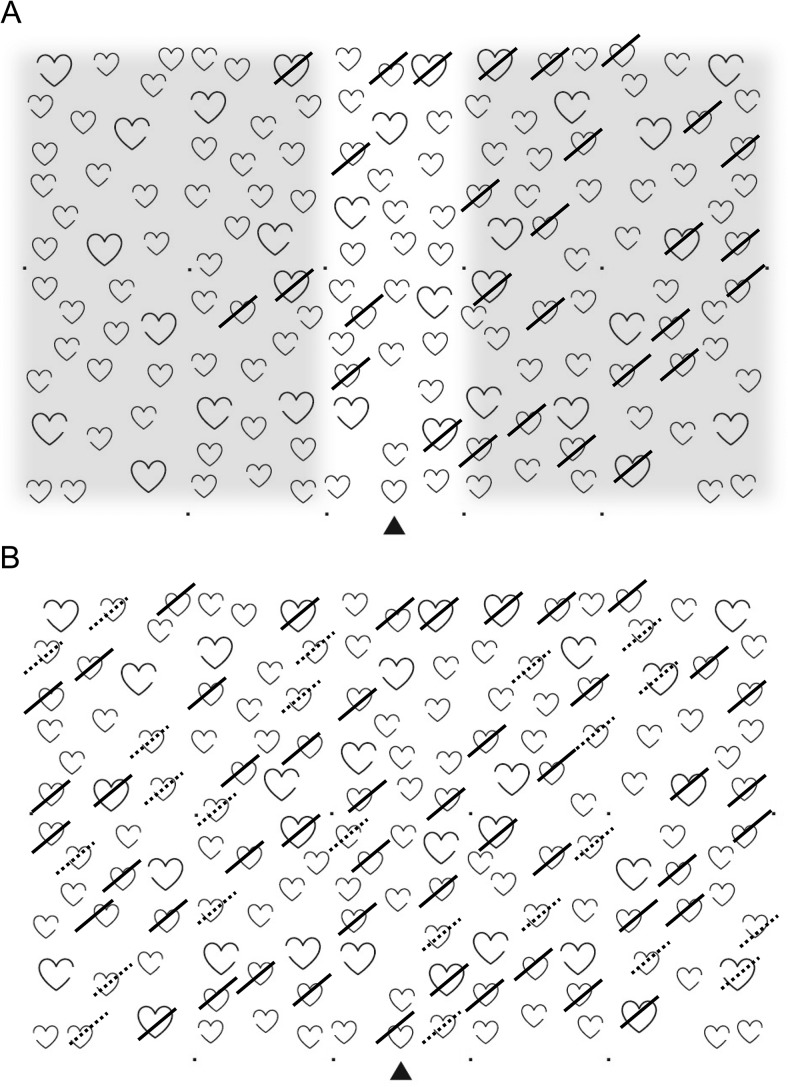
The Broken Hearts test from the Oxford Cognitive Screen (OCS). Panel A: Egocentric neglect is operationalized as an asymmetry value calculated by subtracting the number of hits (full strikes) on the left side of the page from the hits on the right-hand side, also taking into account the total number of hits (the overall correct should be lower than 42, based on the cutoff from normative data). Only the shaded areas are taken into account to calculate the egocentric asymmetry score. Note that the shaded areas have been added only to clarify the scoring; the page presented to the patients contains only the hearts. Panel B: Allocentric neglect is operationalized as an asymmetry score calculated by subtracting the number of false positives (dashed strikes) with a left gap from the number of false positives with a right gap (see also Demeyere et al. 2015).
Figure 4
Figure 4
Prevalence of ego- and allocentric neglect in a consecutive sample of 366 acute stroke survivors (Panel A) and in a subsample where follow-up data were collected (Panel B).
Figure 5
Figure 5
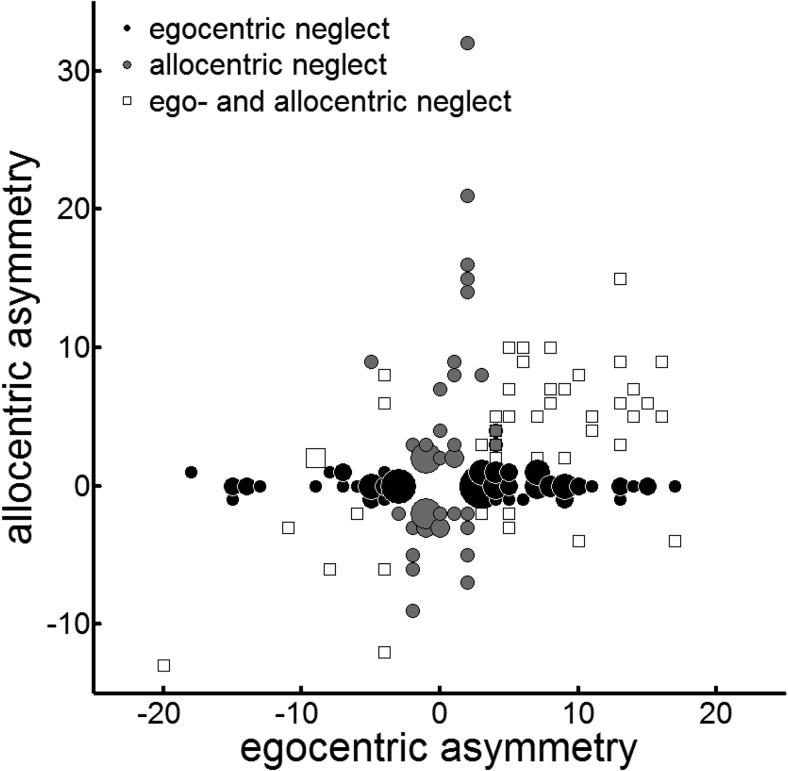
Ego- versus allocentric neglect. Bubble plot of egocentric versus allocentric asymmetry scores in 176 patients with neglect. Positive values reflect left-sided neglect, negative values reflect right-sided neglect. Black circles represent patients with only egocentric neglect (N = 87), gray circles represent patients with only allocentric neglect (N = 44), and white squares represent patients with both ego- and allocentric neglect (N = 45).
Figure 6
Figure 6
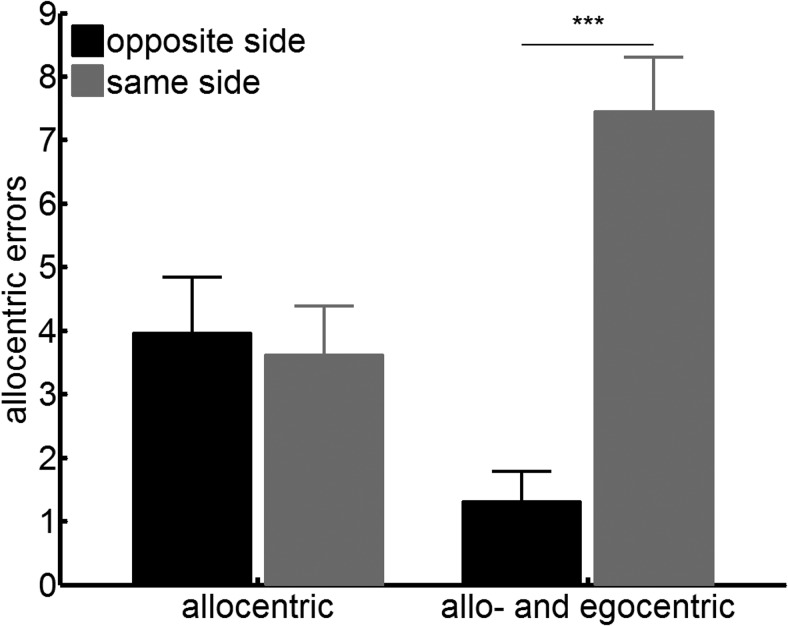
No Egocentric bias in the allocentric errors, demonstrating the opposite pattern predicted in Figure 1. Number of allocentric errors according to the side of space (on the page): numbers of (same vs. opposite side of the allocentric errors) for patients with allocentric neglect only and patients with both ego- and allocentric neglect. Error bars indicate standard error of the mean. *** p < .001.
Figure 7
Figure 7
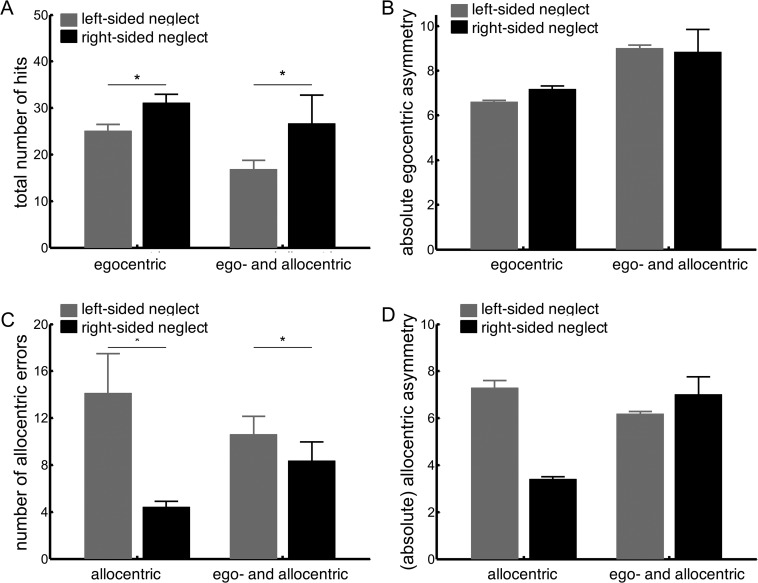
Left- versus right-sided neglect. Severity of egocentric neglect is reflected in the total number of hits (Panel A) and the absolute egocentric asymmetry score (Panel B). Severity of allocentric neglect is reflected in the total number of allocentric errors (Panel C) and the absolute allocentric asymmetry score (Panel D). Error bars indicate standard error of the mean. * p < .05.

References

    1. Agrell B. M., Dehlin O. I., & Dahlgren C. J. (1997). Neglect in elderly stroke patients: A comparison of five tests. Psychiatry and Clinical Neurosciences, 51, 295–300. 10.1111/j.1440-1819.1997.tb03201.x - DOI - PubMed
    1. Baldassarre A., Ramsey L., Hacker C. L., Callejas A., Astafiev S. V., Metcalf N. V., et al. Corbetta M. (2014). Large-scale changes in network interactions as a physiological signature of spatial neglect. Brain: A Journal of Neurology, 137, 3267–3283. 10.1093/brain/awu297 - DOI - PMC - PubMed
    1. Becker E., & Karnath H.-O. (2007). Incidence of visual extinction after left versus right hemisphere stroke. Stroke, 38, 3172–3174. 10.1161/STROKEAHA.107.489096 - DOI - PubMed
    1. Bickerton W.-L., Samson D., Williamson J., & Humphreys G. W. (2011). Separating forms of neglect using the Apples Test: Validation and functional prediction in chronic and acute stroke. Neuropsychology, 25, 567–580. 10.1037/a0023501 - DOI - PubMed
    1. Blini E., Romeo Z., Spironelli C., Pitteri M., Meneghello F., Bonato M., & Zorzi M. (2016). Multi-tasking uncovers right spatial neglect and extinction in chronic left-hemisphere stroke patients. Neuropsychologia, 92, 147–157. 10.1016/j.neuropsychologia.2016.02.028 - DOI - PubMed