


Mild Traumatic Brain Injury Affects Cognitive Processing and Modifies Oscillatory Brain Activity during Attentional Tasks
- PMID: 30896274
- PMCID: PMC6653790
- DOI: 10.1089/neu.2018.6306
Mild Traumatic Brain Injury Affects Cognitive Processing and Modifies Oscillatory Brain Activity during Attentional Tasks
Abstract
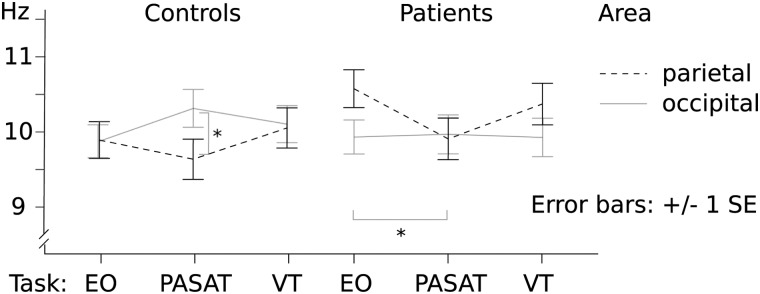
Despite the high prevalence of mild traumatic brain injury (mTBI), current diagnostic tools to objectively assess cognitive complaints after mTBI continue to be inadequate. Our aim was to identify neuronal correlates for cognitive difficulties in mTBI patients by evaluating the possible alterations in oscillatory brain activity during a behavioral task known to be sensitive to cognitive impairment after mTBI. We compared oscillatory brain activity during rest and cognitive tasks (Paced Auditory Serial Addition Test [PASAT] and a vigilance test [VT]) with magnetoencephalography between 25 mTBI patients and 20 healthy controls. Whereas VT induced no significant differences compared with resting state in either group, patients exhibited stronger attenuation of 8- to 14-Hz oscillatory activity during PASAT than healthy controls in the left parietotemporal cortex (p ≤ 0.05). Further, significant task-related modulation in the left superior frontal gyrus and right prefrontal cortex was detected only in patients. The ∼10-Hz (alpha) peak frequency declined in frontal, temporal, and parietal regions during PASAT compared with rest (p < 0.016) in patients, whereas in controls it remained the same or showed a tendency to increase. In patients, the ∼10-Hz peak amplitude was negatively correlated with behavioral performance in the Trail Making Test. The observed alterations in the cortical oscillatory activity during cognitive load may provide measurable neurophysiological correlates of cognitive difficulties in mTBI patients, even at the individual level.
Keywords: alpha frequency modulation; cognitive task; magnetoencephalography; mild traumatic brain injury.
Conflict of interest statement
Author Liisa Helle is employed by a commercial company MEGIN (Elekta Oy), which designs, manufactures, and markets MEG devices. For all the other authors, no competing financial interests exist.
Figures


References
-
- Cassidy J.D., Carroll L.J., Peloso P.M., Borg J., von Holst H., Holm L., Kraus J., and Coronado V.G.; WHO Collaborating Centre Task Force on Mild Traumatic Brain Injury. (2004). Incidence, risk factors and prevention of mild traumatic brain injury: results of the WHO Collaborating Centre Task Force on Mild Traumatic Brain Injury. J Rehabil Med. 43, Suppl., 28–60 - PubMed
-
- Waljas M., Iverson G.L., Lange R.T., Hakulinen U., Dastidar P., Huhtala H., Liimatainen S., Hartikainen K., and Ohman J. (2015). A prospective biopsychosocial study of the persistent post-concussion symptoms following mild traumatic brain injury. J. Neurotrauma 32, 534–547 - PubMed
-
- Pontifex M.B., Broglio S.P., Drollette E.S., Scudder M.R., Johnson C.R., O'Connor P.M., and Hillman C.H. (2012). The relation of mild traumatic brain injury to chronic lapses of attention. Res. Q. Exerc. Sport 83, 553–559 - PubMed
Publication types
MeSH terms
LinkOut - more resources
Full Text Sources
Medical
