Resuscitation incoherence and dynamic circulation-perfusion coupling in circulatory shock
- PMID: 30896570
- PMCID: PMC6511427
- DOI: 10.1097/CM9.0000000000000221
Resuscitation incoherence and dynamic circulation-perfusion coupling in circulatory shock
Abstract
Objective: Poor tissue perfusion/cellular hypoxia may persist despite restoration of the macrocirculation (Macro). This article reviewed the literatures of coherence between hemodynamics and tissue perfusion in circulatory shock.
Data sources: We retrieved information from the PubMed database up to January 2018 using various search terms or/and their combinations, including resuscitation, circulatory shock, septic shock, tissue perfusion, hemodynamic coherence, and microcirculation (Micro).
Study selection: The data from peer-reviewed journals printed in English on the relationships of tissue perfusion, shock, and resuscitation were included.
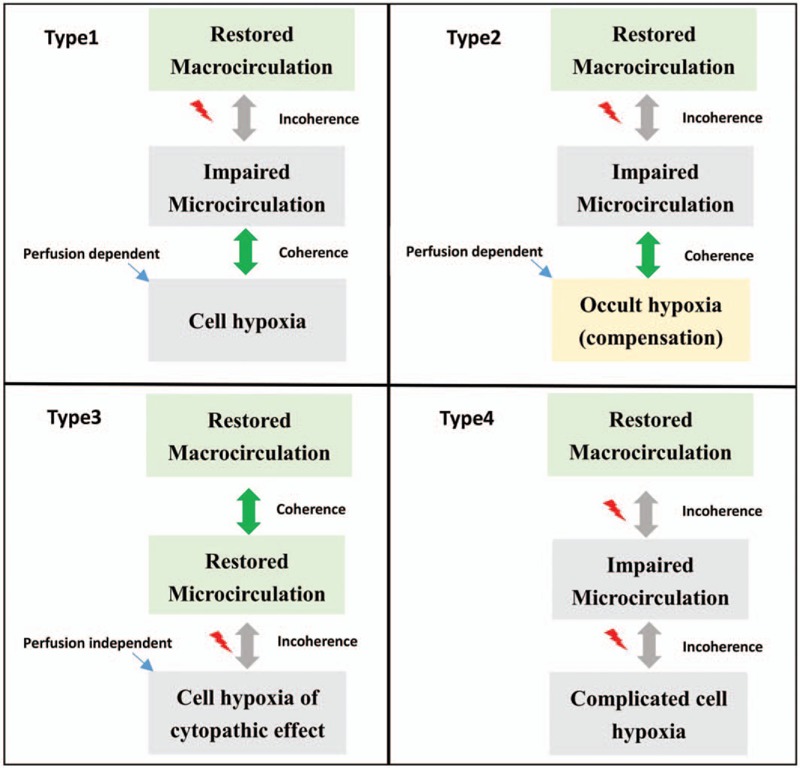
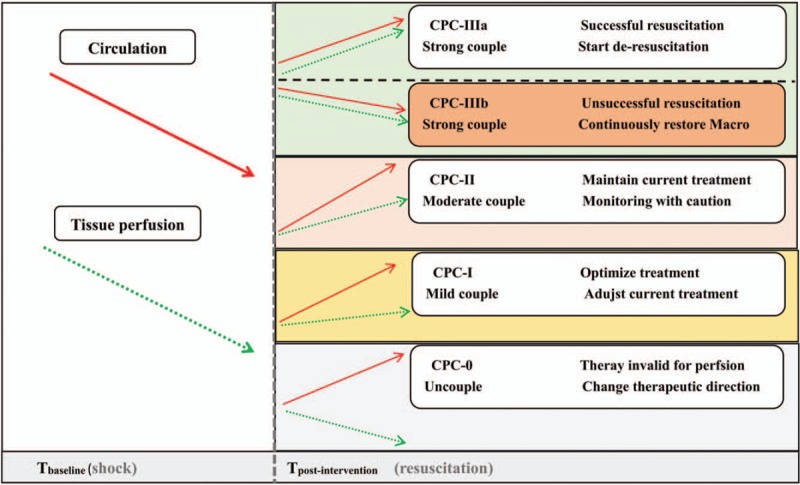
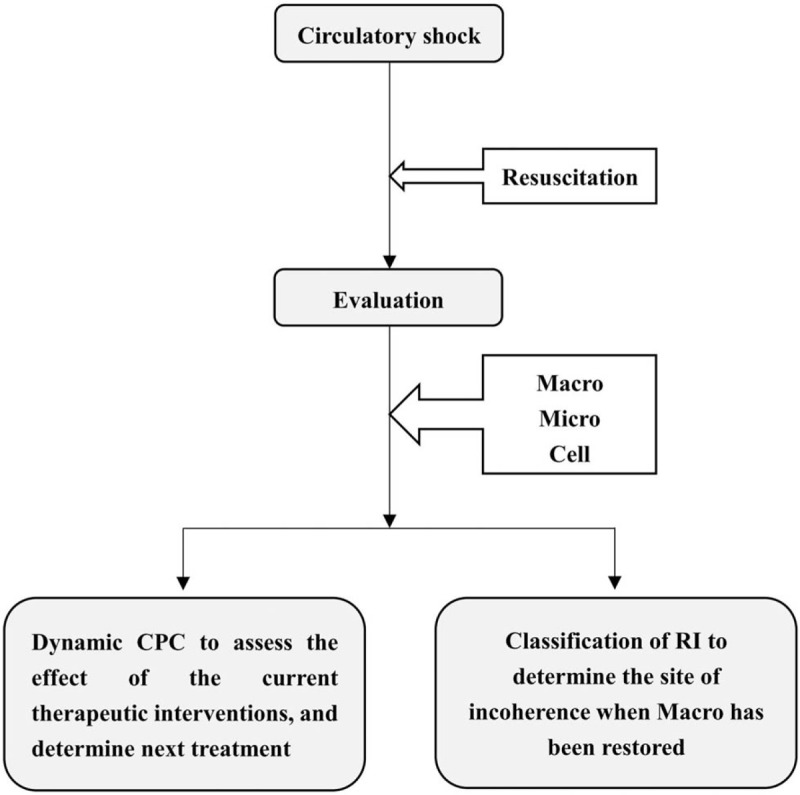
Results: A binary (coherence/incoherence, coupled/uncoupled, or associated/disassociated) mode is used to describe resuscitation coherence. The phenomenon of resuscitation incoherence (RI) has gained great attention. However, the RI concept requires a more practical, systematic, and comprehensive framework for use in clinical practice. Moreover, we introduce a conceptual framework of RI to evaluate the interrelationship of the Macro, Micro, and cell. The RI is divided into four types (Type 1: Macro-Micro incoherence + impaired cell; Type 2: Macro-Micro incoherence + normal cell; Type 3: Micro-Cell incoherence + normal Micro; and Type 4: both Macro-Micro and Micro-cell incoherence). Furthermore, we propose the concept of dynamic circulation-perfusion coupling to evaluate the relationship of circulation and tissue perfusion during circulatory shock.
Conclusions: The concept of RI and dynamic circulation-perfusion coupling should be considered in the management of circulatory shock. Moreover, these concepts require further studies in clinical practice.
Figures
References
-
- Weil MH, Shubin H. Proposed reclassification of shock states with special reference to distributive defects. Adv Exp Med Biol 1971; 23:13–23. - PubMed
-
- Vallée F, Mateo J, Dubreuil G, Poussant T, Tachon G, Ouanounou I, et al. Cutaneous ear lobe Pco2 at 37°C to evaluate microperfusion in patients with septic shock. Chest 2010; 138:1062–1070. doi: 10.1378/chest.09-2690. - PubMed
-
- Lima A, van Bommel J, Sikorska K, van Genderen M, Klijn E, Lesaffre E, et al. The relation of near-infrared spectroscopy with changes in peripheral circulation in critically ill patients. Crit Care Med 2011; 39:1649–1654. doi: 10.1097/CCM.0b013e3182186675. - PubMed
-
- van Genderen ME, Paauwe J, de Jonge J, van der Valk RJ, Lima A, Bakker J, et al. Clinical assessment of peripheral perfusion to predict postoperative complications after major abdominal surgery early: a prospective observational study in adults. Crit Care 2014; 18:R114.doi: 10.1186/cc13905. - PMC - PubMed
MeSH terms
LinkOut - more resources
Full Text Sources