The State of the US Governmental Public Health Workforce, 2014-2017
- PMID: 30896986
- PMCID: PMC6459653
- DOI: 10.2105/AJPH.2019.305011
The State of the US Governmental Public Health Workforce, 2014-2017
Abstract
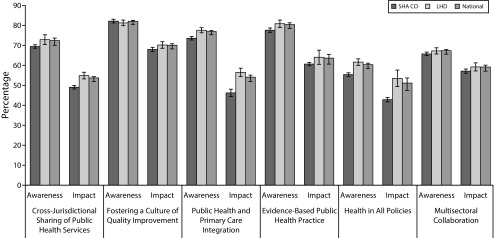
Public health workforce development efforts during the past 50 years have evolved from a focus on enumerating workers to comprehensive strategies that address workforce size and composition, training, recruitment and retention, effectiveness, and expected competencies in public health practice. We provide new perspectives on the public health workforce, using data from the Public Health Workforce Interests and Needs Survey, the largest nationally representative survey of the governmental public health workforce in the United States. Five major thematic areas are explored: workforce diversity in a changing demographic environment; challenges of an aging workforce, including impending retirements and the need for succession planning; workers' salaries and challenges of recruiting new staff; the growth of undergraduate public health education and what this means for the future public health workforce; and workers' awareness and perceptions of national trends in the field. We discussed implications for policy and practice.
Figures
Comment in
-
Public Health WINS Is a Call to Arms as Well as a Roadmap for All Who Care About a Thriving, Healthy Nation.Am J Public Health. 2019 May;109(5):650-651. doi: 10.2105/AJPH.2019.305047. Am J Public Health. 2019. PMID: 30969827 Free PMC article. No abstract available.
-
Public Health Undergraduates in the Workforce: A Trickle, Soon a Wave?Am J Public Health. 2019 May;109(5):685-687. doi: 10.2105/AJPH.2019.305004. Am J Public Health. 2019. PMID: 30969829 Free PMC article. No abstract available.
-
The Role of Salary in Recruiting Employees in State and Local Governmental Public Health: PH WINS 2017.Am J Public Health. 2019 May;109(5):683-685. doi: 10.2105/AJPH.2019.305008. Am J Public Health. 2019. PMID: 30969835 Free PMC article. No abstract available.
-
Mass Exodus of State Health Department Deputies and Senior Management Threatens Institutional Stability.Am J Public Health. 2019 May;109(5):681-683. doi: 10.2105/AJPH.2019.305005. Am J Public Health. 2019. PMID: 30969838 Free PMC article. No abstract available.
References
-
- Gebbie KM, Rosenstock L, Hernandez LM. Who Will Keep the Public Healthy? Educating Public Health Professionals for the 21st Century. Washington, DC: National Academies Press; 2002. - PubMed
-
- Thacker SB. Guide for applied public health workforce research: an evidence-based approach to workforce development. J Public Health Manag Pract. 2009;15(6 suppl):S109–S112. - PubMed
-
- RESOLVE. The high achieving governmental health department in 2020 as the community chief health strategist. 2014. Available at: http://www.resolv.org/site-healthleadershipforum/files/2014/05/The-High-.... Accessed March 7, 2019.
Publication types
MeSH terms
LinkOut - more resources
Full Text Sources
Miscellaneous