Trends in Yoga, Tai Chi, and Qigong Use Among US Adults, 2002-2017
- PMID: 30896991
- PMCID: PMC6459666
- DOI: 10.2105/AJPH.2019.304998
Trends in Yoga, Tai Chi, and Qigong Use Among US Adults, 2002-2017
Abstract
Objectives: To examine the characteristics and temporal trends of yoga, tai chi, and qigong (YTQ) use among US adults.
Methods: Using the 2002, 2007, 2012, and 2017 National Health Interview Surveys, we examined the prevalence, patterns, and predicting factors of YTQ use by Taylor series linear regression, the Wald F χ2 test, and multivariable logistic regression models (n = 116 404).
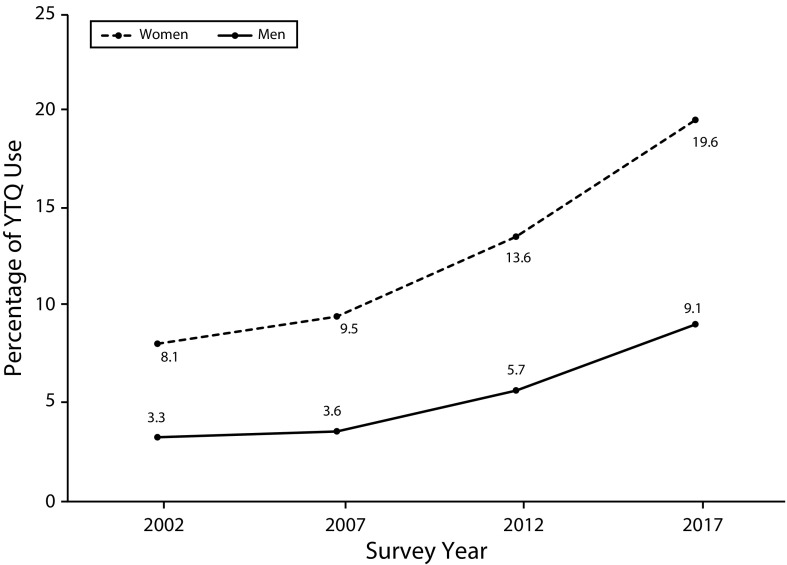
Results: YTQ use increased from 5.8% in 2002 to 14.5% in 2017 (P ≤ .001). Only 6.6% of YTQ users were referred by their medical doctors, and approximately one third disclosed their use of YTQ to medical professionals. Reasons for using YTQ included (1) YTQ was beneficial, (2) YTQ focused on the whole person, and (3) YTQ was natural. Acute and chronic pain, arthritis, and depression were the top 3 medical conditions for which people used YTQ the most.
Conclusions: YTQ use is increasing substantially, mainly because of its natural and holistic healing approach toward health and chronic diseases. Future studies aiming to explore how to best integrate YTQ into the current health care system are warranted.
Figures
Comment in
-
Trends in Yoga, Tai Chi, and Qigong Use: Differentiations Between Practices and the Need for Dialogue and Diffusion.Am J Public Health. 2019 May;109(5):662-663. doi: 10.2105/AJPH.2019.305042. Am J Public Health. 2019. PMID: 30969825 Free PMC article. No abstract available.
-
Letter Response: Yoga, Tai Chi, Qigong, and Health Disparities.Am J Public Health. 2019 Sep;109(9):e5. doi: 10.2105/AJPH.2019.305238. Am J Public Health. 2019. PMID: 31390242 Free PMC article. No abstract available.
-
Wang et al. Respond.Am J Public Health. 2019 Sep;109(9):e5-e6. doi: 10.2105/AJPH.2019.305239. Am J Public Health. 2019. PMID: 31390243 Free PMC article. No abstract available.
Similar articles
-
Participation trends in holistic movement practices: a 10-year comparison of yoga/Pilates and t'ai chi/qigong use among a national sample of 195,926 Australians.BMC Complement Altern Med. 2017 Jun 6;17(1):296. doi: 10.1186/s12906-017-1800-6. BMC Complement Altern Med. 2017. PMID: 28587599 Free PMC article.
-
Participant characteristics of users of holistic movement practices in Australia.Complement Ther Clin Pract. 2018 May;31:181-187. doi: 10.1016/j.ctcp.2018.02.011. Epub 2018 Feb 14. Complement Ther Clin Pract. 2018. PMID: 29705453
-
A Narrative Review of Movement-Based Mind-Body Interventions: Effects of Yoga, Tai Chi, and Qigong for Back Pain Patients.Holist Nurs Pract. 2020 Jan/Feb;34(1):3-23. doi: 10.1097/HNP.0000000000000360. Holist Nurs Pract. 2020. PMID: 31725096 Review.
-
Mind-body practices for cancer-related symptoms management: an overview of systematic reviews including one hundred twenty-nine meta-analyses.Support Care Cancer. 2022 Dec;30(12):10335-10357. doi: 10.1007/s00520-022-07426-3. Epub 2022 Nov 2. Support Care Cancer. 2022. PMID: 36322248 Review.
-
Are movement-based mindful exercises (QIGONG, TAI CHI, AND YOGA) beneficial for stroke and Parkinson's disease? A scoping review.Complement Ther Med. 2023 Mar;72:102912. doi: 10.1016/j.ctim.2022.102912. Epub 2022 Dec 21. Complement Ther Med. 2023. PMID: 36565791
Cited by
-
Feasibility of Implementation Mapping for Integrative Medical Group Visits.J Altern Complement Med. 2021 Mar;27(S1):S71-S80. doi: 10.1089/acm.2020.0393. J Altern Complement Med. 2021. PMID: 33788606 Free PMC article.
-
Quantifying physical activity across the midlife: Does consideration of perceived exertion matter?Prev Med Rep. 2022 Jun 10;28:101850. doi: 10.1016/j.pmedr.2022.101850. eCollection 2022 Aug. Prev Med Rep. 2022. PMID: 35757579 Free PMC article.
-
Determinants of Qigong, Tai Chi, and Yoga Use for Health Conditions: A Systematic Review Protocol.medRxiv [Preprint]. 2025 Mar 21:2025.03.18.25324204. doi: 10.1101/2025.03.18.25324204. medRxiv. 2025. PMID: 40166550 Free PMC article. Preprint.
-
Effects of Tai Chi on health status in adults with chronic heart failure: A systematic review and meta-analysis.Front Cardiovasc Med. 2022 Sep 9;9:953657. doi: 10.3389/fcvm.2022.953657. eCollection 2022. Front Cardiovasc Med. 2022. PMID: 36158796 Free PMC article.
-
Using a Studio-Academic Partnership to Advance Public Health Within a Pragmatic Yoga Setting.J Prim Care Community Health. 2019 Jan-Dec;10:2150132719874621. doi: 10.1177/2150132719874621. J Prim Care Community Health. 2019. PMID: 31538842 Free PMC article.
References
-
- Johnson PJ, Jou J, Rhee TG, Rockwood TH, Upchurch DM. Complementary health approaches for health and wellness in midlife and older US adults. Maturitas. 2016;89:36–42. - PubMed
Publication types
MeSH terms
Grants and funding
LinkOut - more resources
Full Text Sources
Medical