Trends in Yoga, Tai Chi, and Qigong Use Among US Adults, 2002-2017
- PMID: 30896991
- PMCID: PMC6459666
- DOI: 10.2105/AJPH.2019.304998
Trends in Yoga, Tai Chi, and Qigong Use Among US Adults, 2002-2017
Abstract
Objectives: To examine the characteristics and temporal trends of yoga, tai chi, and qigong (YTQ) use among US adults.
Methods: Using the 2002, 2007, 2012, and 2017 National Health Interview Surveys, we examined the prevalence, patterns, and predicting factors of YTQ use by Taylor series linear regression, the Wald F χ2 test, and multivariable logistic regression models (n = 116 404).
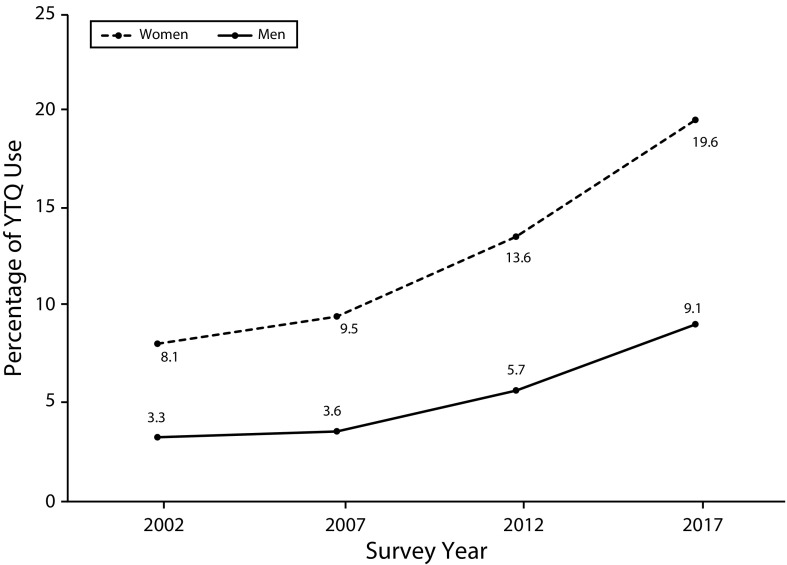
Results: YTQ use increased from 5.8% in 2002 to 14.5% in 2017 (P ≤ .001). Only 6.6% of YTQ users were referred by their medical doctors, and approximately one third disclosed their use of YTQ to medical professionals. Reasons for using YTQ included (1) YTQ was beneficial, (2) YTQ focused on the whole person, and (3) YTQ was natural. Acute and chronic pain, arthritis, and depression were the top 3 medical conditions for which people used YTQ the most.
Conclusions: YTQ use is increasing substantially, mainly because of its natural and holistic healing approach toward health and chronic diseases. Future studies aiming to explore how to best integrate YTQ into the current health care system are warranted.
Figures
Comment in
-
Trends in Yoga, Tai Chi, and Qigong Use: Differentiations Between Practices and the Need for Dialogue and Diffusion.Am J Public Health. 2019 May;109(5):662-663. doi: 10.2105/AJPH.2019.305042. Am J Public Health. 2019. PMID: 30969825 Free PMC article. No abstract available.
-
Letter Response: Yoga, Tai Chi, Qigong, and Health Disparities.Am J Public Health. 2019 Sep;109(9):e5. doi: 10.2105/AJPH.2019.305238. Am J Public Health. 2019. PMID: 31390242 Free PMC article. No abstract available.
-
Wang et al. Respond.Am J Public Health. 2019 Sep;109(9):e5-e6. doi: 10.2105/AJPH.2019.305239. Am J Public Health. 2019. PMID: 31390243 Free PMC article. No abstract available.
References
-
- Johnson PJ, Jou J, Rhee TG, Rockwood TH, Upchurch DM. Complementary health approaches for health and wellness in midlife and older US adults. Maturitas. 2016;89:36–42. - PubMed
Publication types
MeSH terms
Grants and funding
LinkOut - more resources
Full Text Sources
Medical