


Sleep mediates the association between adolescent screen time and depressive symptoms
- PMID: 30897456
- PMCID: PMC6511486
- DOI: 10.1016/j.sleep.2019.01.029
Sleep mediates the association between adolescent screen time and depressive symptoms
Abstract
Objective: This study examined the associations between four types of screen-based activities and depressive symptoms among adolescents. We further investigated whether sleep characteristics (ie, insomnia symptoms and sleep duration) mediate these associations.
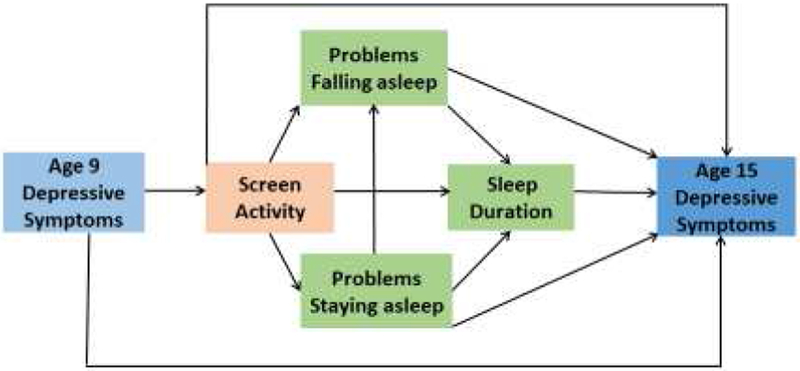
Methods: Data come from 2865 U.S. adolescents (mean age = 15.53, SD = 0.73, 51.8% male) in the age 15 follow-up of the Fragile Families and Child Wellbeing Study. Adolescents completed surveys regarding sleep duration and insomnia symptoms, typical daily duration of four screen activities (social messaging, web surfing, TV/movie watching, and gaming), and depressive symptoms. We constructed a multiple mediation model to elucidate the associations between age 15 screen time, sleep and depressive symptoms, while adjusting for age 9 depressive symptoms.
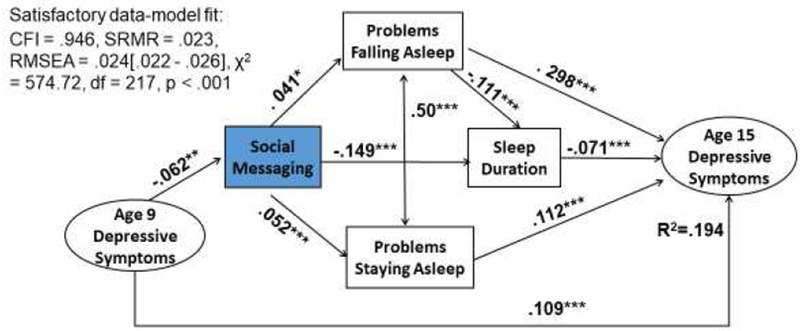
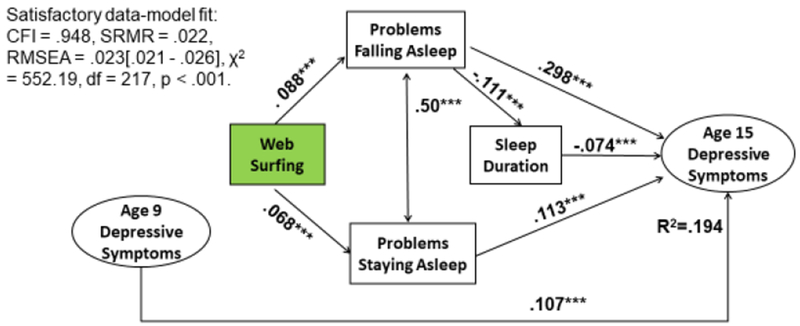
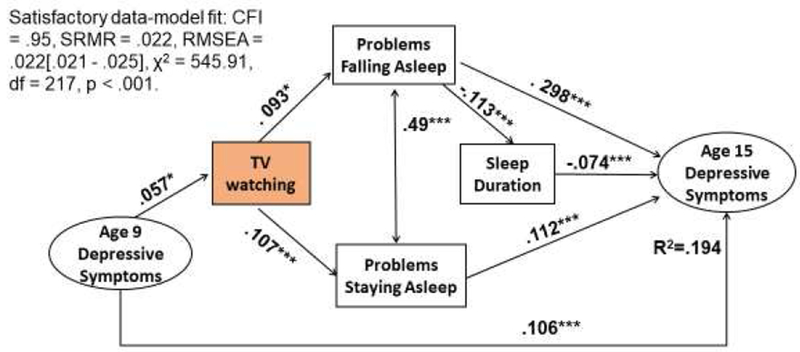
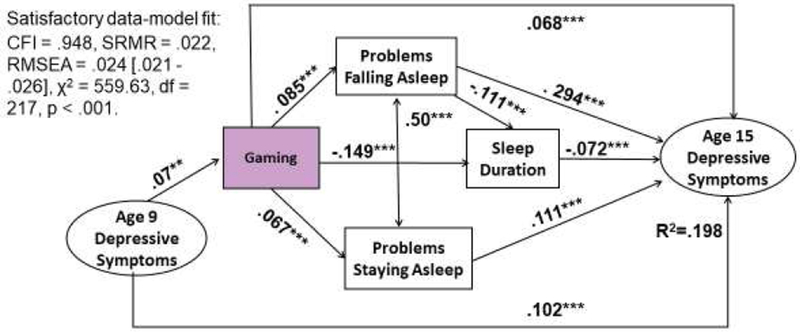
Results: Structural Equation Modeling analyses revealed that the association between screen time and depressive symptoms is partially or fully mediated by sleep. For social messaging, web surfing and TV/movie watching, the three sleep variables fully mediated the positive association between screen time and depressive symptoms. For gaming, the three sleep variables acted as partial mediators in the model, accounting for 38.5% of the association between gaming and depressive symptoms.
Conclusions: Our results highlight both screen-based activities and sleep behaviors as potential intervention targets to reduce depressive symptoms among adolescents.
Keywords: Depressive symptoms; Gaming; Insomnia symptoms; Screen time; Sleep duration; Social messaging.
Copyright © 2019 Elsevier B.V. All rights reserved.
Conflict of interest statement
Conflict of Interest
The other authors declare that they have no conflict of interest. Outside of the current work, Orfeu M. Buxton discloses that he received two subcontract grants to Penn State from Mobile Sleep Technologies (NSF/STTR #1622766, NIH/NIA SBIR R43AG056250). Dr. Lauren Hale receives an honorarium from the National Sleep Foundation for serving as Editor-in-Chief of the journal
Figures
References
-
- Achenbach TM, & Rescorla LA1 (2001). Manual for the ASEBA School-Age Forms & Profiles: Burlington, VT: University of Vermont, Research Center for Children, Youth & Families.
-
- Arora T, Broglia E, Thomas GN, & Taheri S (2014). Associations between specific technologies and adolescent sleep quantity, sleep quality, and parasomnias. Sleep Medicine, 15(2), 240–247. - PubMed
-
- Bartel K, & Gradisar M (2017). New directions in the link between technology use and sleep in young people In Nevšímalová S, & Bruni O (Eds.) Sleep disorders in children (pp. 69–80). New York, NY: Springer.
-
- Bartel KA, Gradisar M, & Williamson P (2015). Protective and risk factors for adolescent sleep: a meta-analytic review. Sleep Medicine Reviews,21, 72–85. - PubMed
Publication types
MeSH terms
Grants and funding
LinkOut - more resources
Full Text Sources
Medical
