


Good Practices in Home Kitchens: Construction and Validation of an Instrument for Household Food-Borne Disease Assessment and Prevention
- PMID: 30897700
- PMCID: PMC6466412
- DOI: 10.3390/ijerph16061005
Good Practices in Home Kitchens: Construction and Validation of an Instrument for Household Food-Borne Disease Assessment and Prevention
Abstract
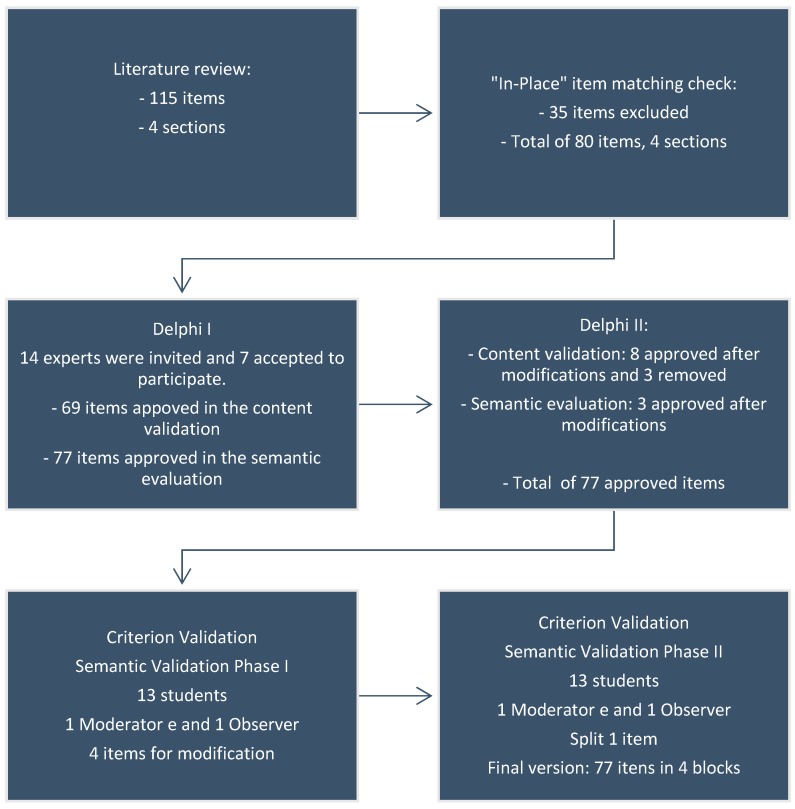
This study aimed to develop and validate an instrument to evaluate Brazilian home kitchens' good practices. We elaborated on the preliminary version of the check-list based on the Brazilian resolution for food safety Collegiate Board Resolution 216 (RDC 216), Collegiate Board Resolution 275 (RDC 275), the standard 22000 from the International Organization for Standardization (ISO 22000) and Codex Alimentarius. Seven experts with experience in the area participated in the check-list validation and semantic evaluation. The criteria used for the approval of the items, as to their importance for the prevention of food contamination and clarity of the wording, was the achievement of a minimum of five out of seven of agreement among the experts (W-values ≥ 0.7). Moreover, items should have a mean ≥3 for the evaluation of importance (content validation) and clarity (semantic evaluation) to be maintained in the instrument. After the expert phase, we conducted another semantic evaluation of the check-list with a focus group composed of 13 undergraduate students, one moderator, and one observer of the process, to evaluate each item regarding its clarity, considering their level of understanding of the item. The final version of the check-list was composed of 77 items, divided into four blocks. The check-list developed was validated with respect to content with a W-value of 0.86 and approved in the semantic evaluation.
Keywords: foodborne disease; good practices; home kitchens; instrument; prevention.
Conflict of interest statement
The authors declare no conflicts of interest.
Figures
References
-
- Parra P.A., Kim H., Shapiro M.A., Gravani R.B., Bradley S.D. Home food safety knowledge, risk perception, and practices among Mexican-Americans. Food Control. 2014;37:115–125. doi: 10.1016/j.foodcont.2013.08.016. - DOI
-
- Draeger C., Akutsu R., Zandonadi R., da Silva I., Botelho R., Araújo W. Brazilian Foodborne Disease National Survey: Evaluating the Landscape after 11 Years of Implementation to Advance Research, Policy, and Practice in Public Health. Nutrients. 2019;11:40. doi: 10.3390/nu11010040. - DOI - PMC - PubMed
-
- Draeger C., Akutsu R., Araújo W., da Silva I., Botelho R., Zandonadi R. Epidemiological Surveillance System on Foodborne Diseases in Brazil after 10-Years of Its Implementation: Completeness Evaluation. Int. J. Environ. Res. Public Health. 2018;15:2284. doi: 10.3390/ijerph15102284. - DOI - PMC - PubMed
-
- Thomas M.K., Murray R., Flockhart L., Pintar K., Fazil A., Nesbitt A., Marshall B., Tataryn J., Pollari F. Estimates of Foodborne Illness–Related Hospitalizations and Deaths in Canada for 30 Specified Pathogens and Unspecified Agents. Foodborne Pathog. Dis. 2015;12:820–827. doi: 10.1089/fpd.2015.1966. - DOI - PMC - PubMed
-
- World Health Organization . In: WHO Estimates of the Global Burden of Foodborne Diseases. 1st ed. WHO Library Cataloguing-in-Publication Data, editor. World Health Organization; Geneva, Switzerland: 2015.
Publication types
MeSH terms
LinkOut - more resources
Full Text Sources
Medical
