


Acquired Resistance to Antibody-Drug Conjugates
- PMID: 30897808
- PMCID: PMC6468698
- DOI: 10.3390/cancers11030394
Acquired Resistance to Antibody-Drug Conjugates
Abstract
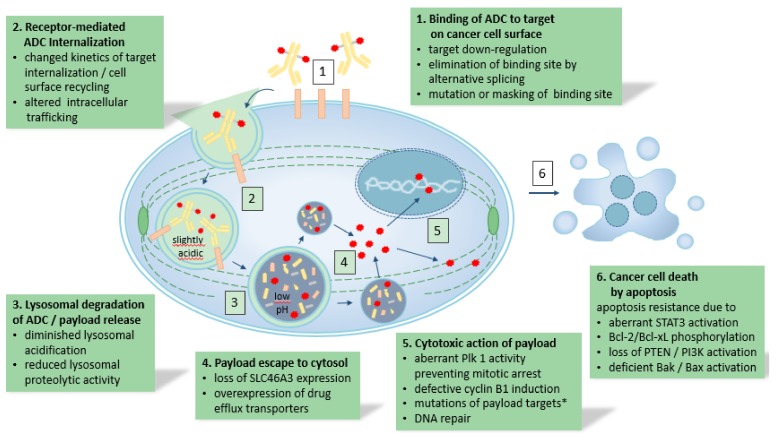
Antibody-drug conjugates (ADCs) combine the tumor selectivity of antibodies with the potency of cytotoxic small molecules thereby constituting antibody-mediated chemotherapy. As this inherently limits the adverse effects of the chemotherapeutic, such approaches are heavily pursued by pharma and biotech companies and have resulted in four FDA (Food and Drug Administration)-approved ADCs. However, as with other cancer therapies, durable responses are limited by the fact that under cell stress exerted by these drugs, tumors can acquire mechanisms of escape. Resistance can develop against the antibody component of ADCs by down-regulation/mutation of the targeted cell surface antigen or against payload toxicity by up-regulation of drug efflux transporters. Unique resistance mechanisms specific for the mode of action of ADCs have also emerged, like altered internalization or cell surface recycling of the targeted tumor antigen, changes in the intracellular routing or processing of ADCs, and impaired release of the toxic payload into the cytosol. These evasive changes are tailored to the specific nature and interplay of the three ADC constituents: the antibody, the linker, and the payload. Hence, they do not necessarily endow broad resistance to ADC therapy. This review summarizes preclinical and clinical findings that shed light on the mechanisms of acquired resistance to ADC therapies.
Keywords: antibody-drug conjugates; apoptosis resistance; drug resistance; immunotoxins; multidrug resistance proteins; targeted delivery.
Conflict of interest statement
G.N., G.K., and B.B. are former employees of Roche Pharma, the company that markets T-DM1, and G.K. is currently working in Roche’s Diagnostics division. G.N. is a co-inventor on immunotoxin-related patents and CEO of a biotech start-up that develops immunotoxins.
Figures
References
-
- Interactive Overview of Antibody Drug Conjugates. [(accessed on 30 January 2019)]; Available online: https://adcreview.com/adc-university/adc-drugmap/
-
- Gemtuzumab ozogamicin (Mylotarg®; Pfizer/Wyeth) ADC Review. [(accessed on 14 March 2019)]; Available online: https://adcreview.com/gemtuzumab-ozogamicin-mylotarg/
-
- Hamann P.R., Hinman L.M., Hollander I., Beyer C.F., Lindh D., Holcomb R., Hallett W., Tsou H.-R., Upeslacis J., Shochat D., et al. Gemtuzumab ozogamicin, a potent and selective anti-CD33 antibody-calicheamicin conjugate for treatment of acute myeloid leukemia. Bioconjug. Chem. 2002;13:47–58. doi: 10.1021/bc010021y. - DOI - PubMed
Publication types
LinkOut - more resources
Full Text Sources
Other Literature Sources
Research Materials
