


Enhancing practitioners' confidence in recruitment and consent in the EcLiPSE trial: a mixed-method evaluation of site training - a Paediatric Emergency Research in the United Kingdom and Ireland (PERUKI) study
- PMID: 30898169
- PMCID: PMC6429745
- DOI: 10.1186/s13063-019-3273-z
Enhancing practitioners' confidence in recruitment and consent in the EcLiPSE trial: a mixed-method evaluation of site training - a Paediatric Emergency Research in the United Kingdom and Ireland (PERUKI) study
Abstract
Background: EcLiPSE (Emergency treatment with Levetiracetam or Phenytoin in Status Epilepticus in children) is a randomised controlled trial (RCT) in the United Kingdom. Challenges to success include the need to immediately administer an intervention without informed consent and changes in staffing during trial conduct, mainly due to physician rotations. Using literature on parents' perspectives and research without prior consent (RWPC) guidance, we developed an interactive training package (including videos, simulation and question and answer sessions) and evaluated its dissemination and impact upon on practitioners' confidence in recruitment and consent.
Methods: Questionnaires were administered before and immediately after training followed by telephone interviews (mean 11 months later), focus groups (mean 14 months later) and an online questionnaire (8 months before trial closure).
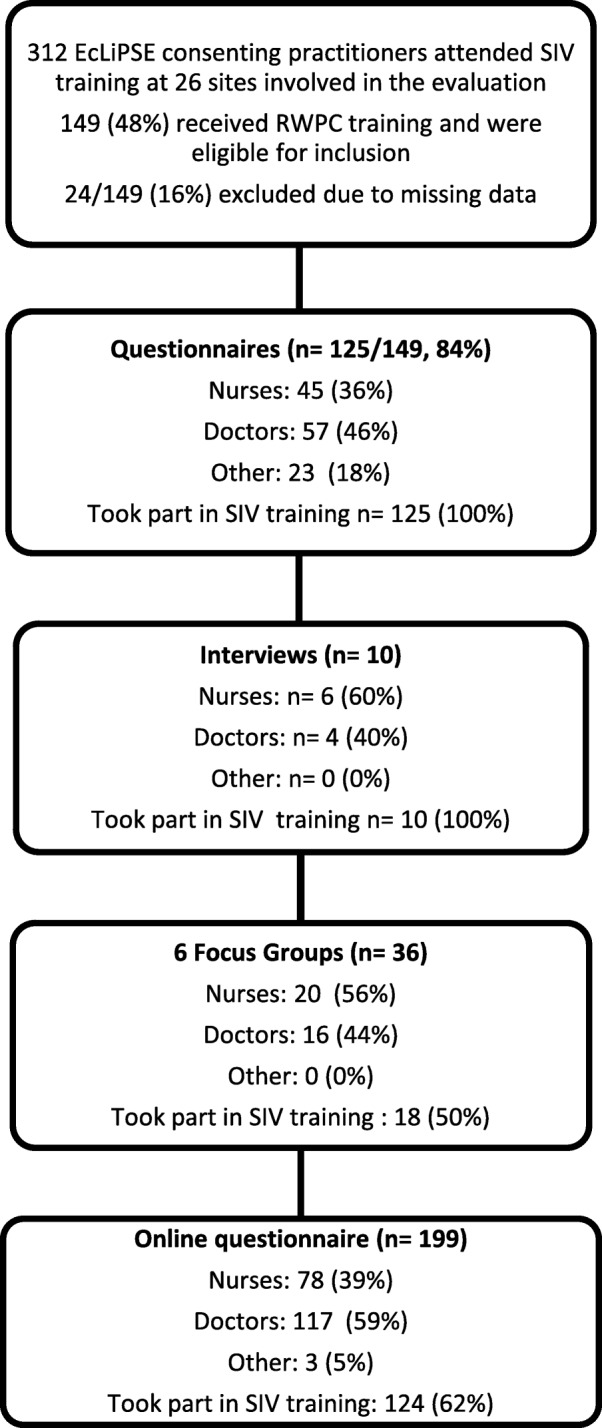
Results: One hundred and twenty-five practitioners from 26/30 (87%) participating hospitals completed a questionnaire before and after training. We conducted 10 interviews and six focus groups (comprising 36 practitioners); 199 practitioners working in all recruiting hospitals completed the online questionnaire. Before training, practitioners were concerned about recruitment and consent. Confidence increased after training for explaining (all scale 0-5, 95% CIs above 0 and p values < 0.05): the study (66% improved mean score before 3.28 and after 4.52), randomisation (47% improvement, 3.86 to 4.63), RWPC (72% improvement, 2.98 to 4.39), and addressing parents' objections to randomisation (51% improvement, 3.37 to 4.25). Practitioners rated highly the content and clarity of the training, which was successfully disseminated. Some concerns about staff availability for training and consent discussions remained.
Conclusions: Training improved practitioners' confidence in recruitment and RWPC. Our findings highlight the value of using parents' perspectives to inform training and to engage practitioners in trials that are at high risk of being too challenging to conduct.
Keywords: Clinical trials; Deferred consent; Paediatric emergency care; Practitioner training; Recruitment; Research without prior consent.
Conflict of interest statement
Ethics approval and consent to participate
Ethical approval was not required to conduct the site training evaluation questionnaire or online questionnaire. Interviews and focus groups with practitioners were approved as part of the EcLiPSE trial by National Research Ethics Service Committee North West- Liverpool Central (15/NW/0090).
Consent for publication
Not applicable as individual details are not contained in the manuscript.
Competing interests
The authors declare that they have no competing interests.
Publisher’s Note
Springer Nature remains neutral with regard to jurisdictional claims in published maps and institutional affiliations.
Figures
References
-
- McDonald AM, Knight RC, Campbell MK, Entwistle VA, Grant AM, Cook JA, Elbourne DR, Francis D, Garcia J, Roberts I, Snowdon C. What influences recruitment to randomised controlled trials? A review of trials funded by two UK funding agencies. Trials. 2006;7:1–8. doi: 10.1186/1745-6215-7-9. - DOI - PMC - PubMed
-
- Treweek S, Mitchell E, Pitkethly M, Cook J, Kjeldstrøm M, Taskila T, Johansen M, Sullivan F, Wilson S, Jackson C, Jones R. Strategies to improve recruitment to randomised controlled trials. Cochrane Database Syst Rev. 2010;(1):MR000013. doi: 10.1002/14651858.MR000013.pub4. - PubMed
Publication types
MeSH terms
Substances
Grants and funding
LinkOut - more resources
Full Text Sources
